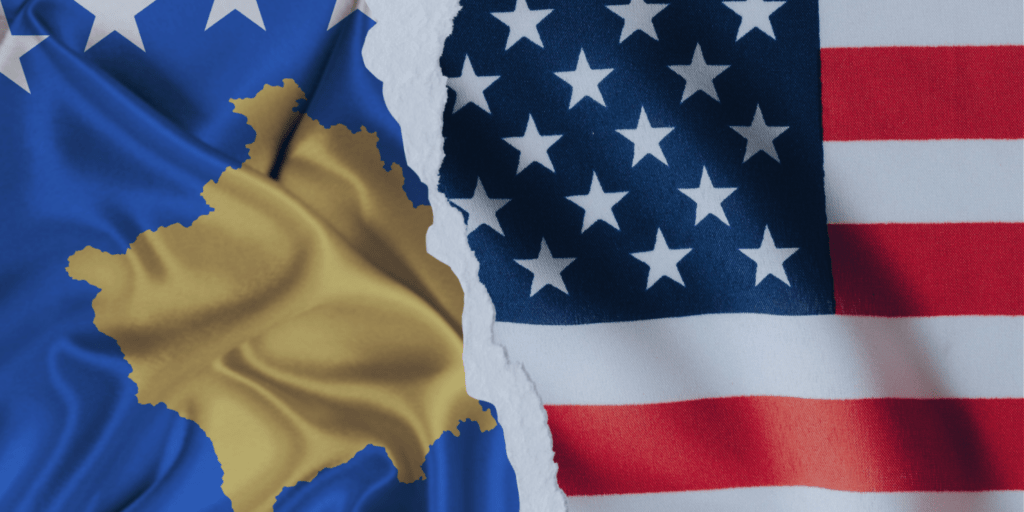

The breakdown in relations between Kosovo and the United States of America (US) has been the focus of public discussion since the first crises in northern Kosovo after the Vetëvendosje Movement (LVV) took power in 2021.
From the Kosovo government's decision for reciprocity in license plates in 2022, then the support of mayors in northern Kosovo who were elected without the participation of local Serbs, to the recent decision of the Central Bank of Kosovo (CBK) to ban payments in dinars, the US had warned the government for its lack of coordination with them and other partners.
However, the government led by Albin Kurti has insisted that relations with the US have not been damaged. But the US ambassador to Kosovo, Jeffrey Hovenier, has mentioned several times during 2023 that relations between these countries have actually been affected.
Most recently, on February 3 of this year, Ambassador Jeffrey Hovenier, unleashed the first warnings of possible reports of a crackdown if the Kosovo government did not withdraw from the decision on the dinar.
"The United States Government is deeply concerned by recent actions by Kosovo Government authorities, which have a direct and negative impact on members of the ethnic Serb community and other minorities in Kosovo. These actions are unnecessarily increasing inter-ethnic tensions and, as a result, limit the United States' ability to serve as an effective advocate for Kosovo in the international arena," had said Ambassador Hovenier on February 3 of this year, referring to the CBK regulation that prohibited the use of foreign currencies in Kosovo and that only authorized the euro as the currency for transactions.
This US reaction came a few days after the Quint countries (US, UK, Germany, France and Italy) issued a public statement, through which they requested the suspension of the CBK's decision on the dinar.
"Following an exchange on this issue with the Prime Minister on Friday, Quint requests the suspension of the application of the regulation to allow for a sufficiently long transition period and for clear and effective public communication. The issue should be discussed further in the framework of the EU Facilitated Dialogue," it said. statement published on January 28, 2024.
However, the Government has stated from the beginning that the decision was made by an independent institution, referring to the Central Bank of Kosovo, and that the government has no influence over the fundamental banking institution in Kosovo.
"The CBK's decisions are independent and the CBK is an independent institution. The regulations they adopt are fully in line with the laws and the Constitution of Kosovo. I believe that we should leave the CBK and Governor Ahmet Ismail alone to do his job, as he has earned the trust of the Assembly of our Republic," Kurti said on January 31st.
On this issue, Serbian President Aleksandar Vučić called a session of the UN Security Council, where states separately commented on the CBK regulation.
Even there, the US did not support Kosovo, requesting the suspension of the implementation of the CBK regulation.
"The decision was taken without proper preparation or consultation with the local population. We once again demand that the implementation of the regulation be suspended until all procedures in line with European standards and good governance practices are undertaken, and that the affected population is well informed about the process," had said US Ambassador to the UN, Linda Thomas-Greenfield on February 8 at the UN Security Council.
The acting deputy head of the US mission to the OSCE in the Permanent Council in Vienna, Tracy Newell, was also in the same line. Kosovo's decision on the dinar called it "a unilateral decision", while calling for the country to "immediately postpone the implementation of this decision and for the parties involved to seek a solution within the framework of the dialogue facilitated by the EU".
Despite continued requests from the US, but also from Kosovo's other international partners, the CBK decision remained in force and Prime Minister Albin Kurti tha in the meantime, that decision cannot be undone.
"We cannot undo this decision. So, they asked for more time and we are giving them more time. Now, even our American and European partners are saying that the regulation is legal because it is fighting the financing of terrorism, illegal activities, but we should not rush too much into full implementation. And that is what we will do during February," Kurti said.
"You don't treat us as a partner, we don't treat you as a partner"
At the UN Security Council, Prime Minister Albin Kurti promised to launch an information campaign for the Serbian population in Kosovo regarding the withdrawal of the dinar. This is what happened, and the CBK was also involved in this campaign, initially opening a toll-free telephone line for the Serbian community in Kosovo.
However, the biggest "slap" to the government came from the number two of American diplomacy.
James O'Brien, US Assistant Secretary of State, in an interview with "Voice of America" on February 13, was blunt.
He said that he spoke with Prime Minister Albin Kurti both before and after the decision on the dinar, and said that "he understood the concerns, promised to work on them, but clearly decided to approve the decision."
"If he doesn't treat us as a partner, it raises questions about whether we can consider this government as a partner. I don't make vague threats publicly. I would say that if we are not treated as a partner, we will not treat the Kosovo government as a partner either," O'Brien said in this interview.
This statement was widely commented on by the public, considering it an open crack in Kosovo-US relations. However, the government did not think so.
Prime Minister Kurti, a day after O'Brien's statement, said that "relations with the United States of America are not being jeopardized."
Asked persistently by journalists about O'Brien's statement, and whether Kosovo's relationship with the US is being jeopardized, Kurti repeated it several times: "It's not being risked, it's not being risked."
But, a day after Kurti's declaration that relations with the US "are not being jeopardized," Ambassador Hovenier called an extraordinary press conference on February 15.
He said that "disagreements over the dinar have affected the quality of the Kosovo-US partnership."
Ambassador Hovenier emphasized the criticisms made by the senior American official to the Kosovo government, while rejecting Prime Minister Kurti's statements that the ban on the dinar has not affected relations between the two countries.
“I must be clear that this is simply not true. It is simply not so. As Assistant Secretary O’Brien stated, this situation has already affected the quality of our partnership between our two governments. Any suggestion to the contrary reflects a fundamental misunderstanding or a misinterpretation of the importance we attach to resolving this issue in a way that responds to our concerns, and most importantly, done in a way that ensures continued support for vulnerable people from Kosovo’s minority communities,” Hovenier said.
However, on February 16, Kosovo President Vjosa Osmani received a letter of congratulations on the 16th anniversary of Kosovo's Independence from her American counterpart, Joe Biden.
The letter states that the two countries "share a lasting friendship and partnership" while urging the country to implement the agreements reached within the framework of the EU-facilitated dialogue between Kosovo and Serbia.
“Alongside nations across the region and around the world, the United States encourages Kosovo’s leadership to fulfill all of its obligations, including all past agreements reached through” the Dialogue process, the letter, which was published by the Presidency of Kosovo, said among other things.
Opposition: Relations with the US at historic low
The leader of the main opposition party, PDK, Memli Krasniqi, commenting on the Hovenieri conference, said that such a situation is not only painful, but also alarming, as, according to him, Prime Minister Kurti and his government, with their mistakes, are bringing about the damage to US-Kosovo relations.
"Albin Kurti does not have the legitimacy to destroy Kosovo's alliances. Kurti won the elections to fulfill the promises he made to the people," Krasniqi said.
On February 15, US Secretary of State Antony Blinken stayed in Tirana. The leader of the LDK, Lumir Abdixhiku, said that "Years ago, such a visit would not have been possible without stopping in Pristina. Kosovo, as a destination, was natural."
"Today, at the same hour and on the same day in Kosovo, dark with populism, the US is telling us about the lowest historical reports. About shaky partnerships and a communication crisis," he said in a Facebook post.
Ramush Haradinaj, leader of AAK, in an interview given to RTK has symbolically said that Kosovo is a ship that Kurti wants to sink after American pressure on the occasion of the ban on the dinar.
"Kosovo is a Titanic, a big ship, but Prime Minister Kurti consciously wants to collide with a big rock, that is, with America. It would be tragic for us, his behavior and actions are wrong, it will depend on the rest of us whether we will allow it," said Haradinaj.
How do local and foreign analysts and opinion leaders view this situation?
"Severe", "very severe", "harsh", "the strictest ever". These are some of the descriptions that analysts and opinion leaders in the country gave to James O'Brien's statement on the Kosovo government.
Former Member of Parliament, Ilir Deda, tha that in diplomacy, when such messages emerge, which he called serious, this is the final stage of the clash between two countries.
for analyst Vehbi KajtaziKosovo has never had stronger messages from any American administration than those of Assistant Secretary O'Brien.
Opinionist Rrahman Paçarizi, referring to the message of Assistant Secretary of State, James O'Brien, tha that "this is the worst thing that could have happened to us."
Former MP Visar Ymeri say that the messages from Americans to the Government should be an alarm for society.
"Hovenier came out to the conference today and almost said that the government is lying about relations with the US. Kosovo's relations with the US are taking on a dangerous dimension. A government that considers itself serious today is trying to hide a truth that is obvious. The US criticisms are not bothering the government, but with some stale phrases they are saying that we are coordinating with the US. They think they can throw it at the people so easily," he said.
David Kanin, professor of European Studies at Johns Hopkins University in the USA, speaking about O'Brien's statement that the Kosovo government is jeopardizing the partnership with the United States with its decision not to allow the use of the Serbian dinar, tha that this "would mean a lot, since the US is the protector of Kosovo."
It is evident that there are cracks in the current relations between the Kosovo government and the US government.
Between the statements of US Assistant Secretary of State James O'Brien, the denial by the Kosovo Government, Ambassador Hovenier's statement reinforcing O'Brien's message, and Biden's letter to Osman, the extent of the escalation of relations remains to be determined.
Analytical article by Agon Osmani