
Wrote: Etrit Rexhepi
Calls for financial assistance for citizens suffering from serious illnesses, the treatment of which is expensive, are often published on social and traditional media. Usually, these contents contain the identity of the affected person (name and surname), a description of the illness, the necessary treatment, the amount requested and the method of contribution. They are often accompanied by a bank account number and a telephone contact for further communication.
On the other hand, it is not uncommon for calls for help to be published without sufficient information, which makes this content suspicious and sometimes difficult to verify. Hibrid.info, as a fact-checking platform, has in some cases treated such content, assessing it as misinforming for the intended audience (see here, here and here).
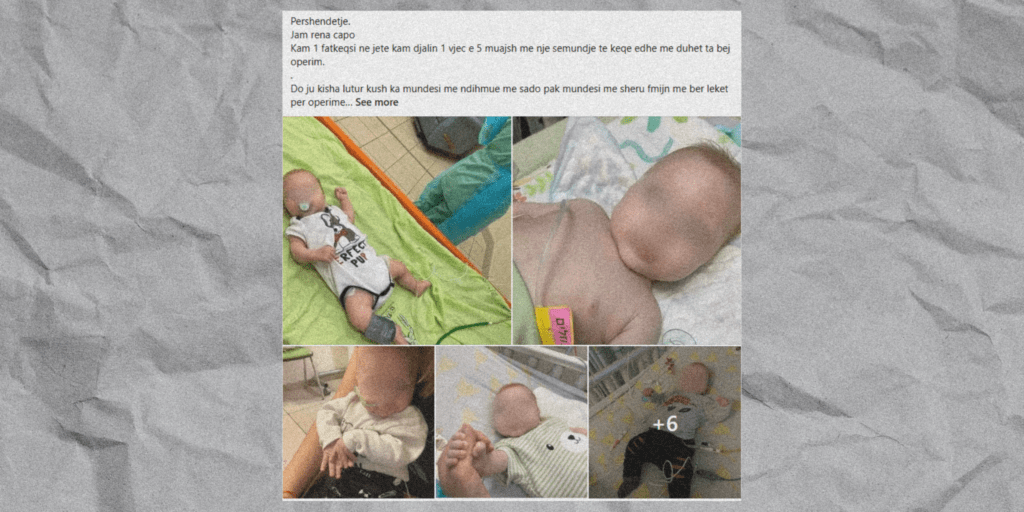
Among these contents treated by hibrid.info, is the claim that a 5-month-old baby is sick, who needs surgery. In the post accompanied by a photo of the baby, financial assistance is requested to carry out the surgery. The peculiarity of this claim is that it has been encountered in several cases and has been treated in three such cases, by hibrid.info (see here, here and here).
It was last treated in June 2024, being assessed as "Fraud", based on the assessment methodology.

Who posts this content?
In all cases addressed, the claim had the same description and was published in public groups on Facebook, by an account named "Rena Capo" (see here). There are no posts on this account's profile, except for a few photos showing a woman holding a baby. While the data section claims that this person lives in Tirana.
Hibrid.info has researched further and found the same post published in dozens of groups, from the same account even after being treated by Hibrid.info (see here).
The truth behind this claim
In the post, the author did not provide her bank account number, justifying her absence with the claim that she is in the hospital.
Using the automated search program, “InVID,” hibrid.info researched and found the real identities of the babies featured in two of the photos published in the post (see here and here).
The information found shows that these two photos were initially published on the Instagram account of a charitable foundation, as part of a fundraising campaign for the treatment of these babies in Russia (see here).
The two photos found, which date back to 2020/21. Through these findings, the different identities of the babies, whose photos were used to falsely present the claim of needing help, by the account "Rena Capo", are shown and proven.
Also, to further clarify the veracity of this post, hibrid.info found the website of the charitable foundation with activities in Russia, called "Vera v detstvo", where more can be learned (see here).
So the author of this misinformation has appealed to human sensitivity, which can be greater especially when it comes to sick babies. He has distributed it in closed and less monitored environments. He has used real photos of sick children, which can increase visual sensitivity, and has justified the lack of transparency with emotional claims, such as "I'm in the hospital, I don't have time to post details."
How can we protect ourselves as an audience from humanitarian aid scams?
Check the source of the post.: Verify who published it, is it a real person or a suspicious profile (no activity, with an unusual name or with few followers)? If it is a page, does it have a clear and reliable history of activity?
Require complete and verifiable data: A serious case should contain the patient's first and last name, a description of the illness, medical documentation, the cost of treatment, and the bank account registered in the name of the person mentioned.
Avoid posts that do not contain any of these elements or that justify their absence with emotional pretexts.
Use image verification tools
Verify the photo using the automated search program, “InnVID.” Fraudsters often use old photos from other countries (such as Russia, India, or the USA).
Check if the case has been reported by the media or fact-checking platform
Use external review platform sites or even Hibrid.info to see if an analysis of the suspicious content has been previously published.
Do not contribute financially without being completely convinced.
If you have any doubts, contact the person who shared the post to request more information.
Consider donating funds only through registered and reputable humanitarian organizations.
Report suspicious content on social networks
On Facebook and Instagram, you can click “Report” and select the “Scam” or “False Information” category. The more reports, the faster the platforms take action.