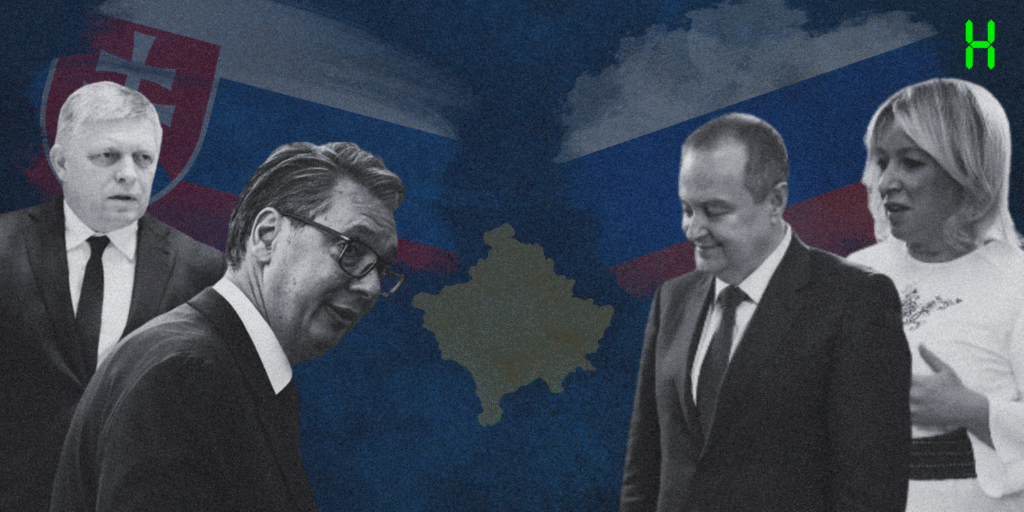

During the election campaign in Serbia, foreign politicians have been involved in rallies and publications by Serbian politicians, where the issue of Kosovo was also mentioned. On October 16, Slovak Prime Minister Robert Fico attended a pre-election rally of Aleksandar Vučić in Novi Sad, where he expressed support for him and stated that Slovakia would not let Serbia down on the issue of Kosovo. On the same day, Ivica Dačić published a video from a meeting with Russian Foreign Ministry spokeswoman Maria Zakharova, in which she said “Kosovo is Serbia.”
These cases come at a time when the campaign for the early parliamentary elections of October 25, 2026 is underway in Serbia. The statements of Fico and Zakharova, as well as the way they were published by Serbian politicians, represent two examples of the involvement of foreign actors in political communication during this campaign.
Fico at Vučić's rally: "We will never disappoint you for Kosovo"
Slovak Prime Minister Robert Fico participated on October 16 in the pre-election rally of the "Aleksandar Vučić - United Serbia" list, held in Novi Sad, where he publicly expressed support for the Serbian president.
According to media reports Klix.ba, Fico said he supports Vučić because, according to him, he defends sovereign Serbia and its right to make independent decisions.
During the speech, Fico also referred to Kosovo, stating: “When it comes to Kosovo, we will never disappoint you.” He added that Serbia will have a sincere friend in him.
Fico's participation in the rally and his statement on Kosovo were part of an activity organized in support of Vučić and the electoral list that bears his name.
Slovakia does not recognize Kosovo's independence. In this context, Fico's statement on continuing support for Serbia on the Kosovo issue is consistent with his country's official position.
So in this case, a foreign prime minister not only participated in a rally for a Serbian electoral list, but also publicly expressed support for Vučić and spoke about Kosovo in the same speech.
Maria Zakharova says "Kosovo is Serbia" during meeting with Ivica Dacic
On October 16, Dacic published a video from his meeting with Maria Zakharova, the spokesperson for the Russian Foreign Ministry, during his visit to Moscow.
According to the report of Politika.rs, Dacic presented Zakharova with a traditional Serbian dress. In the video he posted on his official Instagram account (see here), Zakharova thanked for the gift and finally conveyed the message: "Kosovo is Serbia."
In the video's description, Dacic presented the statement as a message to Serbs and an expression of support and encouragement. He also wrote that he would return to Serbia to continue the election campaign.
Dacic is the bearer of the electoral list “Ivica Dacic – Factor of Stability.” Thus, the publication of Zakharova’s meeting and message was included in his public communication during the campaign period.
Russia does not recognize Kosovo's independence and supports Serbia's position on the issue. Zakharova's statement is consistent with this position, while Dacic distributed it, presenting it as support for the Serbs.
Claims about Kosovo in Serbian election communication
The cases of Fico and Zakharova come after other statements by Serbian politicians about Kosovo during the election campaign.
In the article "Analysis of territorial claims against Kosovo in the Serbian election campaign", hibrid.info (see here) addressed Ivica Dacic's statement that the Serbian flag will fly again in Prizren. In the same context, the statements of Miloš Jovanović were also addressed, who during a visit to Prizren said that "Kosovo and Metohija is Serbia, it has always been Serbia."
These statements present claims to Serbia's sovereignty over Kosovo, expressed through historical references and national symbols.
Meanwhile, hibrid.info has also addressed the claims of Serbian media and officials that Kosovo Prime Minister Albin Kurti is financing support for the Student List in Serbia. In the article “Factless Claims that Kurti is Financing Support for the Student List in Serbia” (see here), it was found that Nenad Rashiqi's statement supporting this list did not prove that Kurti financed it.
Also, in the article "It is claimed without evidence that Kurti is supporting the Student List in Serbia through MP Radulović" (see here), the claim of the Serbian media outlet “Vaseljenska.net” that a video of MP Lazar Radulović proved Kurti’s support for this list was examined. The video did not prove that the MP’s action was instructed or coordinated by the Prime Minister of Kosovo.
These cases differ from the statements of Fico and Zakharova. In the case of the Student List, Serbian media linked the support expressed by political actors in Kosovo with allegations of Kurti’s direct involvement, without presenting evidence for this connection. In the cases of Fico and Zakharova, public statements and participation in activities or publications are documented.
However, all these cases show that the Kosovo issue is part of the political communication that takes place during the election campaign in Serbia, both through territorial claims and through statements related to international support.
Why are foreign politicians used during election campaigns?
Studies in political science have examined the impact that the support and interference of foreign actors can have on a country's elections.
In the study "Taking Sides in Other People's Elections: The Polarizing Effect of Foreign Intervention" (see here), researchers Daniel Corstange and Nikolay Marinov analyze how voters react when external actors support a candidate or political group. The study distinguishes between support for a specific candidate and support for the democratic process in general. According to the authors, biased support from abroad can deepen political divisions, influencing the attitudes of supporters and opponents towards the foreign power involved in the process.
A more recent study, published in 2025 by Michael Tomz and Jessica LP Weeks, entitled “The Domestic Political Costs of Soliciting Foreign Electoral Intervention” (see here), examines voters' reactions to politicians seeking foreign aid to win elections. The authors found that candidates who sought foreign aid lost support on average, although the impact varied according to the circumstances and the manner in which this aid was presented.
cONcluSiON
The participation of Slovak Prime Minister Robert Fico in Vučić's rally and the publication of Maria Zakharova's statement by Dačić show that the Kosovo issue has been included in the public communication of Serbian politicians during the election campaign.
In Fico's case, support for Vučić was accompanied by a pledge that Slovakia would not disappoint Serbia on the Kosovo issue. In Zakharova's case, Dačić published a message that reiterated Russia's stance against Kosovo's independence and presented it as support for the Serbs.
These cases document the use of statements by foreign actors in Serbian electoral communication, while studies on foreign support in campaigns show that such statements can matter for the way candidates present their political positions.