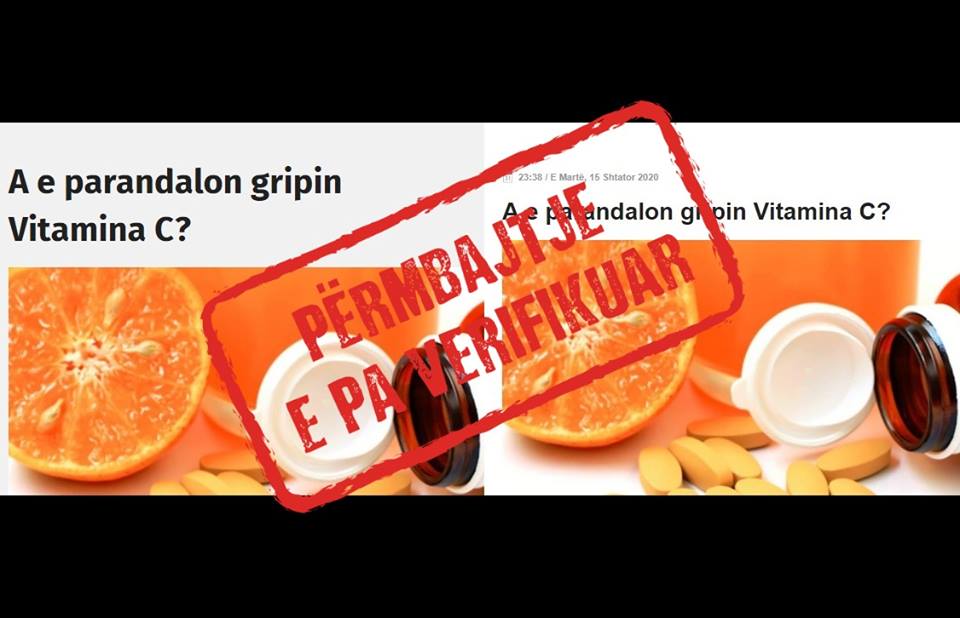

The media has published an article claiming to highlight the benefits of Vitamin C in treating seasonal flu.
This article titled "Does Vitamin C Prevent the Flu?", recently distributed by online media, after research by hibrid.info, appears to have been originally published by the "Telegrafi.com" portal in 2019. While the medical advice presented in this text appears to have no scientific references or source of information.
However, this article was re-published on Tuesday, September 15th by the portals "IndeksOnline.net" and "EkonomiaOnline.com", also without indicating where this claim about Vitamin C was taken from.
This re-publication of this article was done intentionally during this pandemic, as the title itself attracted many readers.
Original text published by several media outlets:
Does Vitamin C prevent the flu?
A number of studies have proven that vitamin C alleviates by about 23% the intensity of the symptoms of lightning and flu, such as: muscle pain, runny nose and cough.
Vitamin C has been shown to reduce the duration of lightening from a few days to a week. But if it prevents lightning and flu, this is difficult to determine, Telegraph reports.
The beneficial effects of vitamin C have been demonstrated in terms of shortening the duration of colds and relieving symptoms.
Although much research shows it doesn't prevent it, one randomized study found that long-distance runners, whose immune systems tend to be weaker after a race, who drank 600 milligrams of vitamin C a day did not caught the flu as often as those who did not take the vitamin at all.
Tip: It doesn't hurt to take a daily dose of vitamin C, especially if you feel like you're getting the flu. If you do get the flu, you're more likely to recover faster and not be bothered by its symptoms as much.
Taking 200 milligrams per day is enough, because part of it is excreted with urine.
Although orange juice is rich in vitamin C, don't rely on it alone. The vitamin C content in it can vary depending on the oranges used and how long the juice has been in the carton.
Vitamin C is unstable and is quickly lost during freezing and refrigeration. It also disappears from heat processing and cooking with water.
Link to the article published by Telegrafi.com in 2019:
https://telegrafi.com/a-e-parandalon-gripin-vitamina-c/
Since this article contains some purported flu advice, it appears that other media outlets have recently shared it with the aim of boosting readership, given readers' interest in such articles during the COVID-19 pandemic.
Links to the article published in several media outlets:
https://indeksonline.net/a-e-parandalon-gripin-vitamina-c9/
Analyze:
This article lacks a source of information that clearly indicates where this study was taken from. Also, the news is old and has now been re-distributed in order to encourage readers, knowing that such news has great readability, as it is related to the current situation of COVID-19. Hibrid.info categorizes this text as “Fake news”, “Unverified content” and “Pseudoscience”.
Reasoning:
Fake news
The “Fake News” rating is given to media reports that are entirely the product of a medium that itself contains factually incorrect claims or information. Content that is rated as fake news can be reliably determined to have been created and distributed with the intent to misinform the public, i.e., to present a claim that is completely false as fact.
Unverified content
The “Unverified” rating is given to those media reports that do not provide sufficient information to confirm the claims made in the report, and which have not been able to confirm the same due to the lack or non-possession of reliable sources.
Pseudoscience
"Pseudoscience" is media reporting that attempts to present certain opinions, attitudes, values, or findings obtained by a non-scientific method and present them as scientific discoveries or facts. Such reports often misinterpret or manipulate existing scientific research, or refer to research that is contrary to scientific verification and fact-finding.