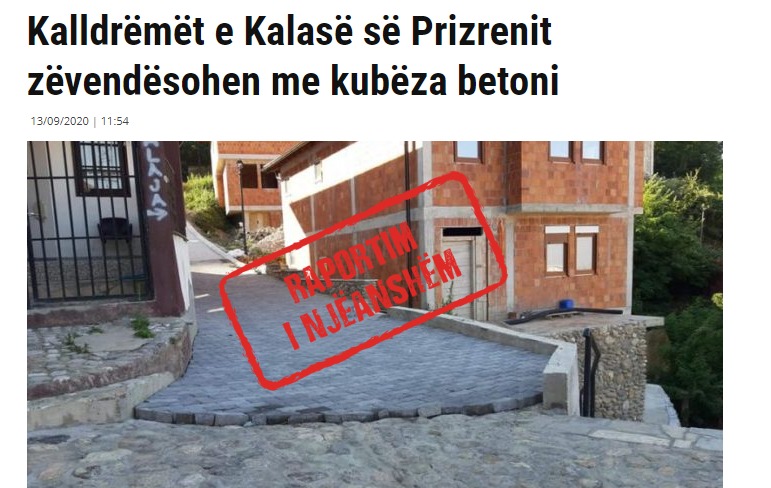

Several online media outlets in Kosovo, last week (September 13), published a news story based on a photograph posted on social media describing how cobblestones are being removed from several streets in the old part of the city of Prizren to be "replaced with concrete cubes."
The photos, along with a comment, were initially published on the personal profile of a Prizren citizen. In this citizen's post, she writes:
"Good morning from my blessed city"
This is how we protect our heritage, a little like this, a little like that!
September 2020, Nenkalaja neighborhood, Prizren”
Full post:
Based on the description of these photos, many Kosovo online portals have constructed news stories, claiming that the local government has replaced the old stones and cobblestones with new concrete cubes on several streets in the "Nënkalaja" neighborhood in Prizren.
Links to the news published on several media portals:
After the publication of this article, the reaction of the mayor of Prizren, Mytaher Haskuka, who had denied the news, also came. Through his denial, Haskuka says this news is false, adding:
"No road or alley that was paved with cobblestones has been covered with cubes or asphalt. The photos that were posted today are of an alley that was previously unpaved, so as can be seen from the photos, it was a gravel and mud road."
Full denial from the mayor of Prizren:
Analyze:
The media in this case have published a news item with biased information and without seeking confirmation from the officials of the Municipality of Prizren. Based on all the facts collected, hibrid.info categorizes this article as "Biased Reporting".
Reasoning:
Biased reporting
A media report is considered “biased reporting” if it is clearly seen to favor facts, positions and conclusions that align with a particular narrative, often disregarding the rule of contact with the other party when it comes to claims that are damaging to someone’s reputation or portrayed by certain actors with a negative approach. One form of biased reporting is the selective presentation of facts, where facts that support a particular thesis are emphasized, while facts that do not confirm it are neglected.