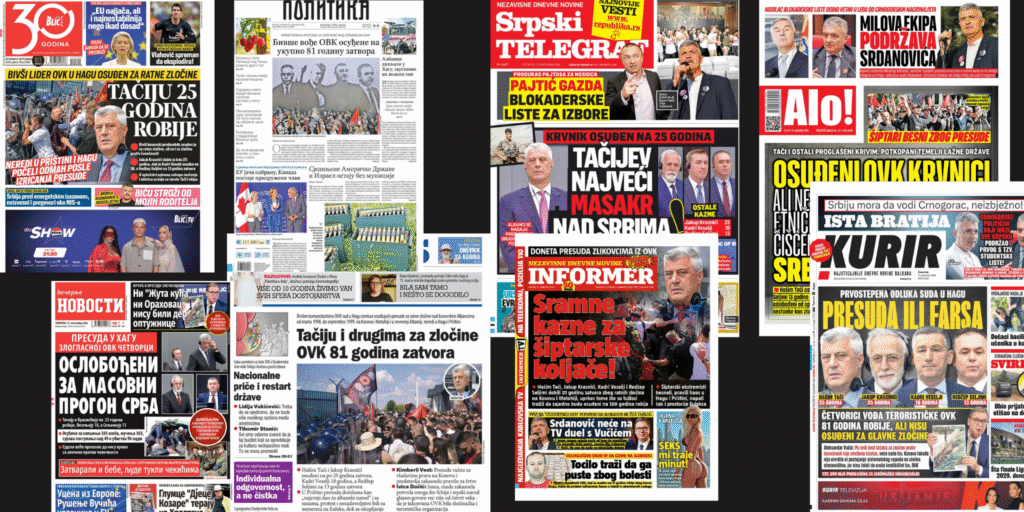

The verdict of the Kosovo Specialist Chambers in The Hague against Hashim Thaçi, Jakup Krasniqi, Kadri Veseli and Rexhep Selimi became one of the main topics of Serbian media reporting on 17 September 2026. The four former KLA leaders were sentenced to a total of 81 years in prison: Thaçi and Krasniqi to 25 years each, Veseli to 18 years and Selimi to 13 years. The court found them guilty of war crimes, including the illegal detention of 385 people, the cruel treatment of 49 people, the torture of 303 people and the murder of 96 people.
However, the way this decision was framed in a significant part of the Serbian media did not focus solely on the facts and legal content of the verdict. The reporting was organized mainly around the question of what was not included in the conviction, especially the charges of crimes against humanity and persecution of Serbs.
Three main frames emerge from the headlines and accompanying reports: the sentences are presented as insufficient, the lack of a sentence for what is described as persecution or ethnic cleansing of Serbs is emphasized, and the verdict is interpreted as a form of incomplete justice. However, these frames do not appear with the same intensity in all media.
Sentences as "shameful" and too lenient
One of the clearest examples of emotional language is InformThe newspaper presented the decision with the headline “Sramne kazne za šiptarske koljače” (Shameful punishments for Albanian butchers). In her reporting, Inform pointed out that the four former KLA leaders received a total of 81 years in prison, while the prosecution had requested a total of 180 years.
The comparison between the requested and imposed sentences is used to present the verdict as much more lenient than, according to the newspaper, it should have been in relation to the crimes dealt with in the process. In this framework, the decision is presented not only as the result of a judicial procedure, but as a decision that, according to the newspaper, does not correspond to the severity of the victims' suffering.
A similar approach, but with a different formulation, uses NewsThe newspaper described the decision with the headline that the convicts were “released for the mass expulsion of Serbs", while in its reporting it compared the sentence given with the sentences the prosecution had requested. The newspaper reported that they were found guilty of arresting 385 people, torturing 303, severely treating 49 and killing 96 people, while at the end it emphasized that "they even locked up babies and beat people with hammers."
also Courier put this dimension at the forefront through the question ""Presuda or farce?" (Verdict or farce?). The wording does not question the existence of the decision, but shifts the debate to its meaning, legitimacy and sufficiency. In subsequent reports, the newspaper also published assessments that the sentences were minimal in relation to the alleged crimes.
“No to ethnic cleansing of Serbs”: focus on what was not condemned
The second frame is particularly visible on the front page. Hello!This media outlet used the title “Osuđeni OVK kvenici, ali ne za etničko cijena Srba"(KLA criminals were convicted, but not for ethnic cleansing of Serbs).
The very structure of the title is significant. Thus, the punishment is not denied, but presented as limited because criminal liability did not extend to charges of crimes against humanity.
Blic used a shorter, less emotional title, "Thaci 25 years in prison” (Thaci 25 years in prison). However, in the accompanying report it emphasized that the sentence was for war crimes and not for crimes against humanity.
Victims, torture and "incomplete justice"
Another powerful way of framing is seen in Serbian TelegraphThe newspaper linked the decision with the headline "Tačijev najji masakr nad Srbima” (Thaci’s biggest massacre against Serbs). The accompanying text uses harsh descriptions of torture and violence, even mentioning infants, the elderly, and people treated inhumanely.
In this case, the victims become the focal point through which the reader is guided to understand the verdict. Thaçi’s 25-year sentence and other convictions are set against the backdrop of a much broader narrative of violence against Serbs. Thus, the verdict serves not only as a report on a judicial outcome, but also as an opportunity to reframe a broader narrative of war crimes in Kosovo.
Along the same lines, Inform uses language that directly links the decision to the Serbian victims. The newspaper described the verdict as an insufficient punishment and an injustice to the victims. Here, the 81-year sentence is not treated as the final outcome of the process, but as a point of comparison with what the newspaper presents as a much broader responsibility.
This way of reporting leads to the third frame: the verdict as incomplete justice. In this interpretation, the court convicted the four former KLA leaders of war crimes, but did not give what some Serbian media outlets present as full accountability for crimes against Serbs. Thus, what is missing from the verdict becomes as important as what is included in it.
Presentation of the verdict
In this spectrum, Politics and Today are presented with a presentational approach. Politics on the front page highlighted that former KLA leaders were sentenced to a total of 81 years in prison and reported on individual sentences and reactions after the verdict was announced. Although subsequent reporting dealt with political statements and crimes that were not included in criminal liability, the front page was less emotional than that of the tabloids.
Today summarized the decision with the wording "Tačiju i uturam za kromene OVK 81 prison building” (Thaci and others 81 years in prison for KLA crimes). The reporting focused on the specific acts for which they were found guilty: illegal detentions, cruel treatment, torture and murder. In this way, the content of the verdict is more central than its political interpretation.
These differences show that there is no single way of reporting the verdict in Serbian media. Tabloids like Inform, Serbian Telegraph, Hello! and Courier They use stronger emotional language and focus on what they present as a lack of justice. Evening News focuses on the lack of responsibility for the expulsion or persecution of Serbs, while Blic connects the reporting to the sentencing of Thaçi and the distinction between war crimes and crimes against humanity. On the other hand, Politics and Today give more space to legal outcomes and process developments.
Vučić's statements at the press conference
Serbian President Aleksandar Vucic held a press conference on Wednesday evening (September 16). special press conference, where he commented extensively on the decision. His main message was that “there is no reason for either joy or sadness” and that Serbs “should not accept this decision with any kind of euphoria.”
He stressed that out of the 10 counts of the indictment, six related to crimes against humanity (persecution, imprisonment, other inhumane acts, torture, murder and enforced disappearance) were dismissed. According to him, “as a court of the so-called Kosovo, they did not want to destroy the credibility of the KLA and did not enter into the merits of the formation of forces aimed at the secession of Kosovo from Serbia and the FRY.”
Vučić noted that crimes committed against Serbs after June 20, 1999, when KFOR arrived, were not included, describing some of them as “the most serious possible.” He specifically mentioned that the “Yellow House” (Žuta kuća) and the organ trade were not part of the indictment, nor were the abductions of Serbs in Orahovac, the Belačevac miners, the Lapusnik camp, Gllogjan, Lake Radonić and other cases.
“Serbs will always be criminals, while others are liberators and heroes,” he said, criticizing the reactions from the region and the international community as “hypocrisy.” Vucic compared the harsh tones towards Ratko Mladic’s funeral with the softer stance towards KLA leaders and cited examples such as Ante Gotovina.
In the end, he emphasized that for Serbia "the most important thing is to maintain peace and stability" and that "all together we were not sufficiently prepared to face our mistakes and the crimes committed in our name."
In general, the Serbian media presented the decision as a political compromise: severe punishments for individual crimes, but “liberation” for the greatest crime – the systematic persecution of Serbs. The Albanian riots in Pristina and The Hague were widely used as “evidence” of the lack of respect for justice, while Vučić’s statements became the main references to support the narrative of “double injustice”.