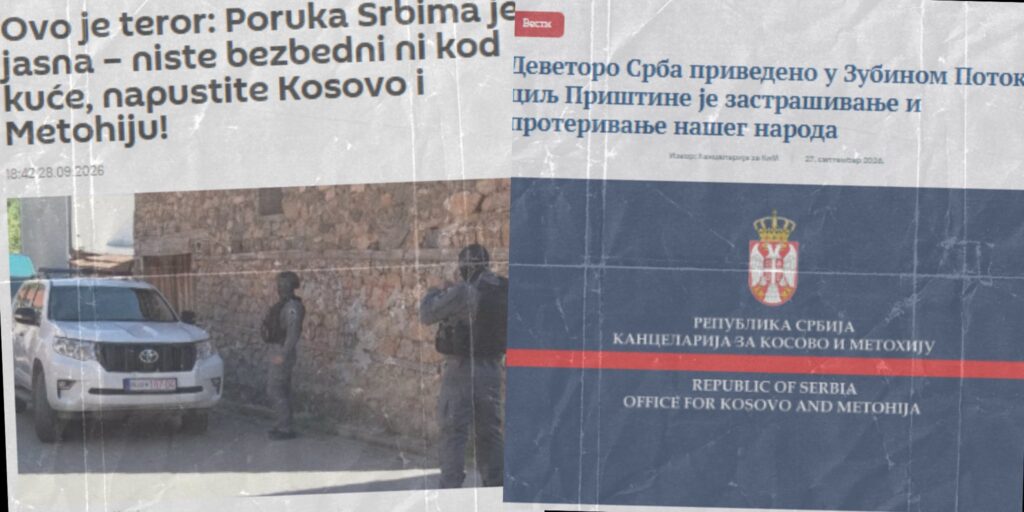

In the reactions following the police action and arrest of nine Serbs in Zubin Potok, Sputnik Serbia and Serbian Government Office for Kosovo have constructed interconnected narratives that place the Kosovo authorities' operation within the framework of systematic pressure and the aim of expelling the population. These positions presented by the Sputnik article and official Serbian statements include specific allegations of terror, lack of evidence and hidden political motives, which are however directly countered by institutional facts, communications and material evidence from the Special Prosecution Office and the Kosovo Police.
The narrative of “terror” and the intention to expel
One of the main thrusts of these sources was the claim that the police action was not about enforcing the law, but about exerting pressure and expelling the population. The Sputnik Serbia article (via politician Ivan Todosijević) described the operation as a form of “additional terror against the Serb population”, claiming that the message sent was that the residents would only be safe if they left their homes. For its part, the Kosovo Office framed the event as sending “police phalanxes” to raid homes in the early hours of the morning during the Easter holiday, with the aim of intimidating and purging the remaining Serbs in Ibarski Kolašin.
This narrative presents the action as an arbitrary measure, but it ignores the facts of the institutional procedure. The operation Kosovo Police and Special Prosecutor's Office was a procedural intervention based on search warrants issued by the court for criminal investigations of war crimes. The suspects were initially ordered to be detained for 48 hours and then sent to the Basic Court in Pristina with a request for detention.
Personalization of Albin Kurti's operation
Another important element of the narrative is the personalization of the action by Prime Minister Albin Kurti. The Office for Kosovo claims that Kurti “sent” police forces to arrest nine Serbs.
However, in the joint statement of the Kosovo Police and the Special Prosecution, the operation is presented as an action of the Directorate for the Investigation of War Crimes, carried out on the orders of the Special Prosecution. These statements do not present any evidence that Kurti personally ordered the arrests.
Thus, an action presented in institutional sources as part of an investigative procedure by the justice and police bodies, in the Serbian press release is personalized to the prime minister and interpreted as his political decision.
Mass criminalization and lack of evidence
Serbian sources also argued that people are being arrested suddenly, without any evidence, proper investigation or real basis. Sputnik pointed out that this creates a situation where anyone could be found tomorrow in an indictment without any connection to the events, while the Office for Kosovo added that the arrested are residents who have lived there for decades without fleeing, being targeted only to be labeled as criminals.
These allegations are refuted by the official documents of the prosecution. According to the official request of the Special Prosecution, the nine persons are specifically suspected of the criminal offense of “War crimes against the civilian population”, namely for participation in the murder and disappearance of 23 civilians. Furthermore, during the field raids, the law enforcement agencies seized material evidence including long weapons, hunting rifles, ammunition, shells, two military booklets, as well as monetary amounts of approximately 23,000 euros and 60,000 Serbian dinars.
However, the existence of these materials does not mean that the guilt of the arrested persons has been proven. The persons continue to be suspects and enjoy the presumption of innocence until a final court decision.
At the same time, the claim of Serbian sources that there was no evidence is not the same as the claim that the evidence presented by the Prosecution is sufficient for a conviction. On September 28, the lawyers of the arrested requested that they be defended in freedom or under a more lenient measure and claimed that the request for detention was insufficient and did not contain concrete evidence linking the suspects to the criminal offenses (see here). These are defense claims and do not constitute a final finding of the court on their guilt or innocence.
"File 23" and the "Group of Intellectuals"
One element missing from the narrative of Serbian sources is the context of the investigation in which the operation took place. According to the Kosovo Police and the Special Prosecution, the September 27th operation was codenamed “File 23” and is linked to the case known as the “Group of Intellectuals.”
The prosecution has stated that all nine suspects are linked to the investigation into the murder and disappearance of 23 civilians.
Therefore, presenting the operation solely as a surprise action against the Serbian population leaves out the context of the specific criminal case that the authorities say they are investigating.
Political context and hidden agenda
At the level of political narrative, the Kosovo Office claimed that Prime Minister Albin Kurti is using these arrests as a campaign to distract public attention from the indictments of the Special Court in The Hague against former KLA leaders and to create an “artificial balance” of guilt, while Sputnik focused on the psychological resistance and determination of the population not to give in to fear.
In contrast to this political interpretation, the prosecution of war crimes constitutes an ongoing legal and institutional obligation of the justice institutions in Kosovo to clarify the fate of missing civilians. Law enforcement agencies have reaffirmed that actions are taken exclusively within the framework of legal competences to bring suspects to justice.
The continuation of the orchestrated narrative of “ethnic cleansing”
For some time now, Serbian and Russian officials have interpreted every institutional action in Kosovo as a decision against Serbs aimed at their expulsion. Through this repeated narrative, various political, administrative or security developments are constantly presented by Belgrade and Moscow as part of an orchestrated process of “ethnic cleansing”, despite the fact that such claims are not supported by the facts or by the reports of international missions in the country (see here and here).
These narratives constructed by Sputnik Serbia and the Kosovo Office merge into a message where a specific criminal operation is presented as part of a broader strategy to pressure, intimidate, and expel Serbs.
Documented facts confirm that on September 27, nine people were arrested in Zubin Potok as part of a Kosovo Police operation, by order of the Special Prosecution Office, related to the “Group of Intellectuals” case and codenamed “File 23”. The authorities have also made public materials seized during the searches, while the procedure continued with the initial detention, judicial review and the imposition of 30 days of pre-trial detention.
At the same time, claims that the purpose of the action was to expel Serbs, that it constituted “terror” or that it was organized to create an “artificial balance” with the trials in The Hague, are presented by Serbian sources as political interpretations and are not accompanied by concrete evidence proving these motives.
Meanwhile, the defense's claims that the Prosecution's evidence is insufficient must be treated separately and cannot be equated with the claim that there was no evidence at all. The guilt or innocence of all nine suspects remains to be determined through judicial proceedings.