
Wrote: Festim Rizanaj
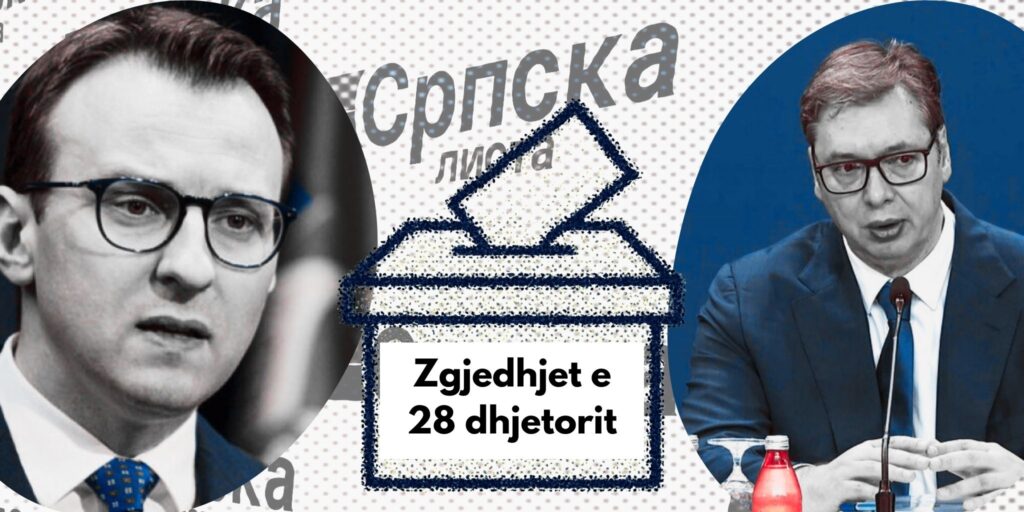
In the run-up to the December 28 elections, the political discourse of Serbian officials has been characterized by an intensification of narratives that present these elections as a decisive moment for the fate of the Serbian community in Kosovo. Through public statements by Petar Petković and the President of Serbia, Aleksandar Vučić, the elections have been constructed as an existential battle, with the political, institutional and demographic survival of Serbs at the center.
In this framework, the Serbian List is presented as the sole legitimate representative and the main mechanism of collective defense, while Kosovo institutions are portrayed as a source of constant pressure, danger, and threat. These narratives, constructed through the language of fear, mobilization, and victimization, create an emotional climate that shifts the debate from political competition to a discourse of survival and ethnic confrontation.
Petar Petković's narratives: elections as a decisive moment for the "survival" of Serbs
In the days leading up to the December 28 elections, the director of the Office for Kosovo in the Government of Serbia, Petar Petkovic, has intensified his public appearances and media statements, presenting these elections as a key moment for the political and existential fate of Serbs in Kosovo. In interviews given on December 26 and 27 to various Serbian media outlets, including “RTS”And“Tanjug.rs", Petkovic declared that these are "decisive" elections, in which, according to him, "the fate of the Serbian people is being decided."
In his discourse, the Serbian List is presented as the only political force that can protect the interests of Serbs, while any other alternative is described as dangerous or manipulated by Pristina. Petkovic has claimed that the Kosovo authorities, led by Prime Minister Albin Kurti, are developing a systematic policy of pressure, intimidation and “institutional terror”, citing the militarization of the north, arrests of Serbs and the closure of Serbian institutions. According to him, the ultimate goal of these actions is to “break the backbone of the Serbian people” and eliminate the Serbian List from the political scene.
An important part of Petkovic’s narrative is also related to the delegitimization of Serbian political alternatives. He has directly accused Nenad Rašić and other Serbian entities of being “projects of Albin Kurti”, which, according to him, aim to create the illusion of multiethnic representation, while essentially harming the interests of the Serbian community. In this context, Petkovic has emphasized that only the victory of the Serbian List of all ten mandates guaranteed for the Serbian community can ensure true political representation and stop the decision-making, which, according to him, is being done to the detriment of Serbs.
He has also called on Serbs displaced in Serbia to travel to vote, presenting this act as a national and moral obligation. In his statements, the elections are described not as an ordinary democratic process, but as a battle for collective survival, where participation is considered a form of political resistance.
Aleksandar Vučić's narratives: Serbs to vote for the Serbian List and criticism of Kurti
Along the same lines, but with a more institutional tone, Serbian President Aleksandar Vučić has constructed a narrative that directly links participation in the elections to preserving Serbia's national unity and state interests. On December 24, during a conference with Serbian ambassadors, Vučić called on Serbs in Kosovo to vote for the Serbian List, describing it as the "true defender of Serbian national interests."
He emphasized that the political representation of Serbs requires “continuous effort and energy” and that it is necessary for them to have “real” representatives, and not, as he put it, representatives who serve Pristina’s policies. In this way, Vučić positions the Serbian List as a key factor of stability and as a guarantee for the continuity of Serbia’s political influence in Kosovo.
The President of Serbia, Aleksandar Vučić, also during the groundbreaking ceremony for the construction of a new facility for the Ministry of Defense and the General Staff of the Serbian Army in Belgrade, on December 27, called on the Serb people in Kosovo to vote for the Serb List in the upcoming elections. Vučić emphasized his belief in Serbian unity, the strength of the Serb people in Kosovo, and the victory of the Serb List, presenting the candidates of this list as serious and trustworthy people, against whom there is no sensitive criticism. He also criticized Albin Kurti, saying that he has made efforts through “Serbian servants” to secure the formation of his government, while the Serb List is presented as a symbol of the strength and unity of Serbs in the region.
Vučić also underlined respect for the democratic rights of all political actors to campaign within the law, including the "door-to-door" method, which he described as a normal and acceptable practice.
Office for Kosovo opens new job openings; Serbian Commissariat for Refugees and Migration calls for votes
In parallel with this political discourse, Serbian institutions have accompanied their messages with concrete social and economic measures. Also on December 24, Office for Kosovo in the Government of Serbia announced the opening of 300 new jobs in Serbian health institutions in Kosovo, as well as the continuation of another competition for 50 jobs announced a few days earlier. According to the official announcement, these employments are described as vital for the “sustainability and survival of the Serbian people”, while it is noted that over the past three years, over 1.500 people have been employed in the Serbian health sector in Kosovo.
These measures have been presented as concrete evidence of "the care of the Serbian state and the personal role of President Vučić in supporting the Serbian community in Kosovo", directly linking social welfare to political orientation and participation in elections.
Serbian Commissariat for Refugees and Migration called on displaced citizens from Kosovo, who are currently in Serbia, to participate in the elections. Authorities stressed that every vote is important for the protection of the interests and survival of the Serbian community in Kosovo.
Overall, the statements of Petković and Vučić build a common narrative that presents the December 28 elections not as a regular democratic process, but as a critical moment for the political, institutional and collective survival of Serbs in Kosovo. The discourse is dominated by strong emotional elements, rhetoric of victimization and ethnic mobilization, while the Serbian List is presented as the only defense mechanism against what is described as systematic pressure from Kosovo institutions.
In this way, the election campaign is transformed from a political process into an existential narrative, where participation in voting is presented as an act of collective defense and not as a free political choice.