
Wrote: Endrit Berisha
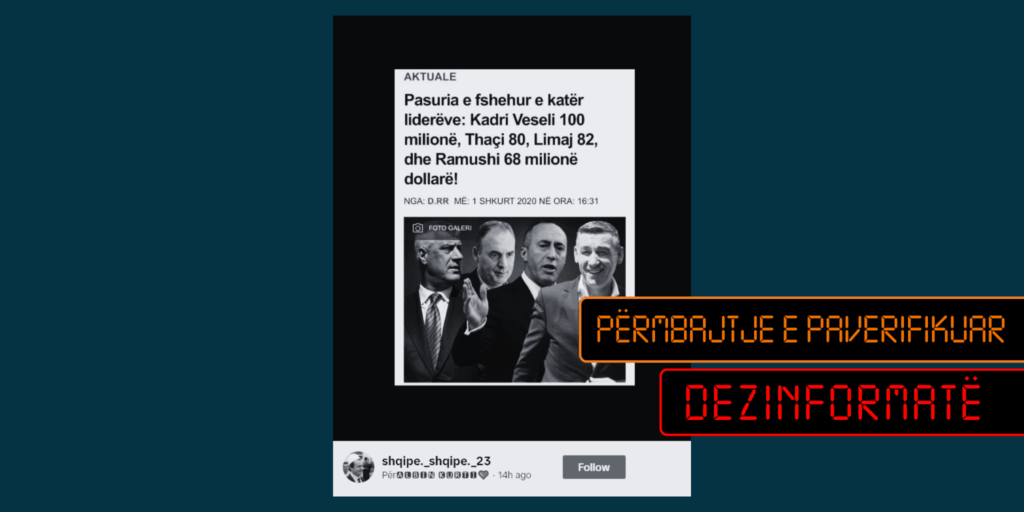
Through a publication, an old article titled "The hidden wealth of four leaders: Kadri Veseli 100 million, Thaçi 80, Limaj 82, and Ramushi 68 million dollars!" has been reposted on TikTok.
The TikTok post was made by the account named "albania._albania._23" yesterday (September 25) and so far has received over 60 thousand views and over 1400 likes.
What's wrong with the content?
After fact-checking by hibrid.info, it turns out that the content of the "botasot.info" article, reposted on TikTok by the account "shqipe._shqipe._23", is unfounded.
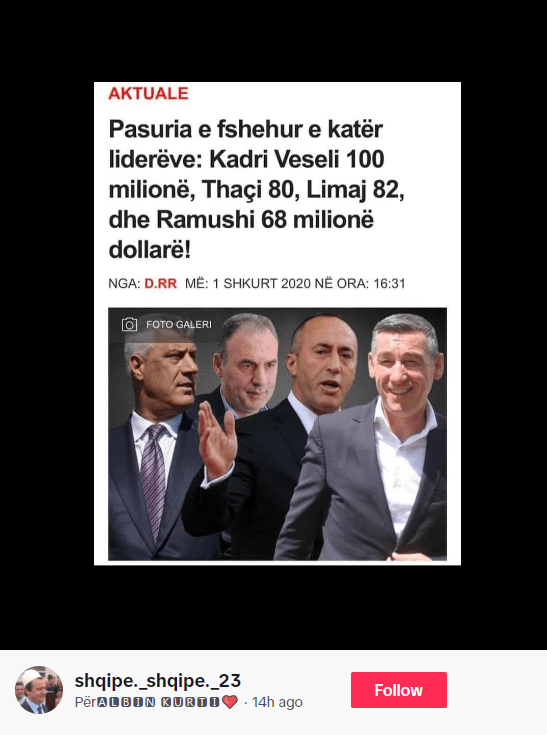
Ky ITEM on the Albanian-language portal "botasot.info" it is dated February 1, 2020.
In content, the article was based on “a comment that a journalist had made on information marked as a top secret document”. According to the article, the source of the information was “a young woman from Peja, Valentina T. Alijaj, according to data on FB, who posted only foton without commenting."
Hibrid.info searched Facebook under the name Valentina T. Alijaj. By verifying the photo on the Facebook profile, through the “Google” search engine, it was found that the photo is the same as the “Anna Robosch” account on Facebook. The “Anna Robosch” account had published the photo on January 6, 2017, while the account "Valentina T. Alijaj" February 15, 2018.
There was no fact, apart from the alleged photograph, that the leaders of that time had hidden assets worth hundreds of millions. Hibrid.info searched on "Google" with the keywords "The hidden wealth of Hashim Thaci, Kadri Veseli, Ramush Haradinaj, Fatmir Limaj". The only article found is that of "botasot.info".
Analyze:
The claim of hundreds of millions of secret assets of former Kosovo leaders, Kadri Veseli, Hashim Thaçi, Fatmir Limaj and Ramush Haradinaj, has returned to the social media TikTok.
The account named "shqipe._shqipe._23" reposted a 2020 "botasot.info" article. After fact-checking by hibrid.info, it turns out that the content was unverified.
Based on its work methodology, hibrid.info assesses publications as "Unverified Content" and "misinformation".
Reasoning:
The "Unverified" rating is given to those informative contents that do not provide sufficient information to confirm the claims made in the report, and which could not be verified due to certain circumstances (speed, lack of sources) during the publication of the content.
"Disinformation" is defined as information content that contains a "mix" of inaccurate sources or even half-truthful attributes, and that is created and/or distributed with the deliberate intention of causing harm. The motive behind the producers/distributors of disinformation content lies in achieving a political, financial, psychological or social goal.