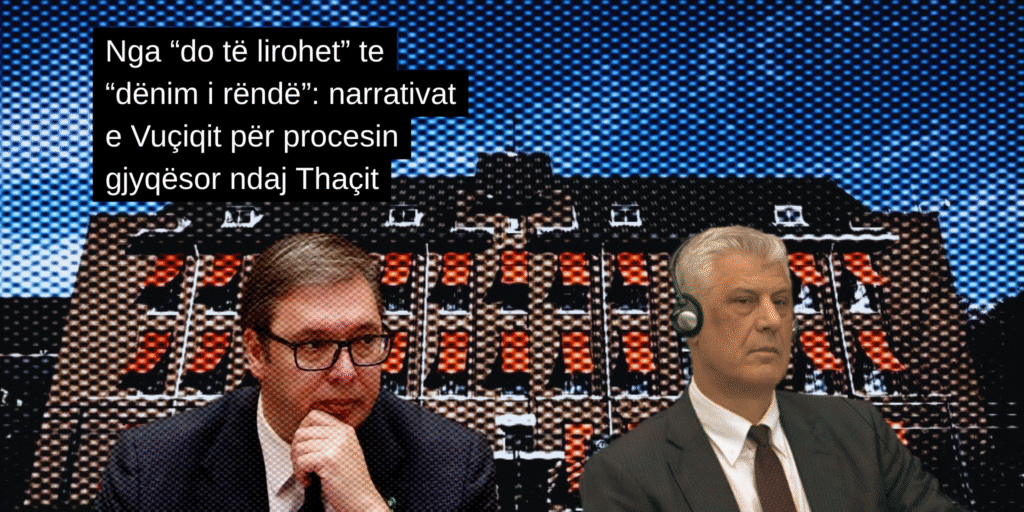

Serbian President Aleksandar Vučić has promoted different narratives in his recent statements regarding the verdict against former Kosovo President Hashim Thaçi at the Special Court in The Hague. Initially, he claimed that Thaçi would be acquitted of war crimes charges and would be convicted only of charges related to obstruction of justice. A few days later, however, Vučić changed his version, claiming that he had received new information according to which Thaçi could face a severe sentence. Both statements were presented as predictions based on information that Vučić claims to have received from unidentified sources.
Thaçi initially appears innocent of the main charges, but convicted of obstruction of justice
In the first statement (August 28), Vučić claimed that Hashim Thaçi would be acquitted of war crimes charges, while he would be convicted of charges related to interference in the administration of justice (see here).
Through this statement, Vučić presented as predetermined an outcome of the court process that had not yet concluded. In this version of the narrative, Thaçi would not be found guilty of the main charges of the indictment, but would face a sentence for acts related to influencing the justice process.
The statement was accompanied by a claim that Vučić had knowledge of the possible outcome of the process, although the decision had not yet been made public. In this way, he presented the statement not simply as a personal opinion, but as a prediction based on information he claimed to have at his disposal.
The narrative changes: Thaçi could receive a "severe punishment"
In his statement on Saturday (September 12), Vučić presented another version of the possible outcome of the trial. He claimed that during his stay in Paris he had received new “information” and that, according to it, Thaçi could receive a severe sentence (see here).
"15 days ago I received information that he would be sentenced to a measure that covers the time of detention; I received this from our services. Now, when I was in Paris and talking with several European and world leaders, I received several different signals. In four days we will see who is right," Vucic claimed.
This statement represents a significant shift from the previous narrative. Instead of a sentence limited to charges of obstruction of justice, Vučić now leaves open the possibility of a severe sentence for Thači.
Unlike the first statement, where Vučić presented Thaçi's acquittal from the main charges as possible, in the second statement he links the possible outcome to new "information" obtained from sources he does not identify.
Conflicting predictions and unidentified sources
Vučić's two statements construct two different narratives for the same trial. In the first, he predicts Thaçi's acquittal of war crimes charges and a conviction only for obstruction of justice. In the second, he warns of the possibility of a severe sentence.
The common element of both narratives is the claim that Vučić has information about the outcome of the trial before the verdict is announced. However, he does not identify the sources from which he obtained this information, nor does he present evidence that would support such a prediction.
In this way, his statements create the impression that the outcome of the trial is known or predictable through sources outside the Court, even though the official decision rests with the trial panel in The Hague.
Instead of remaining in a single stance, Vučić's narrative shifts from a prediction of a limited punishment to a warning of a severe punishment. This makes the contradiction between the statements the main element of the treatment, especially since both versions are presented without verifiable sources.
These statements should be distinguished from the Special Court's verdict itself, as Vučić's predictions do not constitute official announcements of the outcome of the trial.
The verdict against Thaçi and others is expected to be announced on September 16th.
A protest in support of former KLA leaders was held in Pristina today (September 12), ahead of the verdict against Hashim Thaçi, Kadri Veseli, Rexhep Selimi and Jakup Krasniqi. Protesters expressed support for the accused and opposition to the trial in The Hague.
The Kosovo Specialist Chambers have announced that the verdict in the trial of Hashim Thaçi, Kadri Veseli, Rexhep Selim and Jakup Krasniqi will be pronounced on 16 September 2026, at 10:00. According to the official announcement, the Trial Panel has set this date taking into account the volume of evidence and the complexity of the trial, as well as the need for a full and reasoned assessment of the evidence (see here).
The four defendants face individual charges of six counts of crimes against humanity – persecution, imprisonment, other inhumane acts, torture, murder and enforced disappearance – as well as four counts of war crimes, including unlawful and arbitrary arrest and detention, cruel treatment, torture and murder.
According to the indictment, the alleged crimes took place between March 1998 and September 1999 in several locations in Kosovo, as well as in Kukës and Cahan in northern Albania. The prosecution alleges that they were committed against hundreds of civilians and non-combatants, as part of a widespread and systematic attack on individuals suspected of opposing the Kosovo Liberation Army (KLA).
The trial began on April 3, 2023, while the evidentiary proceedings were concluded on December 18, 2025. 134 witnesses testified at the trial, while closing statements were held from February 9 to 18, 2026. The verdict of September 16 will determine the outcome of the trial against the four defendants.