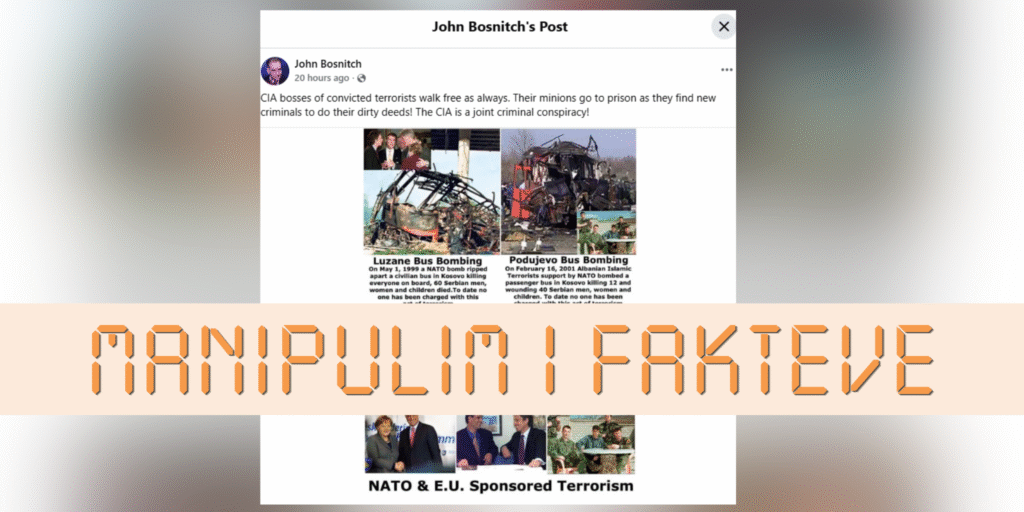
Through a post on Facebook, published on September 16, John Bosnitch, a Canadian-Serbian journalist and activist, known for his stances against Kosovo's independence and NATO intervention, has published allegations regarding two attacks on buses in Kosovo, which occurred in 1999 and 2001.
In the post's description, Bosnitch writes:
"The CIA's convicted terrorist bosses walk free, as always. Their servants end up in prison, while they find new criminals to carry out their dirty deeds! The CIA is a joint criminal conspiracy!"
The post also published photographs of former Kosovo President Hashim Thaçi during meetings with foreign officials and politicians.
In addition to this description, in the same publication Bosnitch also presents two claims regarding the attacks on buses in Lluzhan in 1999 and in Livadicë in 2001, linking these events to NATO. (see photo below).

First claim
Bosnitch claims that on May 1, 1999, during NATO bombing, a rocket hit a civilian bus in Lluzhan, Kosovo, killing “60 Serb men, women and children.” He also claims that no indictments for “terrorism” were filed in this case.
facts
The attack on the bus in Lluzhan on 1 May 1999 occurred during the NATO air campaign. NATO had admitted that a bus had been hit during an attack on the bridge over the Llap River, arguing that the bridge was the target of the strike (see here).
However, the claim that the victims were 60 Serbs does not match the data of Radio Free Europe. In a 2021 article, REL writes that 44 people were killed in this incident, of whom 31 were Albanians and 13 were Serbs (see here).
Human Rights Watch has also documented the incident, recording 39 civilians killed in the attack on the bus. The figures vary between sources, but they do not support Bosnitch's claim that 60 Serbs were killed in the incident (see here).
Bosnitch also claims that “no one has been charged” for this attack. It does not appear from the sources consulted that any person has been criminally charged with “terrorism” in connection with the attack in Lausanne. However, the incident has been documented and examined in the context of international reports on civilian casualties of the NATO air campaign (see here).
Second claim
Bosnitch claims that on February 16, 2001, “Albanian Islamic terrorists, supported by NATO,” bombed a bus in Kosovo, killing 12 and wounding 40 Serbs. He also claims that no one has been charged for this attack.
facts
On 16 February 2001, a bus carrying Serbian civilians from Kosovo to Serbia was attacked near Livadicë/Livadica, in the Podujevo municipality. The bus was under KFOR escort when an explosive device placed near the road exploded as it passed (see here).
So, it was a ground-based explosive attack, not a NATO bombing. The 2001 US State Department Human Rights Report also described the attack as a roadside bomb detonation while the bus was under KFOR escort (see here).
Florim Ejupi was prosecuted for this attack. In 2008, an international panel at the Pristina District Court found him guilty of terrorism and sentenced him to 40 years in prison (see here).
However, in 2009, the Supreme Court of Kosovo overturned the conviction and acquitted Ejupi, finding that the evidence was insufficient. EULEX has subsequently documented issues related to the evidence used in the case (see here).
Even the number of casualties presented by Bosnitch differs from source to source. The Humanitarian Law Center documents 11 people killed and 46 injured in this attack (see here).
There is no evidence in these sources that the attack was carried out with NATO support. On the contrary, the sources document that the bus was under KFOR escort, while NATO publicly condemned the attack.
What's wrong with the claims?
Bosnitch's claims combine two real events, but inaccurately present the authorship, number, and affiliation of the victims.
In the case of Lluzhan, NATO admitted that the bus was hit during an airstrike on the bridge, but the claim that 60 Serbs were killed does not match the documentation of the cited sources. According to REL, the victims were 31 Albanians and 13 Serbs.
In the case of Livadica, the attack was carried out by a roadside bomb rather than a NATO bombing. In this case, a person was initially tried and convicted of terrorism, before the conviction was overturned by the Supreme Court due to insufficient evidence.
Who is John Bosnitch?
John Bosnitch is a Canadian-Serbian journalist and activist. He has been publicly engaged in issues related to the Serbian community and has expressed positions against Kosovo's independence and NATO intervention in 1999. In his public biography, Bosnitch describes himself as one of the voices that opposed NATO intervention and Kosovo's secession from Serbia (see here).
Analyze
John Bosnitch presents two attacks on buses in Kosovo (1999, 2001) as NATO-related attacks, but the facts show otherwise.
In Lluzhan, the bus was hit during a NATO airstrike on a bridge, but the victims were not 60 Serbs. According to reports, 31 Albanians and 13 Serbs were killed. Meanwhile, in Livadice, the bus was attacked with explosives while under KFOR escort, and Florim Ejupi was tried for the case, but later acquitted for lack of evidence.
Based on its work methodology, hibrid.info assesses this content as "Manipulation of facts".
rationale
“Factual manipulation” is a rating given to informational content that uses facts known to be accurate but interprets them in a distorted manner. These reports typically use accurate information to draw incorrect conclusions or claims, thereby misleading consumers of media content about the actual meaning of the facts presented.