
Media and Information Education – EMI – is about equipping citizens with the competences and skills to engage and interact effectively and responsibly with media and information systems. This enables them to become active and critical citizens who can participate in civic life and contribute to strengthening democracy.
Although until recently two separate definitions were used: media literacy and information literacy, the United Nations Educational, Scientific and Cultural Organization (UNESCO) has conceived a composite definition Media and Information Education (MIE) as this approach provides a more comprehensive definition of the need to provide related education such as financial, health, digital education, etc. In the following pages, the concept of EMI is presented according to the UNESCO framework.
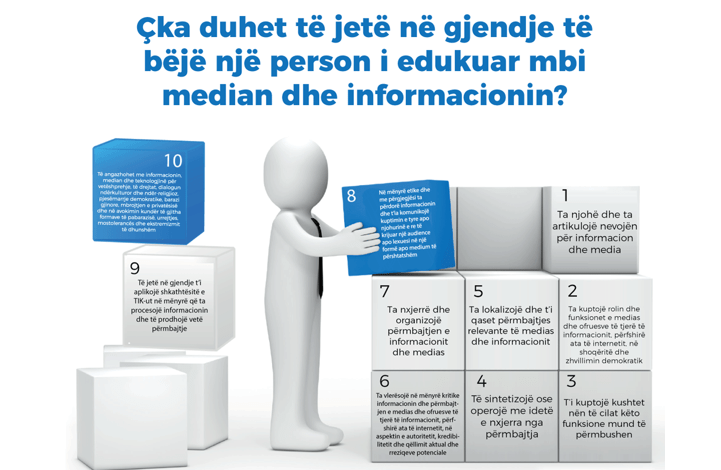
EMI, understood as a composite concept, includes the knowledge, skills and attitudes that enable citizens to:
- Understand the roles and functions of the media and other information providers in democratic societies;
- Understand the conditions under which these functions can be fully fulfilled;
- Recognize and articulate the need for information;
- Find and access relevant information;
- Critically evaluate information and content from media and other information providers, including those on the Internet, in terms of authority, credibility and purpose;
- Extract and organize information and media content;
- Synthesize or act on ideas abstracted from the content;
- Ethically and responsibly communicate the understanding of the knowledge created to the audience or reader in an appropriate form and medium;
- Be able to apply ICT skills in order to process information and produce content;
- Interact with the media and other information providers, including those on the Internet, for self-expression, freedom of expression, intercultural dialogue and democratic participation.
Furthermore, EMI also includes the use of media and information to contribute to the knowledge society through the acquisition of skills to create information and media content. Thus, the use of media and various information providers is seen as key not only for information, but also for personal and social empowerment as well as participation in decision-making and more broadly in the knowledge society.
EMI is interested in giving people an understanding of the importance of media and other information providers so that:
- make informed decisions;
- to learn about the world around them;
- to build a sense of community;
- to maintain public discourse, and
- to engage in lifelong learning.
EMI has the potential to combat the biggest challenges of the 21st century such as disinformation, radicalism, hate speech, populism and gender discrimination. When the audience is clear about what is ethical, professional and when they manage to read every text critically then the aforementioned phenomena will be faced with appropriate reactions. By possessing the competencies of EMI, we will contribute more and more to a more educated, developed and equal society.
Article from Gentians of Paçarizi