
Wrote: Etrit Rexhepi
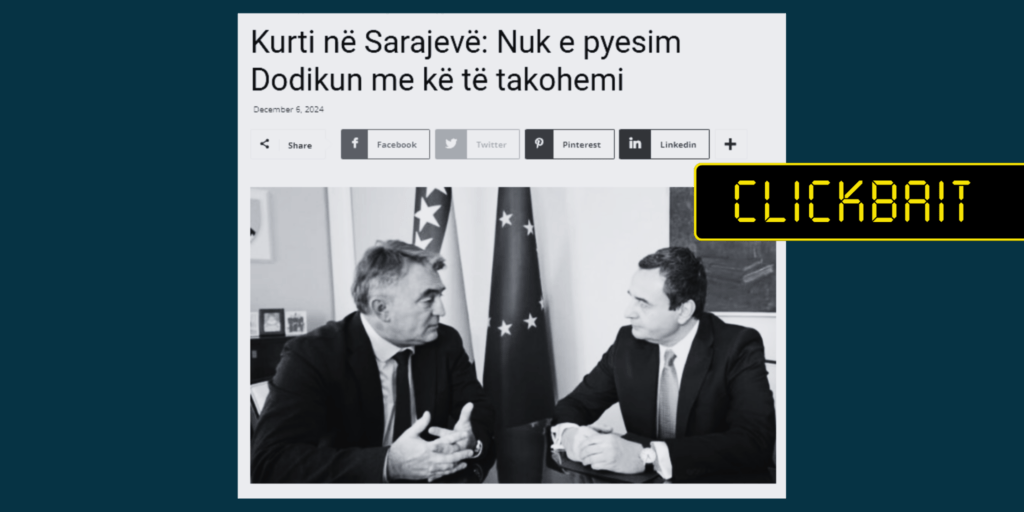
A headline claimed that Kosovo Prime Minister Albin Kurti, during his official visit to Sarajevo, said that he did not ask the head of the Republika Srpska entity in Bosnia and Herzegovina, Milorad Dodik, who he could meet with.
"Kurti in Sarajevo: We are not asking Dodik who to meet with" is the title of the article published by the Albanian-language portal "lajmpress.org" on Friday (December 6).

What's wrong with this title?
After verifying the facts, it turns out that such a statement was not made by Kurti, but by Željko Komšić, the Croat member of the Presidency in Bosnia and Herzegovina. This is also understood from the content of the article being discussed.
"Regarding the alleged criticism of Kurti's visit and the meetings he has in Bosnia and Herzegovina, coming from Republika Srpska and the region, I would like to remind you that Republika Srpska is not a subject of international law and is not responsible for issuing visas to enter Bosnia and Herzegovina, and that the members of the Presidency of Bosnia and Herzegovina will certainly not ask Dodik or anyone else who we will meet with and what we will discuss.", Komsic wrote in Facebook after the meeting with Kurti on Friday.
Why was this statement made about Dodik?
Bosnia and Herzegovina and Kosovo have not recognized each other due to the opposition of Republika Srpska, which is headed by Milorad Dodik, who is pro-Russian and is sanctioned by the United States for undermining the Dayton Agreement. Kurti's visit to Sarajevo has been opposed by Dodik, who has said that the Kosovo prime minister's stay in Bosnia will complicate the situation in that country. "Bosnia and Herzegovina has not recognized Kosovo. We will not allow Albanians from that region to enter with an ID card," Dodik said, according to Srna reporting. The Kosovo prime minister did not hold a meeting with the Serbian member of the Presidency of Bosnia and Herzegovina, chairwoman Zelja Cvijanović (Article with details: "evropaelire.org".
ÇWhat do the two dots in the title mean?
The colon (“:”) in this title they have a separating role and are used to separate the statement. The colons signal that someone's opinion is being quoted. In the case in question, it is implied that this statement was made by Kurti.
Analyze:
"Kurti in Sarajevo: We don't ask Dodik who to meet with" is the headline published by the Albanian-language media outlet "lajmpress.org", on Friday after the meeting that Kosovo Prime Minister Albin Kurti held with Zeljko Komšić, the Croatian member of the Presidency in Bosnia and Herzegovina.
Hibrid.info has found that unlike the content, the title of this article is presented in the form of a statement coming from Kurti, although this statement was made by Komshiq.
Based on its working methodology, hibrid.info evaluates this content as "Clickbait".
Reasoning:
“Clickbait” is considered to be informational content whose title is general and does not disclose the location of the event, context and relevance. Such texts and articles aim to attract the attention of the audience with sensational headlines with misleading consequences, which do not accurately clarify the content of the article. “Clickbait” headlines are mainly made to attract readability in the case of media publications and/or to earn from clicks in the case of commercial publications.