

Wrote: Festim Rizanaj
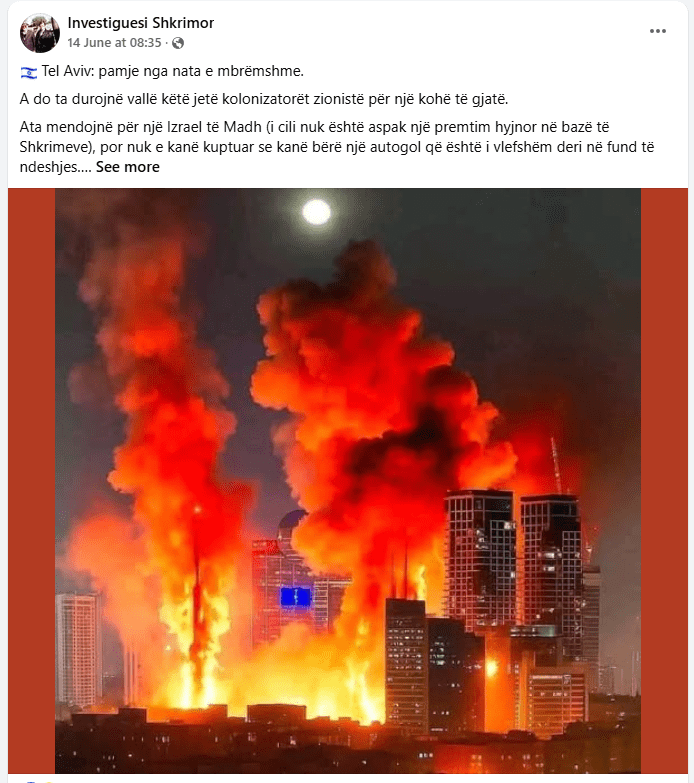
On Saturday, June 14, the Facebook account "Investiguesi Shkrimor" published an image where traces of an explosion and fire appear among tall buildings, accompanied by the description: "Tel Aviv: view from last night."
What did hibrid.info find?
After verifying the facts, hibrid.info confirmed that the image is not authentic, but was generated with the help of artificial intelligence.
During a reverse search of the image published by the account "Investiguesi Shkrimor", it was found that no reliable source had distributed or reported this image.
This image has been widely shared by a number of social media pages and accounts, which are not considered reliable or professional sources of information. (here)
The image was then analyzed through the online platform's artificial intelligence-generated content detector. illuminartyAccording to the tool's assessment, with a probability of 88.3%, the image "is likely to contain elements created by artificial intelligence or to be fake content." This result reinforces doubts about the authenticity of the image and suggests that it has been manipulated or artificially produced for the purpose of disinformation.

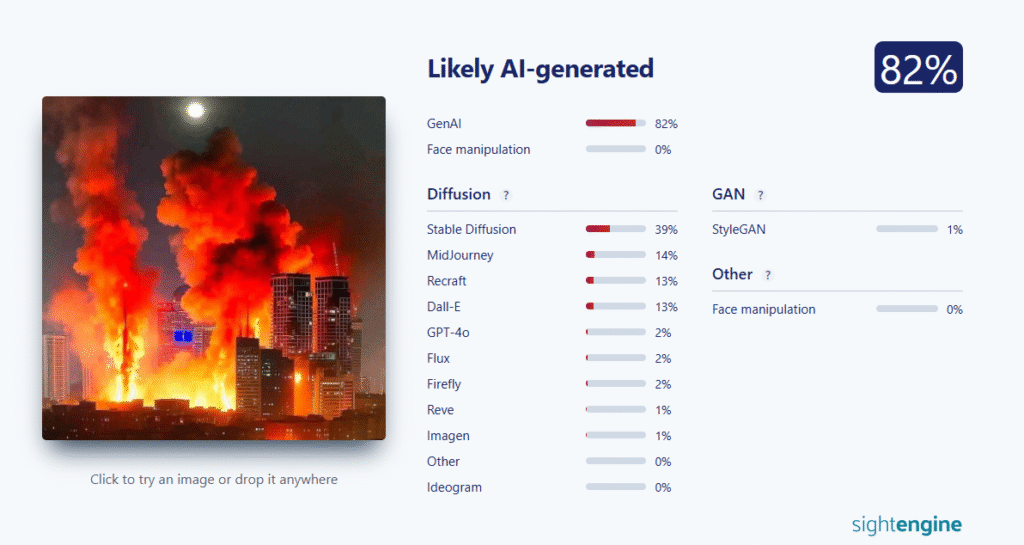
The image was also analyzed through another specialized platform for verifying content created with artificial intelligence.sightengine.com”, which estimated with a probability of 82% that the image was generated by artificial intelligence. This assessment further reinforces doubts about the inauthentic origin of the image.
Analyze:
On June 14, the Facebook account "Investiguesi Shkrimor" published an image showing traces of an explosion and fire among tall buildings, claiming it was a scene from the previous night in Tel Aviv.
However, after a fact-checking process, hibrid.info concluded that the image is not real, but was created through artificial intelligence tools.
Based on its work methodology, hibrid.info classifies this image as a "fraud".
Reasoning:
The “Deception” rating is given to informational content that is manipulated in terms of visual (deepfake, cheapfake), audio, or textual content to deceive the audience. This form of deception is usually used to produce false and manipulated content.