

An analysis of the fact-checking network EDMO. Organizations that contributed to this analysis: PagellaPolitica/Facta, Delfi, Eesti Päevaleht, Proveri-AFP, Re:Baltica
Disinformation related to Ukraine is spreading in the EU in many different languages, including Russian. In some EU countries there are large Russian communities or a large part of the population understands Russian. As we will see, the main disinformation narratives in Russian are, surprisingly, in essence very similar to those in other European languages. But, according to an investigation by the EDMO fact-checking network, there are some specificities and elements that are worth highlighting.
Main disinformation narratives uncovered in the EU
Since February 24, when Russia invaded Ukraine, a massive volume of disinformation about the war began to circulate across the EU, spreading in different languages and in different countries. Two months later, EDMO’s fact-checking network was able to isolate seven main disinformation narratives conveyed by the fake news, images and videos it uncovered.
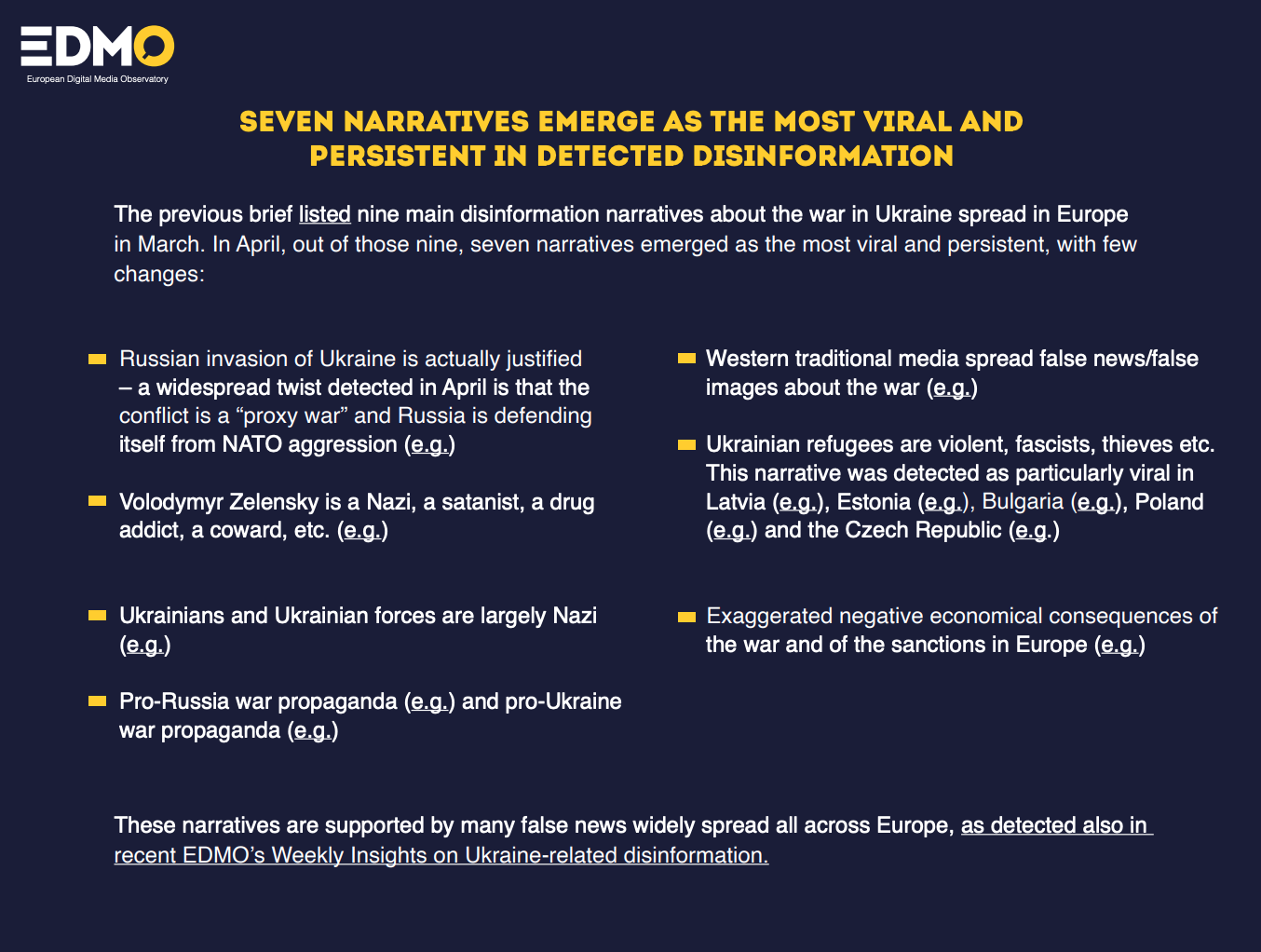
During the analysis, we noticed that in some EU countries disinformation was circulating not only in national languages, but also in Russian. This prompted us to investigate what kind of disinformation is circulating among Russian-speaking communities and whether it differs from or resembles that prevalent in European languages across the EU.
To analyze disinformation in Russian, we focused on the three Baltic EU member states (Estonia, Latvia, and Lithuania) where large Russian communities live, and on Bulgaria, where a significant portion of the population understands Russian.
We asked four different fact-checking organizations – AFP in Bulgaria, Delfi in Lithuania, Eesti Päevaleht in Estonia and Re:Baltica in Latvia – and a Bulgarian journalist, Ruslana Margova, an expert in the fight against disinformation at the GATE Institute for Big Data at Sofia University “St. Kliment Ohridski”. Here’s what we found.
The stories are almost the same
In the four monitored countries, all disinformation narratives previously isolated by EDMO’s fact-checking network were spread in both national languages and Russian. As expected, the only partial exception is pro-Ukrainian war propaganda.
This alignment is not surprising, given that the main pro-Russian disinformation narratives emanate directly from the Russian government, mass media, and propaganda apparatus. For example, Foreign Minister Sergei Lavrov spoke of Nazi sympathies in Ukraine and claimed that the massacres in Bucha were staged, while Maria Zakharova, a Russian press worker, wrote that Russia did not start the war, but rather ended it, intervening to stop an 8-year genocide in the Donbass region.
A specific story for the Russian-speaking public
The most obvious difference between the disinformation stories spread in EU languages and those spread in Russian, according to reports from various fact-checking organizations and experts who contributed to this investigation, is that in the latter case we have an original set of fake news, which specifically aims to exaggerate the support shown by foreign communities for Russia's actions.
For example, in May the Latvian Re:Baltica uncovered two examples of fake news in Russian, one that exaggerated support for the Russian invasion of Ukraine in the Arab world and another that exaggerated support worldwide (e.g. old videos of protests in Italy against the “green pass” were presented as pro-Russian demonstrations).
In Lithuania, an old video has been used to spread the fake news that Ukrainians in Odessa were demonstrating in support of Russia's continued occupation. A video in which a German journalist living in Russia spreads disinformation – first about the pandemic, now about the war in Ukraine.
In Bulgaria, a Facebook post claimed that there was a Bulgarian flag in Moscow’s Red Square during the May 9 celebrations, with the caption “Words are unnecessary.” But it’s false: it’s actually the flag of the Suvorov Order, a Soviet blue ribbon.
Interesting elements at the national level
Estonia
In Estonia, a significant amount of Russian-language disinformation stemmed directly from Russian embassy statements about Ukraine committing genocide in Donbass, or about secret US laboratories in Ukraine, or about the Bucha massacre being staged.
A disinformation narrative aimed at exaggerating Russophobic sentiment in the EU – which was detected in Europe in March but progressively faded, overall, over the following weeks – was reported as particularly prominent in Estonia, where various Russian sources alleged ongoing persecution – or even genocide – taking place against the Russian minority in the country.
The disinformation narrative targeting Ukrainian refugees – claiming that they are violent and steal resources from the EU population – is particularly relevant in Estonia. Martin Laine, journalist and fact-checker for Eesti Päevaleht, explains: “Already before the war, Estonia had a somewhat sizeable Ukrainian community. Estonian wages are among the highest in Eastern Europe, and this has created an influx of Ukrainian migrant workers living here. This has also meant that many Ukrainian refugees could connect with their families in Estonia, making us a more desirable destination for them compared to other Baltic states. Statistically, Estonia’s assistance in hosting refugees has been notable. For Russian activists and propaganda, this has been fertile ground for disinformation campaigns and incitement to conflict.”
But it's not just Russian propaganda that's spreading fake news about migrants. "Unfortunately, far-right populist political forces have also taken the bait, so these narratives are not only spread by pro-Russian activists, but also in politics.
Latvia
In Latvia, the most prominent Russian-language disinformation stories claim that the war is actually justified, exaggerate the negative economic consequences of the war, and focus on refugees. On the other hand, narratives accusing Zelensky and the Ukrainian population of Nazi sympathies are not very popular.
Evita Purina, a journalist and fact-checker at Re:Baltica, says that fake news about refugees represented “the main propaganda narrative in March and early April.” “One of the main sources is TikTok videos posted by random people living in Latvia, Poland, Moldova, etc.,” Purina says. “The anonymous TikTok videos are then republished in Russian state media materials as evidence. For example, the Russian news agency Ria Novosti published a story titled “Citizens of different countries outraged by the behavior of Ukrainian refugees,” which in turn was republished by several other media outlets on various platforms. Ukrainian refugees are also being attacked from other sides, with fake news claiming that they are not real refugees, or that they are actually rich and therefore do not need help.
In terms of exaggerating the negative economic consequences of the war and sanctions, one of the main narratives – created and spread by Russian and Latvian channels in Russian – presents Latvia as dependent on Russia as a large neighbor (with inaccurate data) and thus claims that it would be better for the country to focus on its own population instead of helping Ukraine.
A final interesting element of the situation in Latvia, highlighted by Purina, relates to the evolution of various disinformation channels, which shifted from spreading fake news related to the pandemic to fake news related to Ukraine. While this is a common phenomenon in the EU, in Latvia the shift caused disinformation spreaders to lose followers, and as a result their audience today “is not as large as it was during the pandemic,” Purina explains. “Russia is very familiar to Latvians, so it is not easy to poison people’s minds with war propaganda and lies. The main disseminators of disinformation are others, such as Russian media and random local and Russian pro-Kremlin bloggers. The vast majority of disinformation is spread in Russian.”
Lithuania
In Lithuania, the Russian-language disinformation narrative about Ukrainian refugees is reported to be less prominent than in Estonia and Latvia. On the other hand, the narrative about the negative consequences of the war and sanctions on the economy seems quite strong and targets both the European economy as a whole and the Lithuanian economy in particular.
A defining feature of Russian-language disinformation about the economic situation in Lithuania – highlighted by Aiste Meidute, a journalist and fact-checker at Delfi – is a line of fake news spread by Belarusian state television, which creates an entire narrative about Lithuanians buying goods mostly from Belarus and about Lithuania’s desperate need to import goods from Belarus. These claims are unfounded, and the actual impact of a possible full ban on Russian and Belarusian goods exports to Lithuania is estimated to be minimal.
Bulgaria
In Bulgaria, disinformation in Russian is a widespread phenomenon. “Since both Bulgarian and Russian are Slavic languages, and the two countries have historically had close relations, it is much easier for Russian disinformation to reach Bulgarian audiences than in Western Europe,” explains Rossen Bossev, a journalist and fact-checker for AFP-Proveri (the Bulgarian bureau of AFP).
In general, in Bulgaria all narratives discovered in EU languages have also been discovered in Russian (with the usual and obvious exception of pro-Ukrainian war propaganda).
“In general, Bulgarians can be informed through Telegram, Yandex and other channels about the events in Ukraine and Russia, in the Russian language,” says Ruslana Margova. “Meanwhile, there are several major Bulgarian newspapers and online media that inform Bulgarians about the official position of the Kremlin.
This massive exposure of Bulgarian public opinion to Russian propaganda may be one of the reasons why a recent Eurobarometer survey found in Bulgaria the lowest approval ratings of all European countries for the EU sending military aid to Ukraine, and the second (after Cyprus) highest percentage of people who disagree that the war is primarily Russia's responsibility.
In a previous investigation into disinformation related to Covid-19, we have already reported how Bulgaria is one of the EU countries with the most favorable environment for the spread of fake news.
Conclusions
Since the beginning of the war in Ukraine, pro-Russian disinformation and propaganda have been circulating significantly in the EU. So far, we have focused mainly on disinformation spread in EU languages, but in this investigation we