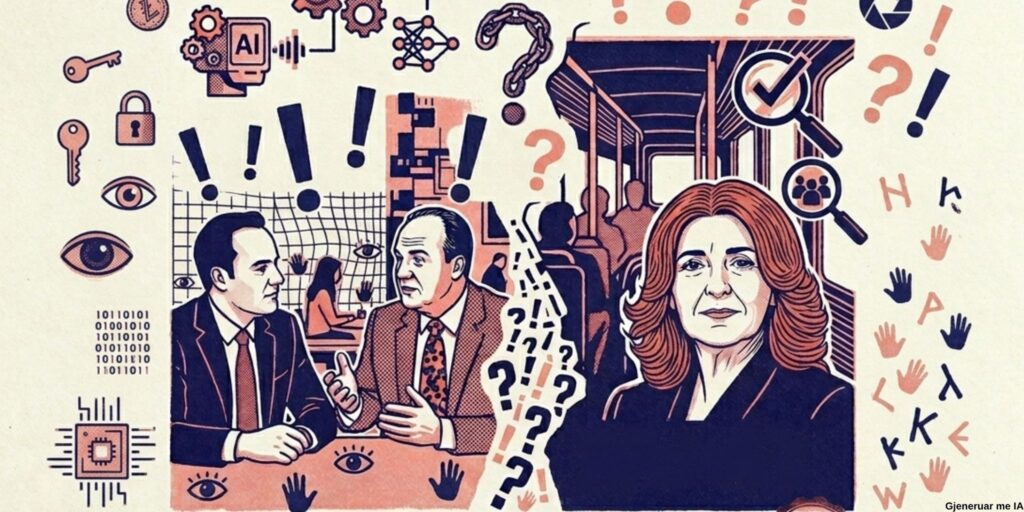

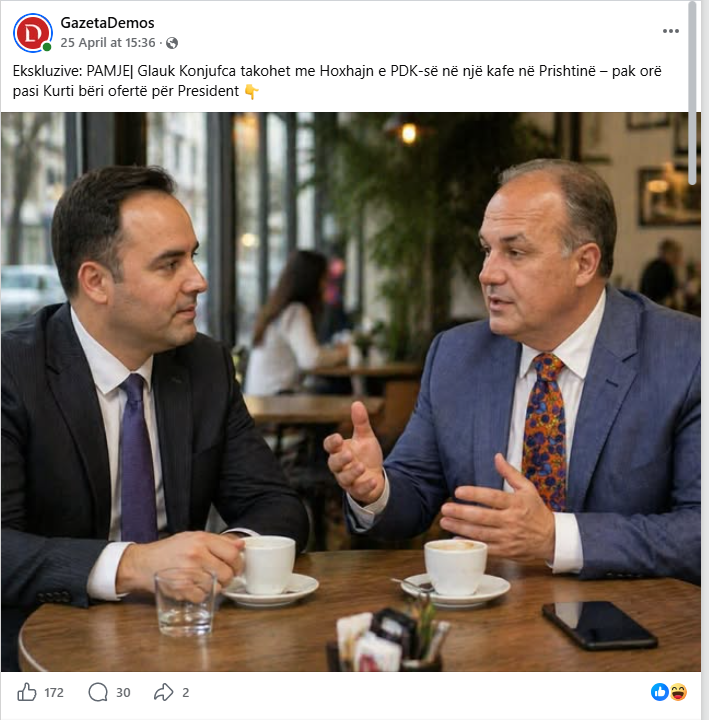
The use of artificial intelligence (AI)-generated images in media reporting is raising serious questions about transparency and journalistic ethics. One such case was highlighted in an article published on April 25. from the newspaper Demos, entitled: "Exclusive: VIEW | Glauk Konjufca meets with PDK's Enver Hoxhaj in a cafe in Pristina, a few hours after Kurti made a bid for President".
The cover of this article uses a photo of Konjufca and Hoxhaj drinking coffee, which turns out to be generated with artificial intelligence. Although the image is labeled as an “illustrative photo” within the article, the way it is presented on social networks, especially on “Facebook”, creates the impression that it is an authentic and exclusive image. from the real meeting, that is, from the scene of the incident.
This discrepancy between formal labeling and visual presentation to the public can be considered problematic, as it exploits audience trust to increase interest and clicks, risking misinformation.
In the same article, upon clicking, another photo appears that claims to be from the aforementioned meeting, while the first image, the AI-generated one, remains as the main view on the front page. This selective use of visual content reinforces the wrong perception among readers who do not open the article to verify it further.
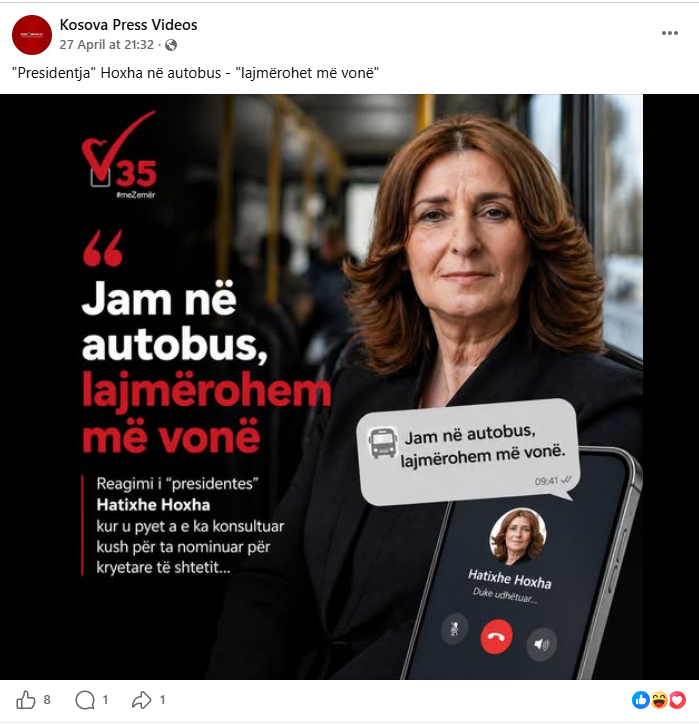
A similar case was also observed in a publication of KosovaPress on April 27, with the title: "President Hoxha on the bus – 'to be announced later'”. In this case, a photograph of Hatixhe Hoxha was used as an illustrative image, with the interior of a bus in the background. Although as an illustration, the use of a real figure in such a context can create confusion and create the perception of a real photograph from the scene.
Ethical dilemmas and international media guidelines
According to Kosovo Press Council (KPMC), the use of artificial intelligence in the media is permitted, but requires clear transparency and full editorial responsibility. Even when an image is labeled as “illustrative”, it should not create the impression of a real event, as the information must be not only formal, but also understandable to the public, in order to avoid misinterpretation.
In cases where AI-generated images are used to depict actual events, simulating reality, this conflicts with ethical principles of non-deception and accuracy. The KMShK emphasizes that responsibility for content remains with the media and any use that could lead to visual misinformation is considered problematic practice, regardless of whether it is technically marked as an illustration.
International guidelines for the use of AI in journalism, drawn up by media outlets such as the BBC, Reuters, The New York Times and Reporters Without Borders, converge on a few basic ethical principles: transparency, human responsibility and content verification. Essentially, they emphasize that AI should only be used as an aid and not a replacement for journalism, while any generated content should be overseen by editors and accompanied by clear explanations for the public.
A special emphasis is placed on the use of generated images: most guidelines (such as USA Today or Agencia EFE) prohibit their use to illustrate current news or require very clear labeling to avoid confusion with reality. The general principle is that any use of AI that could mislead the public, distort facts or create false impressions of real events is considered an ethical violation, putting the journalist's role as guarantor of the truth back at the center.
International media guidelines regarding the use of artificial intelligence-generated images show a clear stance: they should not be used in a way that confuses them with reality.
Gazeta USA Today stresses that “synthetic images should never be used to illustrate breaking news” and that they “should be clearly labeled to avoid any suspicion that they depict real events.”
Along the same lines, Heidi News emphasizes that it will not publish synthetic images "that could be confused with real photographs."
Meanwhile, EFE Agency takes an even more emphatic stance, stating that it “will not use AI-generated images to illustrate current news.” According to this guideline, these images are only allowed in specific cases, such as illustrating discoveries that cannot be photographed – for example, the reconstruction of an animal from fossils or views of space from inaccessible places. In any case, “their nature must be clearly and unambiguously indicated in the description or accompanying text of the video.”
As well, El País warns that any use of AI "that could be confused with reality, deceive or spread disinformation" should be avoided. BBC requires that the use of AI “does not distort the meaning of the information” and that the public be clearly informed about how and why it is being used. Meanwhile, Reporters Without Borders stresses that the media should assist the public with clear labeling and restrictions to avoid confusion with real events, while The Guardian establishes as a principle transparency and use only in the public interest. Essentially, these standards consider any use of AI images that creates an illusion of reality as a serious ethical problem and a risk of misinformation.
Photography as a source of information
In the basic literature of journalism, photography is clearly treated as a source of information and an essential element of the news, not simply as a visual illustration. For example, in the book “The Elements of Journalism" by Bill Kovach and Tom Rosenstiel emphasizes the principle that journalism has an obligation to "tell the truth" and verify information, which also includes visual materials such as photographs, which are considered part of the informational evidence presented to the public.
Another reference for the role of photography is the book “Photojournalism: The Professionals' Approach" by Kenneth Kobre, which emphasizes that photography in journalism "is not just illustration, but a form of reporting that transmits information and documents reality." So, in the basics of journalism, photography is considered visual evidence that contributes to the construction of the news and its credibility.