

A content is published with the caption "The US hits Serbia very hard: They approve the draft law against discrimination against Albanians in Serbia".
This content was published on Sunday (August 16) on Facebook, by a page called "Interesting".
What is the truth?
The article does not say that the US has finally approved the bill in question.

The page that published the claim has over 90 followers, while the post in question has received over 80 reactions and comments, indicating that there is a possibility that users perceive the event as credible.
The content also has an article with the same title, published on the domain “infofirst.net” (see here).
The introduction to the article reads: "The US Congressional Foreign Affairs Committee has voted to advance a bill requiring the Secretary of State to prepare a comprehensive report on the treatment of Albanians in the Presevo Valley by Serbian authorities..
Hibrid.info has checked through the search engine "Google", using as keywords, the entry of this text (see here).
The results showed several articles reporting that a bill for the protection and respect of the rights of Albanians in the Presevo Valley was approved in January 2026, in the Foreign Affairs Committee of the US Congress (see here, here and here).
Hibrid.info researched the stages of passing a law in the United States of America (USA). The US Congress website shows that a bill in the US goes through several stages of the legislative process: first it is introduced by a member of Congress and referred to the relevant committee for review and amendments. After that, it is debated and voted on in the House of Representatives or the Senate, depending on the chamber where it was introduced, and finally it is sent to the President for signature or veto (see here).
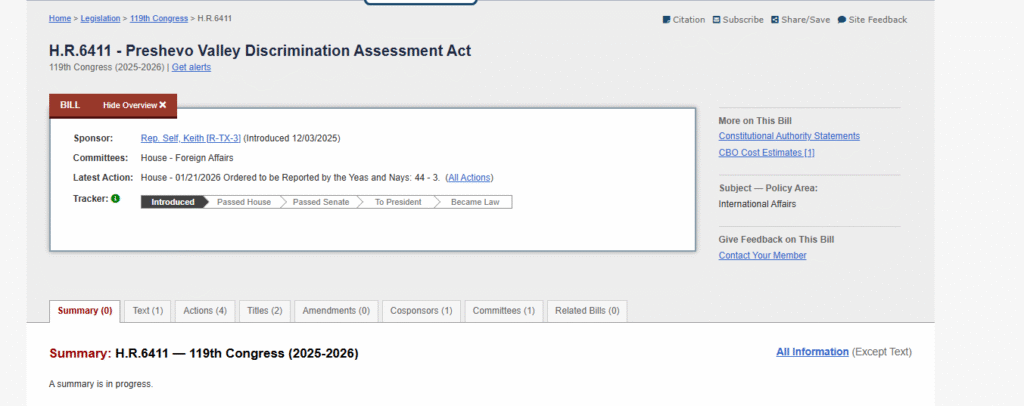
Hibrid.info also found the draft law in question. From public data it was learned that the draft law in question is in the presentation/passage phase in the House of Representatives. Which means that it has not yet passed and has not become law (see here).
Given the fact that the bill has not yet been approved in the House of Representatives or the Senate, it cannot be considered approved.
What does this draft law foresee?
The draft, known as the “Preshevo Valley Discrimination Assessment Act,” requires the US Secretary of State to prepare and submit an official report to Congress on the treatment of ethnic minorities in Serbia, with particular emphasis on Albanians in the Preshevo Valley.
The document requests that the Secretary of State investigate and assess a number of key issues affecting Albanians in the Presevo Valley.
This includes the practice of address passivation and its impact on the right to personal documents and voting, as well as the lack of proportional integration of Albanians in the administration and state institutions. The report should also address the non-recognition of Kosovo diplomas, obstacles to the provision of textbooks in the Albanian language, restrictions on the use of this language in documents and institutions, and the suppression of ethnic symbols.
Furthermore, it is required to analyze the unequal distribution of funds for municipalities with an Albanian majority, the use of law enforcement for intimidation, support for local media, review of mandatory military service for Albanians, and measures that affect the increase in poverty in the region.
The report must be submitted to the Senate and House Foreign Affairs Committees within 180 days of the act's passage.
Analyze:
The content that claims that "US hits Serbia very hard: Approves draft law against discrimination against Albanians in Serbia" does not clearly present the stage in which the draft law in question is.
The article reports that the US Congress's Foreign Affairs Committee has voted to advance the bill, which requires the preparation of a report on the treatment of Albanians in the Presevo Valley by Serbian authorities.
However, the bill has not yet been approved by the US House of Representatives and Senate, so it cannot be considered approved by the US Congress.
Therefore, based on the working methodology, hibrid.info assesses the content as "Manipulation of facts".
Reasoning:
“Factual manipulation” is a rating given to informational content that uses facts known to be accurate but interprets them in a distorted manner. These reports typically use accurate information to draw incorrect conclusions or claims, thereby misleading consumers of media content about the actual meaning of the facts presented.