
Wrote: Festim Rizanaj
Two MEPs have nominated the students from Serbia, who are leading the protests, for the Sakharov Prize - the highest award the European Union gives to defenders of freedom of thought and human rights.
MEP Irena Joveva announced on August 18 on the social network X, along with her colleague Helmut Brandšteter, have nominated the students participating in the Serbian protests for this prestigious award, emphasizing that they "represent the true spirit of the Sakharov Prize."
How was this nomination reported in the Serbian media?
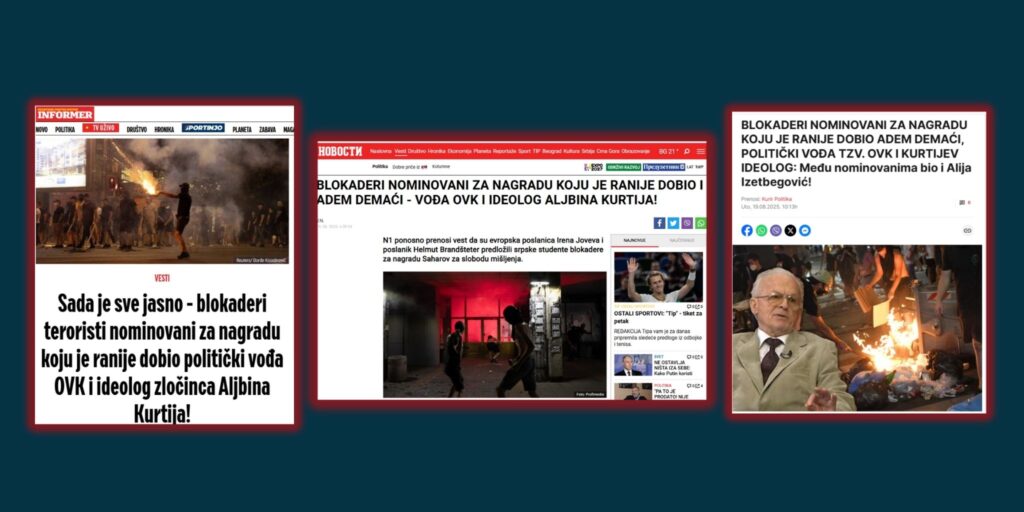
However, the news of this nomination was reflected differently in some Serbian media, which accompanied the reporting with a delegitimizing narrative through guilt by association. Through the mention of Adem Demaçi, former Albanian political prisoner and winner of the Sakharov Prize in 1991 for freedom of thought and defender of human rights and freedoms (here), these media outlets try to present the award as compromised and linked to figures described as "terrorists".
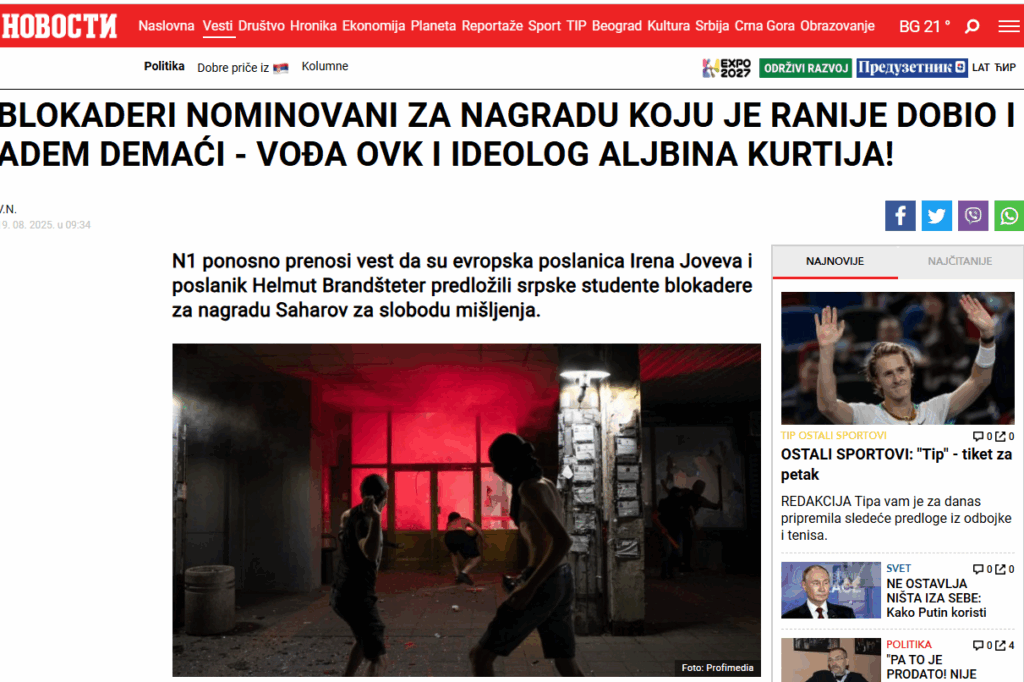
News (August 19) published the headline: “BLOCKADER NOMINATED FOR THE AWARD THAT ADEM DEMAĆI – KLA LEADER AND IDEOLOGIST OF ALBIN KURTI – RECEIVED BEFORE!” (Blockaders nominated for the award that Adem Demaçi – KLA leader and Albin Kurti’s ideologue previously received), describing Demaç as an “ideologist of violence” and “Kurti’s political father.” (here)
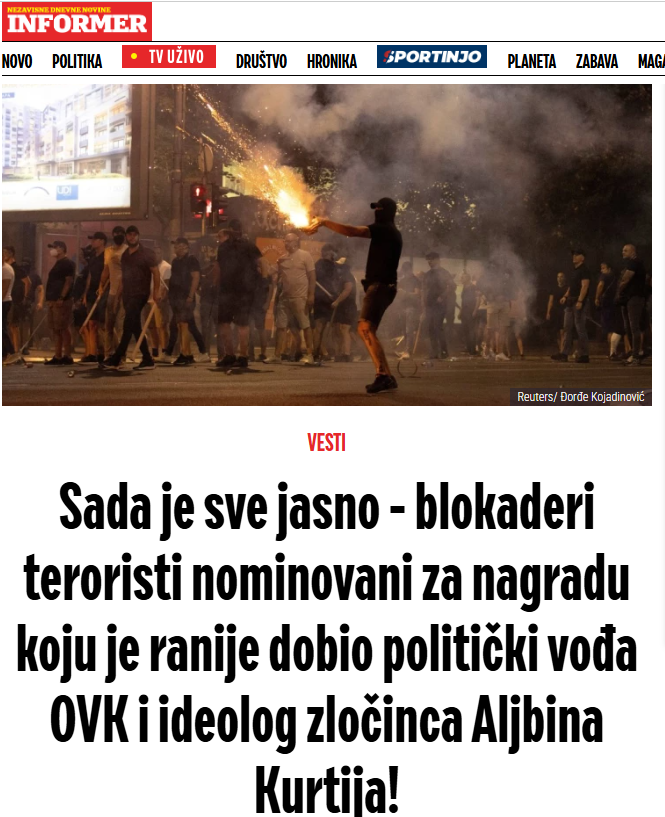
Inform (August 19) wrote: “Now everything is clear – the terrorist blockers nominated for the award previously received by the political leader of the KLA and the ideologist of the criminal Albin Kurti!”. The text presents the protesters as “violent blockaders” who are “terrorizing the citizens of Serbia” and are directly linked to the “crimes of the KLA” and the current Prime Minister of Kosovo. (here)
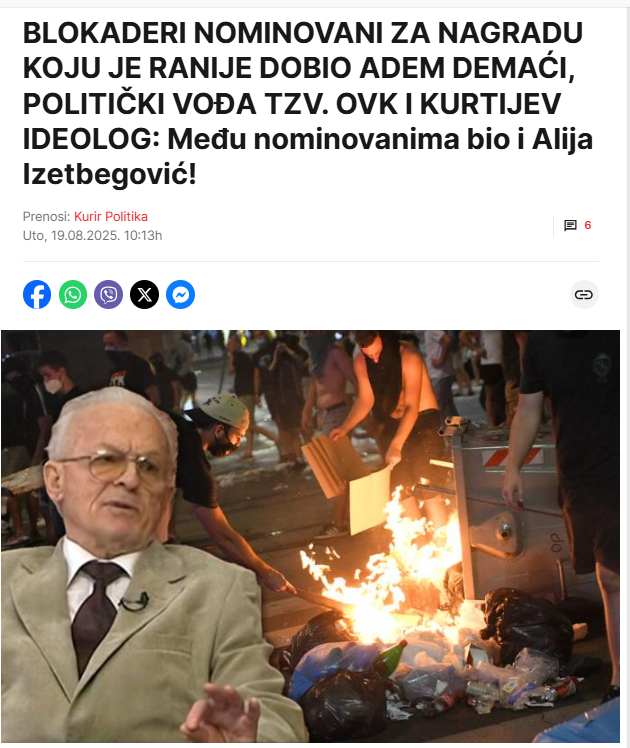
Courier (August 19) reported: “BLOCKERS NOMINATED FOR THE AWARD THAT WAS PREVIOUSLY RECEIVED BY ADEM DEMAĆI, POLITICAL LEADER OF THE SO-CALLED KLA AND KURTI'S IDEOLOGY: Among the nominees was Alija Izetbegović!”, expanding the narrative to include other historical figures such as Izetbegović, presented as a “war criminal” and “Islamist.” (here)
From a theoretical point of view, "guilt by association" works through three main steps (here):
- Identifying a stigmatized figure (e.g., Adem Demaçi as “KLA ideologist”).
- The connection of the current figure to this precedent (Albin Kurti as "Demaçi's successor").
- Spreading stigmatization to a wider group (current protesters in Serbia as "terrorists" following their legacy).
In all these cases, the mechanism of blame through nexus is evident: today’s protesters are presented not as students articulating democratic discontent, but as “followers of a violent Albanian line”, previously represented by Adem Demaçi, the Kosovo Liberation Army and Albin Kurti. Thus, every act of protest in Serbia is inserted into a discursive framework where it is described as an internal threat, instigated by “external enemies”.
This discourse works by shifting attention from the real reasons for the protests to an emotionally charged and historically charged narrative. Instead of a debate on the students’ demands, the public is offered a simplistic and polarizing version: the protests are not an expression of social discontent, but a continuation of an “anti-Serb and terrorist” tradition.
In this way, the Sakharov Prize – intended as a symbol of freedom of thought – is presented to Serbian public opinion not as recognition of civic resistance, but as evidence of the bias of European institutions, which, according to this discourse, “support the enemies of Serbia”.
What is "guilt by association"?
One of the most used techniques in political and media discourse, especially in polarized contexts, is what is known as "guilty by association" – blame through association. This strategy consists of building a narrative where an individual, group, or idea is associated with stigmatized figures or events, in order for them to also be perceived as dangerous, illegal, or undesirable.
Blame by association is not only a rhetorical technique, but also a powerful political instrument. It aims to close the space for rational debate, replacing it with emotional associations, where every new actor is seen as part of a hostile and criminalized chain. In this way, the legitimacy of individuals, international awards, and democratic institutions themselves is called into question through a single figure who serves as a bridge of discredit.