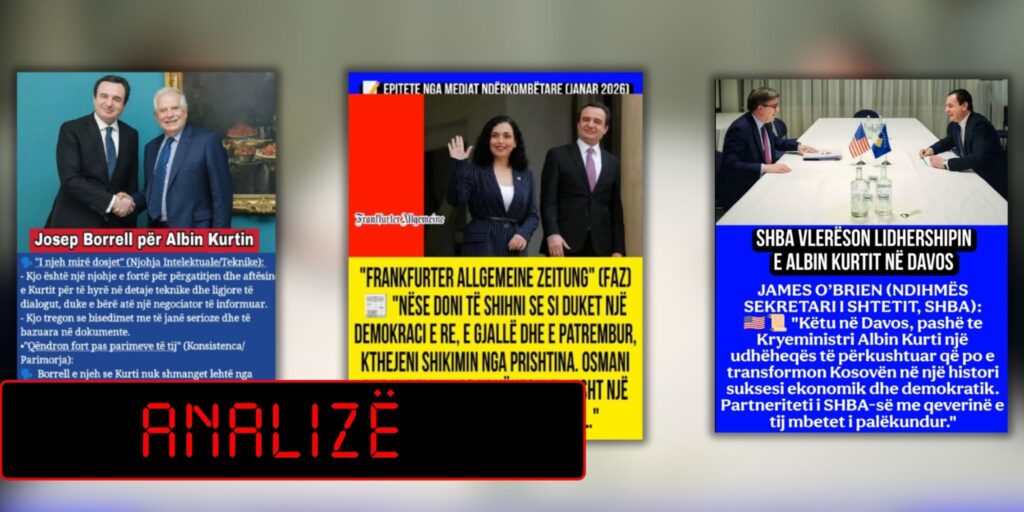

Prepared by: Etrit Rexhepi
During the election campaign for the early parliamentary elections of December 28, 2025, content was often found in which various political personalities were attributed with various unspoken statements about politicians in Kosovo. Hibrid.info had noticed this phenomenon and through an article advised the audience to be careful and verify the facts before believing such content (see here).
Since the publication of the article, hibrid.info has dealt with several other similar publications, where it is claimed that statements by various personalities in favor of politicians in Kosovo were made. The British journalist, Richard Quest, who comments on the results of the early elections in Kosovo, another who claims that the British Prime Minister, Keir Starmer, has congratulated and described the acting Prime Minister Albin Kurti as a "world-class leader", the American Embassy that has praised the Kurti Government for the situation in the north and former President George Bush who declares about Hashim Thaçi and his judicial process in The Hague. These are some of the contents treated and assessed as "Fake News", based on the methodology used by hibrid.info (see here, here, here and here).
Even after these treatments, such content continues to be published on social media (Facebook and TikTok). Hibrid.info has encountered some of them (see here, here, here, here, here, here and here).
What is fake news?
The “Fake News” rating is given to informational content that is completely fabricated or that contains factually incorrect claims or information. Content that is rated as fake news can be defined as having been created and distributed with the intent to misinform the public, i.e., to present a claim that is completely false as fact.
Why does fake news seem real to us?
In the book "The psychology of fake news", published by Rainer Greifeneder, Mariela Jaffe, Eryn Newman and Norbert Schwarz, writes that fake news seems real to us. It also explains the reasons why this happens.
The book shows that when consuming false content, intuition takes precedence over facts. According to the book, we rarely analyze information with scientific accuracy. Instead, we use “cognitive fluency,” which means that if a message is easily processed by the brain, it “feels” accurate.
The book also lists five criteria for intuitive "accuracy":
- Compatibility: Does it fit with my beliefs?
- Coherence: Does it sound like a logical story?
- Credibility: Does the source seem familiar (even if it's just a catchy name)?
- Consensus: Do others like and share it?
- Evidence: Can I easily think of an example of this?
Another reason is the power of repetition. A repeated fake news story becomes “familiar.” The brain confuses familiarity with truth. This happens even when we know the information is false, but it just “feels” like there’s something true about it.
It is also emphasized within this publication that social media is designed to increase the sense of authenticity as messages are short, come from friends, and are repeated endlessly.
Finally, there is the danger that when we correct a fake news story by repeating it, we inadvertently make it more familiar. Over time, people forget the correction and only remember the lie that now seems “heard” to them.
Characteristics of these contents
These contents contain highly evaluative statements (about Kurti, Osmani, and Thaçi) but without links, exact dates, context, or verifiable official references.
The images have names of institutions, media outlets, or well-known personalities that are used as authorities, to create credibility, without proof that the statements are real.
The photos can be real or archival, but the text is added later, which can make the content more visually compelling, even when the message is untrue.
Also, it is not clarified when, where, and under what circumstances the meeting or statement was made, which allows an old or neutral photo to be used for current narratives.
Typically, this content is published by social media accounts and pages (not the media). Such posts generate a large number of likes and comments, and the content is perceived as authentic by the audience.



What this means is that it can be concluded that the publication of these contents is not random. They are constructed in such a way as to align with the audience's existing beliefs, using the authority of well-known figures or institutions, to thus activate intuitive mechanisms of credibility.
The lack of verifiable sources, time context, and official references, combined with the use of images and text, makes this type of content easy to process and perceive as true. Furthermore, their publication on social media, where messages are repeated and shared by non-media accounts, increases the sense of familiarity and consensus, further reinforcing the perception of accuracy.
As a result, this content can be published with the aim of influencing public perception, creating favorable narratives for certain political figures, and exploiting the way intuitive information processing works in the digital environment, especially during politically sensitive periods.
Faced with the continuous spread of this content, it becomes imperative that the audience show increased caution when consuming information on social media and not accept as facts statements that lack verifiable sources and that do not have a clear context. Only through verification of information and the development of critical thinking can the impact of these false narratives on public opinion be reduced.