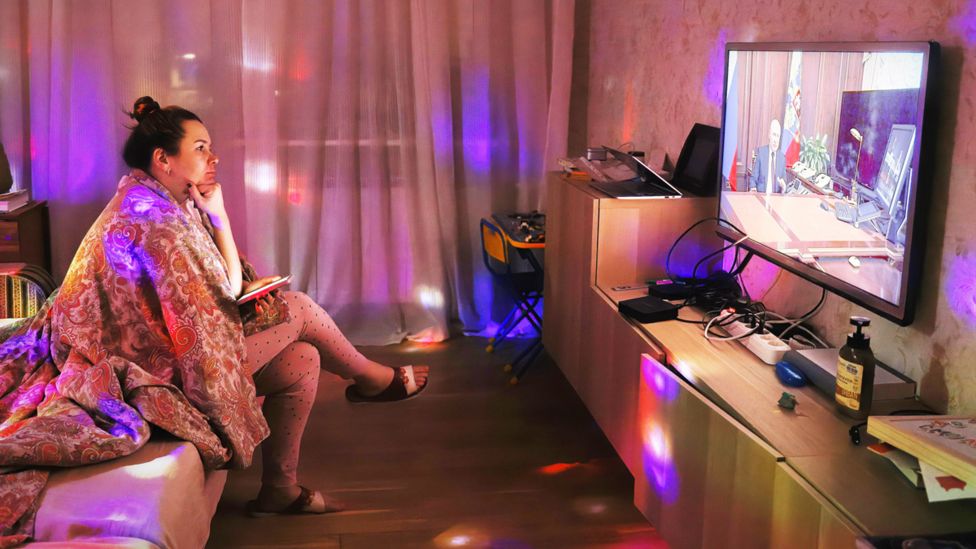

There has never been a better illustration of the alternative reality presented by Russian state media than at 17:00 GMT on Tuesday. As BBC World TV opened its bulletin with reports of a Russian attack on a television tower in the capital Kiev, Russian TV was announcing that Ukraine was responsible for attacks on its own cities.
So what are Russian viewers seeing about the war? What messages are they hearing on the airwaves? Below is a snapshot of what ordinary Russians would have received, on Tuesday, March 1, as they were channeled through the country's main television stations, which are controlled by the Kremlin and its corporate allies.
Short gray introductory line
Good morning, on state-controlled Channel One, one of Russia's most popular channels. To the casual observer, it's no different from the morning broadcast found in many other countries, with its mix of news, culture and light entertainment.
On Tuesday, the normal schedule is interrupted at 05:30 Moscow time [02:30 GMT]. The presenters announce that the television schedule has been changed “due to well-known events”, and there will be more news and current affairs. The news bulletin suggests that reports of Ukrainian forces destroying Russian military equipment are false, designed to “deceive inexperienced viewers”.
"Images that cannot be described as anything other than fake continue to circulate on the internet," explains the presenter, as viewers are shown photos of what are described as "unsophisticated virtual manipulations."
Later in the morning, at 08:00 Moscow time, the morning bulletin begins on the NTV television channel, which is owned by a subsidiary of Gazprom, a Kremlin-controlled firm. It focuses almost exclusively on events in Donbas, the region in eastern Ukraine, where on February 24, Russia declared that it was launching its “special military operation” to demilitarize and denazify Ukraine.
There is no mention of any reports of a long military column making its way from Belarus north to the Ukrainian capital Kiev.
"We start with the latest news from Donbass. LNR [Luhansk People's Republic] fighters continue their offensive, having advanced 3 km, while DNR [Donetsk People's Republic] units have advanced 16 km," says the NTV presenter.
The presenter is referring to the Moscow-backed rebels who have controlled the so-called Donetsk and Luhansk People's Republics since Russia's intervention in eastern Ukraine eight years ago.
The full article in BBC