
Wrote: Festim Rizanaj
As the early parliamentary elections on December 28, 2025 approach, a worrying increase in artificial intelligence-generated videos and images containing manipulated political narratives has been observed. This phenomenon is not simply an isolated case of misinformation; it demonstrates the use of advanced technology to influence the perceptions and political decisions of citizens and the diaspora.
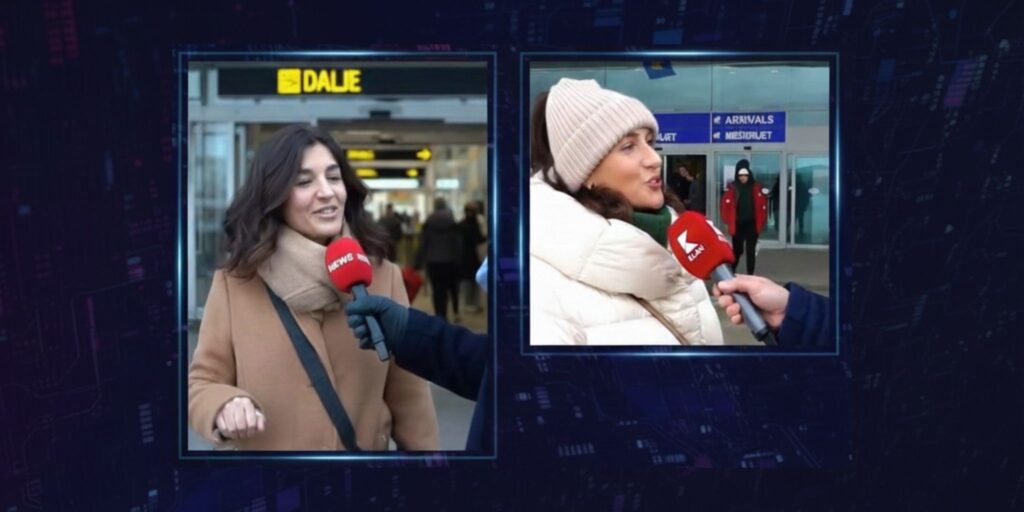
These videos and images include diaspora citizens presented in a public location, such as Prishtina Airport, where they are interviewed about their participation in the elections. Their content aims to create the impression that diaspora citizens will be active in the electoral process and will support a particular candidate, suggesting massive diaspora support and strong political support. In some cases, the videos and images also contain more specific claims, for example: it is also alleged that a political leader had a meeting with a member of parliament from another party immediately after a parliamentary session where another candidate for prime minister was voted against. These claims, like the statements made in the diaspora interviews, do not reflect the real situation and are created with the intention of manipulating public perception.
Analysis by specialized verification platforms showed that the videos and images contain typical deepfake distortions: facial expressions are unnatural, texts are often distorted, the voice is robotic, and the visual coherence of the scenes is not consistent. These indicators make it clear that the content has been manipulated with artificial intelligence and does not reflect reality.


The high level of engagement with this content – thousands of views, hundreds of comments and shares – shows that a portion of the audience takes it as truth, increasing its impact on public perception. This effect is not simply an indicator of popularity; it shows that manipulated content can create a broad sense of social support and influence political attitudes and decisions.
This content is also not verified by groups of individuals who consider it politically or ideologically appropriate, and at the same time provokes reactions from the rest of the public, further deepening political polarization.
The publication of these videos and images on platforms like Facebook and TikTok, where algorithms favor rapid and massive distribution of content, shows that this phenomenon has great capacity for amplification and impact on diverse audiences, including younger users and the diaspora.
As a phenomenon, the use of artificial intelligence to create videos and images with political narratives shows that technology can be used for manipulation on a large scale. These contents are not only tools to spread false messages, but also instruments to influence public perceptions and opinion. The phenomenon highlights the need for increased public awareness, the use of content verification tools, and increased accountability of social platforms for the content they amplify.
Although they appear real, the videos and images do not reflect the factual situation and are classified as artificial intelligence-generated content. This phenomenon is a clear warning of the risk that artificial content generation technologies pose to democratic processes and a call for greater public and media awareness to identify and avoid disinformation.
This phenomenon highlights the importance of using AI responsibly in journalism and fact-checking. AI can be used as an auxiliary tool to improve the language and clarity of articles, summarize long documents, assist in organizing text and its layouts, create drafts for graphics or content for social networks, as well as for data analysis or identifying trends in information. AI can also be used to transcribe interviews, debates and conferences, as well as to translate content into different languages, making information more accessible to different audiences.
However, any AI-generated content must be reviewed and approved by editorial staff to ensure that the information is correct, accurate and verified. The use of AI should not replace human editorial judgment; any apparent influence of AI on the formulation, analysis or delivery of content should be clearly disclosed to the audience. Furthermore, any audiovisual content created with AI should be clearly labeled, using visible text or a watermark, so that the consumer has the opportunity to understand that part of the material has been artificially produced.
An important part of using AI in journalism and fact-checking is the verification of visual, audiovisual and textual content to prevent the spread of misinformation. For images, tools such as Google Lens, TinEye, Bing Visual Search, FotoForensics, HuggingFace AI Image Detector, JpegSnoop and Hive Moderation AI-Generated Image Detector can be used. Signs of manipulation include body deformities, inaccurate shadows, inappropriate lighting and watermark residue.
For videos and deepfakes, InVID-WeVerify Toolkit, Amnesty YouTube DataViewer, Deepware Scanner, Hive Moderation Deepfake Detector, and frame-by-frame inspections with FFmpeg and OSINT can be used. Indicators of manipulation include unnatural eye movements, synchronization of mouth movements with what is being said, background distortions, and inappropriate reflections.
For AI-generated or manipulated texts, useful tools include GPTZero, OpenAI Content Classifier, Hive Text AI Detector, DetectGPT, and ZeroGPT, which help identify signs of AI modeling. These tools should always be used in combination with human editorial review to ensure the accuracy and integrity of the information.
In this way, AI can serve as a powerful tool that increases the efficiency, accuracy, and clarity of journalism and fact-checking, while preserving editorial integrity and the reliability of information, and becoming a weapon against the spread of disinformation and political manipulation.
(This text was edited with Chatgpt and the illustrative image was created with the assistance of Gemini)