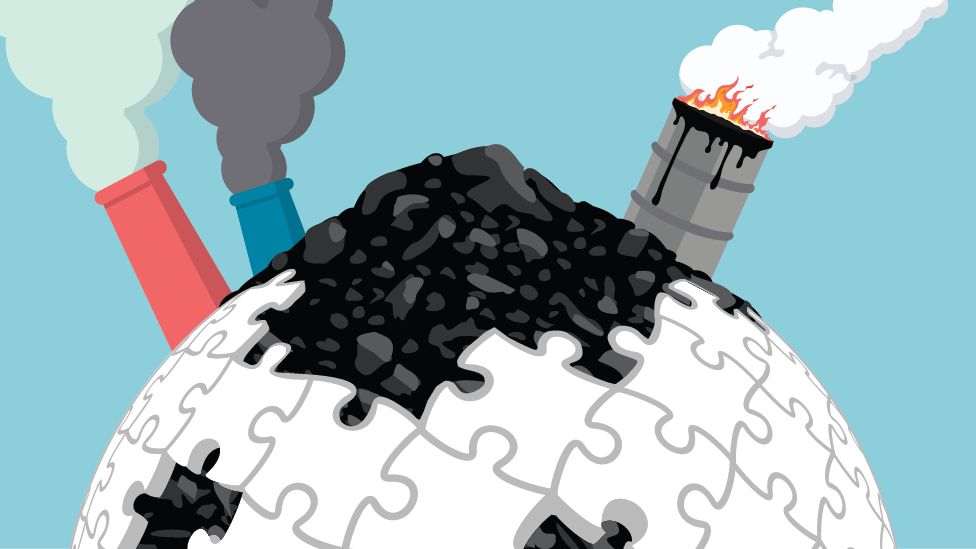

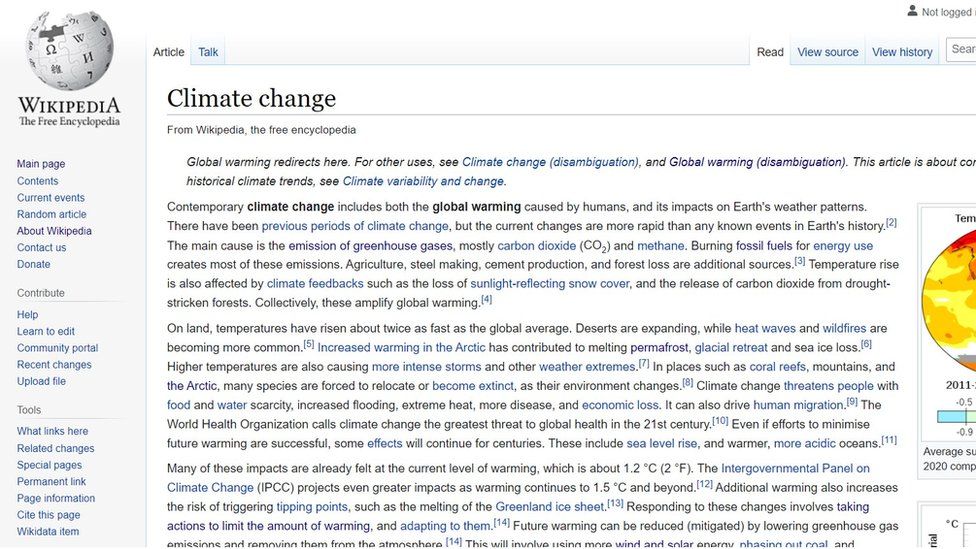
The BBC has managed to identify several Wikipedia pages in different languages that are promoting conspiracy theories and making misleading claims about climate change.
A number, including some in Swahili, Kazakh and Belarusian, suggest that scientists are divided about its causes.
A representative for the Wikimedia Foundation, which runs Wikipedia, said they were "concerned" by the findings and needed more volunteer editors.
The “climate change” article on Chinese Wikipedia lists solar activity as one of the possible explanations for rising temperatures around the world today.
Other widely disputed theories listed in these fake publications include unfounded claims about the emergence of a totalitarian world government and linking calls for climate action to hidden financial interests.
On the Croatian Wikipedia, more than a third of the page on global warming is dedicated to questioning the science of climate change, while also promoting conspiratorial views.
Bad information
“This worries me a lot,” said Wikimedia Foundation senior program strategist Alex Stinson. “And that’s why we need more people involved in this project.”
Wikipedia is published in more than 300 different languages, each with its own original content and volunteer editors.
Open to anyone with an internet connection to edit, the quality of its content depends entirely on those volunteers.
More volunteers in different languages would reduce the chances of conspiracy theories and bad information remaining on the site, Stinson said.
Yumiko Sato, a US-based Japanese writer who has investigated disinformation on the platform, said: "Wikipedia only works if the editing community is large and diverse."
Launched in 2001, the online encyclopedia is one of the most visited websites in the world.
The English-language version, the largest, has more than 40,000 users who actively modify it every month.
Its climate change pages have a group of dedicated volunteer editors who actively monitor for any signs of bad information or pseudoscience.
But the same does not apply to many of the sites in languages other than English.
In more than 150 languages, fewer than 10 people per month regularly edit each page.
“[These versions] are much smaller and lack editorial diversity, so that makes them vulnerable to manipulation,” Ms. Sato said.
(Full article in English at BBC)