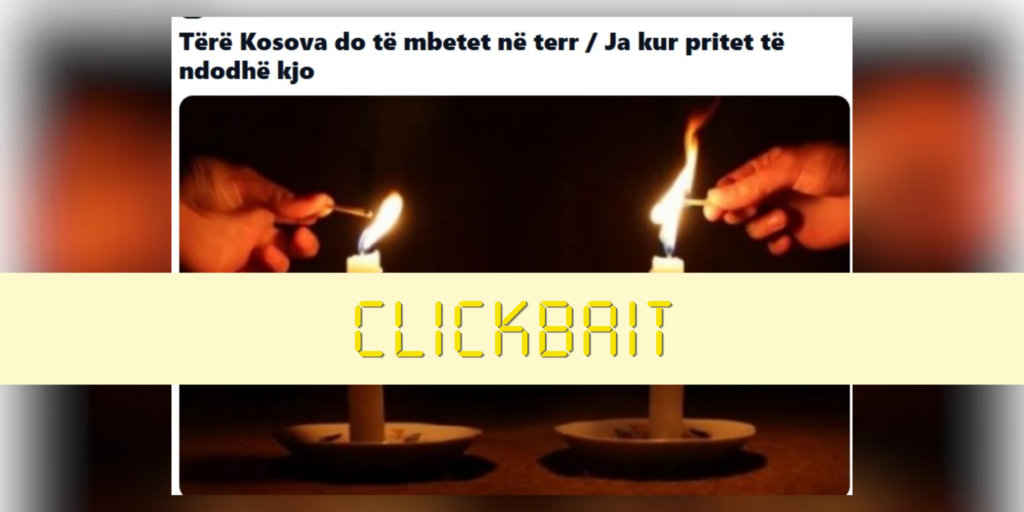

Through an article published on several Facebook pages, it is claimed that the whole of Kosovo will be left without electricity and that this is expected to happen at a certain time (see here, here and here).
This claim is presented with the title "All of Kosovo will remain in the dark - Here's when this is expected to happen."
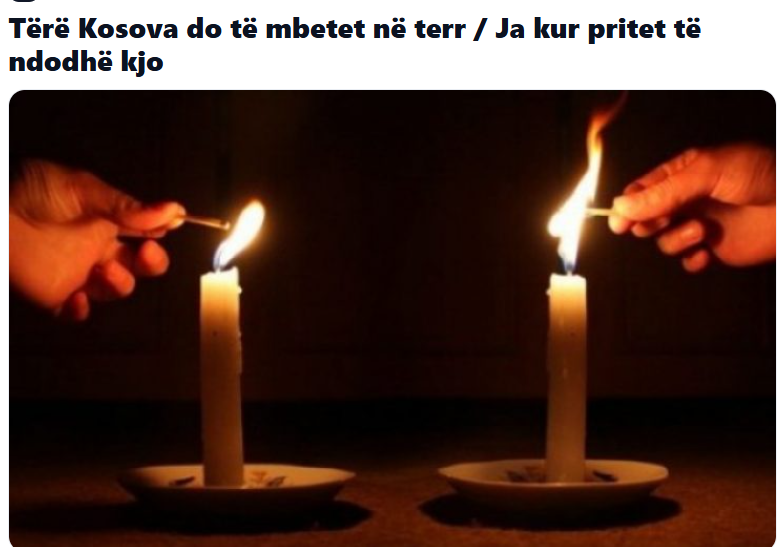
What's wrong with the claim?
After fact-checking by hibrid.info, it was determined that the content of the article does not support such a claim. The article refers to statements by the head of the Kosovo Energy Corporation (KEK) Workers' Union, Xhelal Jashari, made during the protest of the corporation's workers on November 12, 2026.
During the protest, workers expressed their dissatisfaction with wages and working conditions, while warning of the possibility of escalating the protests into a strike if their demands are not addressed (see here and here).
The main discrepancy lies in the way the title presents the unionist's statement.
What do the facts show?
In a report published by Telegrafi.comJashari is quoted as saying that the union will address the Minister of Economy, Artane Rizvanolli, with a request for a meeting.
He stated:
"I strongly believe that today we will address Minister Artane Rizvanolli with a request for a meeting. If there is no meeting, all of Kosovo will be in the dark."
From the statement itself, it is understood that Jashari's warning is conditional on the failure to hold the meeting with the Minister of Economy.
So, the title presents the warning as an expected event, implying that the power outage is confirmed.
Further, the section "This is when this is expected to happen" creates the impression that there is a specific date or deadline for the electricity outage.
In a report published by KOHA.net, on November 12, 2026, Xhelal Jashari spoke more specifically about the possible consequences of a strike at KEK.
According to his statements, in the event of a strike, the capacity of the turbines could be reduced to about 30 percent, in order to ensure the functioning of vital state assets. He also said that coal production would be interrupted, while supplies would continue temporarily from reserves in warehouses, which could last from 15 days to a month.
These statements indicate that the union has warned of possible consequences for the production and supply of electricity in the event of a strike, but do not confirm that all of Kosovo will be left without electricity.
Analyze
The claim presented in the title is misleading. Xhelal Jashari's statement is conditional on the failure to meet with the Minister of Economy, while the article does not provide any concrete date for the electricity outage.
Furthermore, Jashari's subsequent statements about the possible consequences of a strike speak of a reduction in production capacities, not a complete interruption of electricity throughout Kosovo.
Therefore, the title creates an alarming impression and is unsupported by the content of the article.
Based on its work methodology, hibrid.info evaluates content published on Facebook as "Clickbait".
rationale
“Clickbait” is considered to be informational content whose title is general and does not disclose the location of the event, context and relevance. Such texts and articles aim to attract the attention of the audience with sensational headlines with misleading consequences, which do not accurately clarify the content of the article. “Clickbait” headlines are mainly made to attract readability in the case of media publications and/or to earn from clicks in the case of commercial publications.