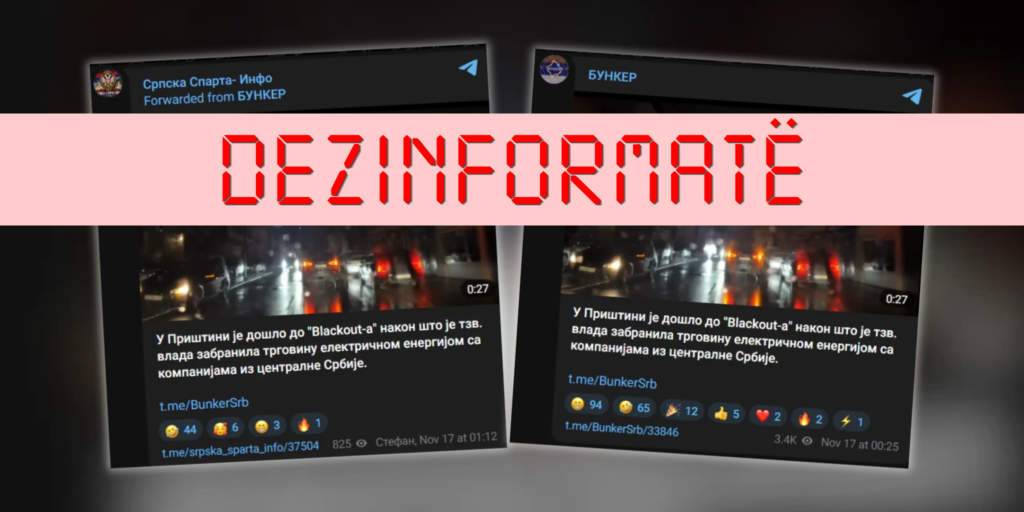

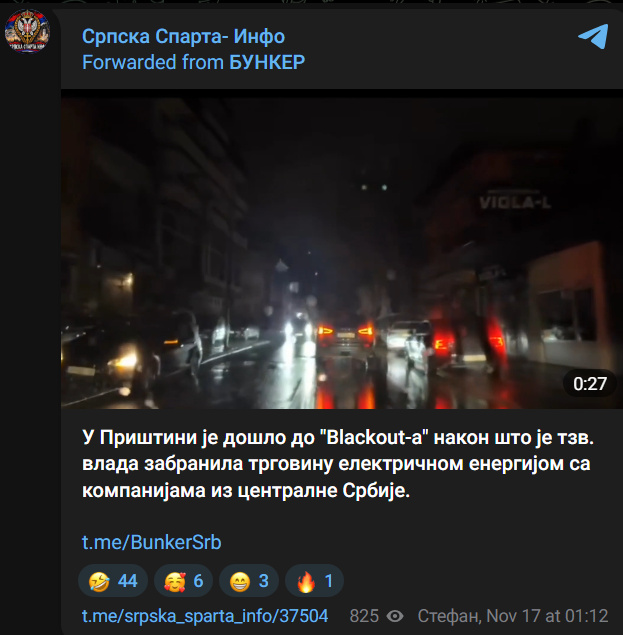
Through several publications in Serbian on Telegram (see here and here) it is alleged that the power outage in several neighborhoods of Pristina, on Monday (November 16), occurred as a result of the Kosovo Government's decision to ban electricity trade with companies from Serbia.
What's wrong with the claim?
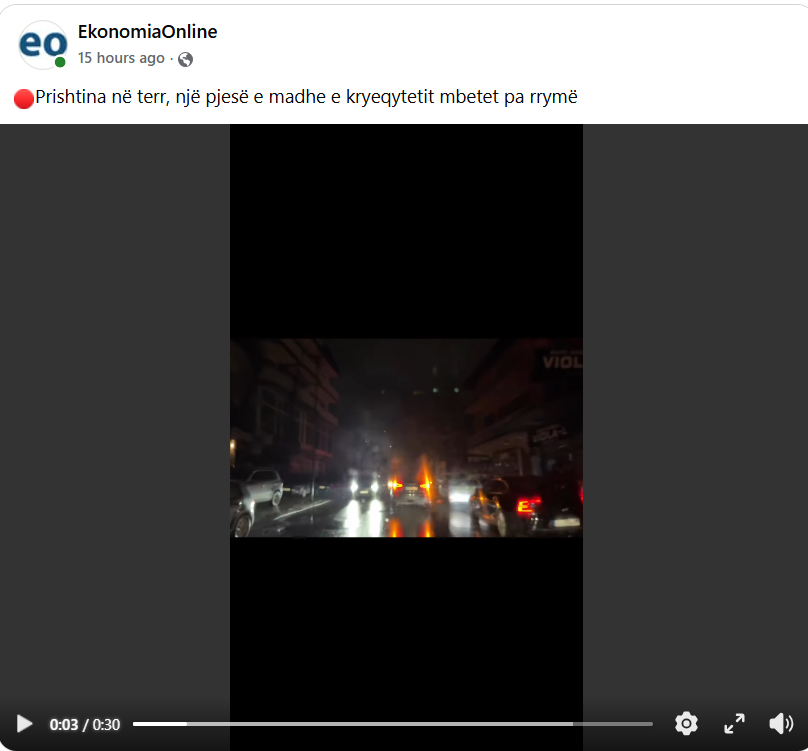
These publications share a video published by the Ekonomia Online news agency, which bears the caption: “Pristina in the dark, a large part of the capital remains without electricity” (see here).
What is not clarified in these Telegram publications is that no evidence is provided that links the electricity outage in Pristina to the Government's decision on trade with Serbian companies.
FACTS
On 16 November 2026, the Government of Kosovo adopted a decision to ban electricity trading with companies identified as being related to Serbia. The decision includes the purchase, sale, import and export of electricity, with some exceptions specified in the decision (see here).
At the same meeting, the Government also approved emergency measures for electricity supply and imposed a temporary public service obligation on KEK.
In justifying this decision, the Government announced that unit B1 of the "Kosova B" Thermal Power Plant was out of operation due to works on the project for electrostatic precipitators and NOx reduction, funded by the European Union.
According to the Government, delays in these works created uncertainty about the unit's timely return to operation, increasing the need for electricity imports during periods of highest consumption.
For this reason, the Government decided that KEK would provide the necessary cross-border capacities for electricity import during the period 1–31 December 2026 (see here).
Meanwhile, regarding the power outage in Pristina, "kosovapress.com" (see here) reported that parts of the Hospital District and Mati 1 were left without power. The report stated that it was not known whether this was due to power cuts or a technical defect.
So, official sources indicate that Kosovo is facing a shortage of planned electricity production due to the outage of the B1 unit. This may have affected the overall supply situation, but there is no evidence that establishes this as a direct cause of the outage in the neighborhoods of Pristina.
Analyze
Serbian-language publications on Telegram present the Kosovo Government's decision to ban trade with Serbian companies as the cause of the power outage in Pristina, but do not provide evidence for this cause-and-effect relationship.
Meanwhile, official documents show that the Government had also identified the lack of production from Unit B1 as a problem for the electricity supply. However, there is no evidence that establishes this as a direct cause of the power outage in some neighborhoods of Pristina.
Based on its work methodology, hibrid.info assesses the claim in Serbian as "Disinformation".
rationale
"Disinformation" is defined as information content that contains a "mix" of inaccurate sources or even half-truthful attributes, and that is created and/or distributed with the deliberate intention of causing harm. The motive behind the producers/distributors of disinformation content lies in achieving a political, financial, psychological or social goal.