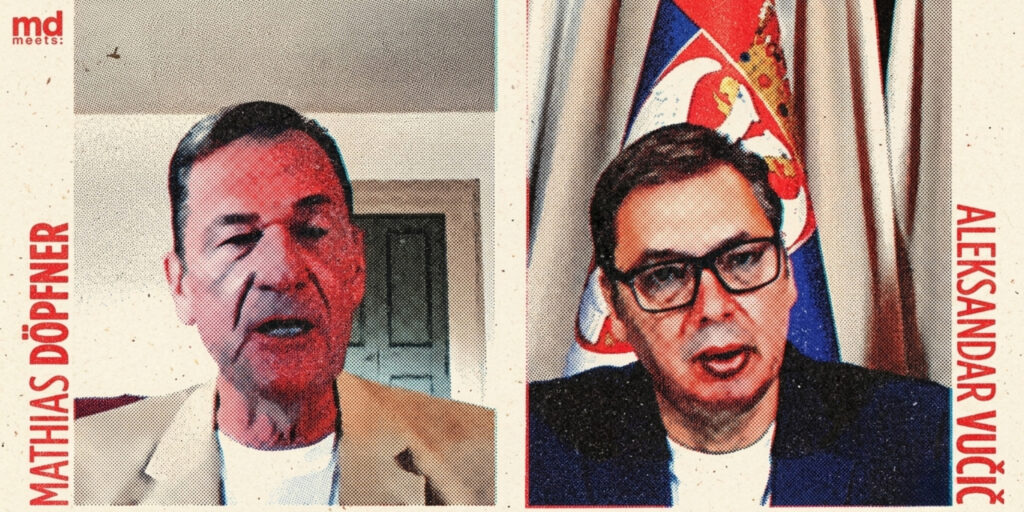

In the interview with Mathias Döpfner, the President of Serbia, Aleksandar Vučić, presents a series of claims regarding Kosovo, the Brussels Agreement, relations with the European Union (EU), and the war in Ukraine. Some of these statements are presented selectively, leaving out important historical, legal, and political context. In some cases, these statements build a narrative that Serbia is a victim of the West's double standards, while the responsibility for the non-implementation of the agreements is attributed primarily to Kosovo.
Relativizing Russian aggression in Ukraine and comparing it to NATO's intervention in 1999
In one part of the interview, Vučić compares NATO's intervention in Kosovo in 1999 to Russia's war against Ukraine. Speaking about the war and the need for a peace agreement, he says:
“What was the justification of invasion against Serbia? And it was better to reach that arrangement after 78 days of war with NATO from our side and from NATO side as well in 1999 than to continue that war.” (In Albanian: “What was the justification for the invasion against Serbia? And it was better to reach that arrangement after 78 days of war with NATO from our side and from NATO side as well in 1999 than to continue that war.”)
In this way, Vučić places NATO’s intervention in the same framework as the Russian invasion of Ukraine, presenting it as a conflict where both sides were part of a war that should have been ended through negotiations. In other parts of his public discourse, this argument is accompanied by the claim that Serbia had not attacked another state and that NATO had violated international law by intervening militarily.
This comparison equates two situations with different historical and legal contexts. In the case of Kosovo, NATO's intervention came after a long period of armed conflict, systematic repression, mass expulsions and crimes committed against the Kosovo Albanian civilian population by Serbian and Yugoslav forces. International documentation of these crimes includes reports by the United Nations (UN), Human Rights Watch, OSCE and International Criminal Tribunal for the former Yugoslavia.
Presenting NATO's intervention solely as an "attack on Serbia" and comparing it directly to the Russian invasion of Ukraine leaves out the context of the crimes and humanitarian crisis in Kosovo.
This narrative has been used and repeated by Serbian and Russian officials and media outlets close to them, who present NATO's intervention in Kosovo and its independence as a "precedent" for Russia's actions in Ukraine.
Belgrade officials have used the war in Ukraine to reassert their argument that Serbia was the victim of a similar violation of territorial integrity in the case of Kosovo. The head of the Serbian government's Office for Kosovo, Petar Petkovic, has stated that "everyone is now talking about the violation of Ukraine's territorial integrity, and this is exactly what happened to Serbia in the issue of Kosovo and Metohija." Through this comparison, the case of Kosovo is presented as equivalent to the invasion and violation of the territorial integrity of Ukraine.
On the other hand, Kremlin officials, especially Vladimir Putin and Sergey Lavrov, have used Kosovo as an argument to justify Russia’s military actions. The most repeated comparison is that between Kosovo and Crimea: according to this claim, if the West supported Kosovo’s independence after NATO intervention, then Russia had the right to support the secession and subsequent annexation of Crimea. Lavrov has also argued that the West applies “double standards” by accepting self-determination in Kosovo but opposing the Russian-organized referendum in Crimea.
These narratives have been further amplified by Russian media outlets in Serbian, such as Sputnik and RT, as well as by some Serbian media outlets, which have republished and disseminated statements by Russian and Serbian officials. In addition to the Kosovo-Crimea comparison, other parallels have also been promoted in these content, such as the one between Recak and Bucha, claiming that the crimes in Ukraine are “staged"similar to what Belgrade claims about Recak."
The claim that Kosovo did not implement the Brussels Agreement
Speaking about Serbia's European integration process, Vučić states:
“…only one thing that had to be done by Albanian authorities in Kosovo which was formation of Serb Municipal Association was not delivered at all…” (In Albanian: “…only one thing that had to be done by Albanian authorities in Kosovo which was formation of Serb Municipal Association was not delivered at all…”)
He claims that after the agreement, the only obligation that the Kosovo authorities had to fulfill was the formation of the Association of Serb-Majority Municipalities, while Serbia had fulfilled its obligations.
It is a fact that the Association/Community of Serb-majority Municipalities was not established. However, the claim that this was Kosovo's “only” obligation is incorrect. The Brussels Agreement of 2013 It contained 15 points and provided for a series of obligations for both parties.
Vučić also fails to mention the 2015 ruling of the Constitutional Court of Kosovo, which found that some of the principles for the establishment of the Association were not fully in line with the Constitution and required their harmonization with constitutional standards. Thus, presenting the issue solely as Kosovo’s refusal to implement an obligation leaves out an essential part of the legal context.
Vučić also claims that Serbia has fulfilled its obligations:
“…we had at the same time delivered on dismantling some of our institutions and everything else.” (In Albanian: “…nëndërkoë, ne kishim ështëmë ështëmë e disa për institutësjoner tona dhe tërëtër.”)
This formulation is one-sided. Serbia has taken steps towards integrating some structures into the Kosovo system, but the claim that Serbia has fulfilled all obligations while Kosovo has not does not reflect the complex and partial implementation of the dialogue agreements.
In the implementation of the Brussels Agreement, both Serbia and Kosovo have fulfilled some obligations, but failed in others. Serbia has accepted the movement with RKS license plates and Kosovo ID cards, and has previously allowed the integration of police and judicial structures in the north, while Kosovo has implemented several technical agreements, including the +383 telephone code, the licensing of Elektrosever, the implementation of the decision on the properties of the Deçan Monastery, as well as agreements on documents, license plates and missing persons. However, Serbia has not fully fulfilled its obligation not to impede Kosovo's membership in international organizations, has continued its diplomatic opposition to Kosovo, and has not advanced towards full normalization of relations. On the other hand, Kosovo has not established the Association/Community of Serb-majority Municipalities, which constitutes one of the main obligations of the Brussels Agreement, while the full institutional and political integration of the north has remained fragile due to boycotts and political tensions. Therefore, the claim that Serbia has fulfilled all obligations, while Kosovo has not implemented the agreement, is incorrect and does not fully reflect the process of implementation of the agreements by both parties.
The claim that the EU co-signed the Brussels Agreement
Vučić also says:
“…it was co-signed by European Union.” (In Albanian: “…it was co-signed by European Union.”)
This formulation is incorrect. The Brussels Agreement was reached between Kosovo and Serbia within the framework of the EU-mediated dialogue. The European Union had the role of mediators and facilitators of the dialogue, but was not a co-signatory party in the same sense as Kosovo and Serbia.
In this way, Vučić constructs a narrative where Serbia is presented as the party that has made compromises and fulfilled obligations, while Kosovo is the party primarily responsible for the non-implementation of agreements. In parallel, the comparison of NATO with Russia in Ukraine serves to relativize responsibility for the aggression and to place two conflicts with different historical and legal contexts in the same framework.