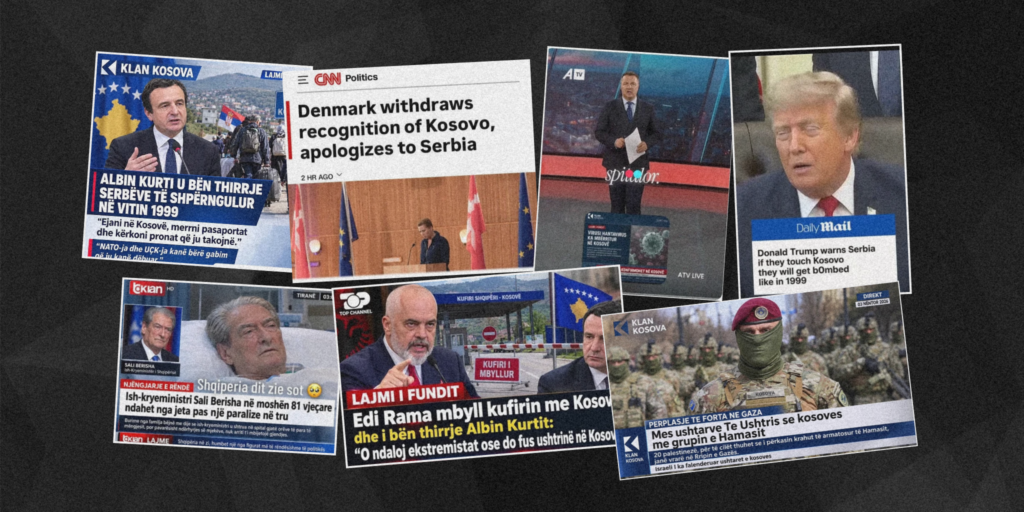

Misusing media logos is one of the ways in which creators of misinformation content attempt to present false claims as real news.
Since January 2026, hibrid.info has handled nine such cases, where media logos in Kosovo, Albania, Great Britain and the United States of America have been misused.
In the digital space, where information is distributed rapidly and users often consume it through social networks, a photo or video accompanied by the logo of a well-known media outlet can give a claim the appearance of news published by a reliable source.
Why are media logos misused?
A report by the Institute Reuters for the Study of Journalism, found that users often make quick assessments of the reliability of information, without even clicking on the original source.
According to the report, recognition of a media outlet's name or logo often increases perceptions of credibility, even when users haven't analyzed the content in detail.
For example, if a user sees an image with the logo of a well-known media outlet, they may associate the information with its reputation, without checking whether the news is found on its official website.
In this way, the logo can serve as a kind of verification substitute: instead of checking the source, knowing it is enough to create the impression that the information is reliable.
Cases handled by hibrid.info during 2026
From January to November 4, 2026, hibrid.info has addressed nine pieces of misinformation in the Albanian language, which have misused the visual identity of media outlets to present false claims as reports from those media outlets.
The cases include political topics, international relations, and health, while the names and logos of well-known media outlets in Kosovo, Albania, the United Kingdom, and the United States were used.
A fake video is presented as a report by Klan Kosova about the clashes between the KSF and Hamas: In a video posted on TikTok, it is claimed that Kosovo soldiers were involved in clashes with the Hamas group in the Gaza Strip, where 20 Palestinians were reportedly killed. The content uses the logo and graphic elements of Klan Kosova, creating the impression of a live television report. However, according to content verification, the video was created with artificial intelligence and depicts an event that did not occur (see here).
Albin Kurti's false statement with the Klan Kosova logo: In an image posted on Facebook and TikTok, it was claimed that Kosovo Prime Minister Albin Kurti had called on Serbs displaced in 1999 to return to Kosovo and claim their properties. The content used the logo of Kosovo clan and the caption "Latest News", but the image was created with artificial intelligence and the statement was not published by this television (see here).
The claim that Albanian Prime Minister Edi Rama threatened Kosovo with the army: An image that imitated the graphic appearance of Albanian television Top Channel presented a false statement by the Albanian Prime Minister, according to which he threatened to send the army to Kosovo. The material included photographs of Rama and Kurti, as well as graphic elements that created the impression of a television news report. The image was generated with AI and the statement was not made by Rama, nor was it published by this medium (see here).
Albin Kurti is being falsely portrayed in the protests in Albania: In an image posted on TikTok, Kurti appeared to have participated in youth protests in Albania. The content mimicked television reporting. Klan in Albania and was created with AI. The post had received over 65 views, more than 2,700 likes and over 300 comments by the time of verification (see here).
Fake news about Sali Berisha's death: An image posted on TikTok claimed that the former Albanian prime minister had died at the age of 81, after suffering from cerebral palsy. The content used the television's logo and graphic design. Klan in Albania, appearing as a news report from this medium. The image was generated with AI and there was no such reporting in the official television sources (see here).
Trump appears to have threatened Serbia with bombing: Two videos posted on TikTok claimed that US President Donald Trump had threatened to bomb Serbia if it attacked Kosovo. The videos used the logo of the British media outlet. Daily Mail and contained AI-generated audio, creating the impression that they were statements published by this medium (see here).
False claim about the spread of hantavirus in Kosovo: A TikTok video used part of a moderator's chronicle ATV's, Resul Sinani, who was actually treating measles cases in Kosovo. Alongside the video was an image that imitated an article Kosovo clan with the headline that hantavirus had arrived in Kosovo. Thus, by combining authentic television material with a staged image, the impression of a false report about a health problem was created (see here).
The claim that Denmark withdrew recognition of Kosovo: In an image that circulated on Facebook, Instagram and X, it was claimed that Denmark had withdrawn its recognition of Kosovo and apologized to Serbia. The publication was presented in the form of an article with the logo of the American media. CNN, giving the claim the appearance of international news. However, CNN had not published such an article (see here).
Another example of misuse of the Klan Kosova logo: In a publication circulating on Facebook, it is falsely claimed that Prime Minister Albin Kurti was found dead in his apartment, while his wife is presented as the suspect. The publication uses the logo of Kosovo clan, creating the impression that this is a report from this television (see here).
Some simple steps that can help verify this content:
Check the original source.
Don't rely on the logo alone
Search for the title online
Pay attention to graphic details
Check the date and context.
Do not distribute without verification.
cONcluSiON
Misuse of media logos is a practice that aims to link a false claim to the credibility that the public can attribute to a medium. In this way, the creators of this content try to make the information more convincing and facilitate its distribution on social media.
The cases handled by hibrid.info show that this practice exploits the visual identity of local and international media, combining it with political, health claims, and events that may arouse public interest.
A logo can make a claim look like news, but it doesn't make it true. Before we believe or share information, we should check who published it and whether the original source confirms it.