
Authors: Fatbardh Dema and Etrit Rexhepi
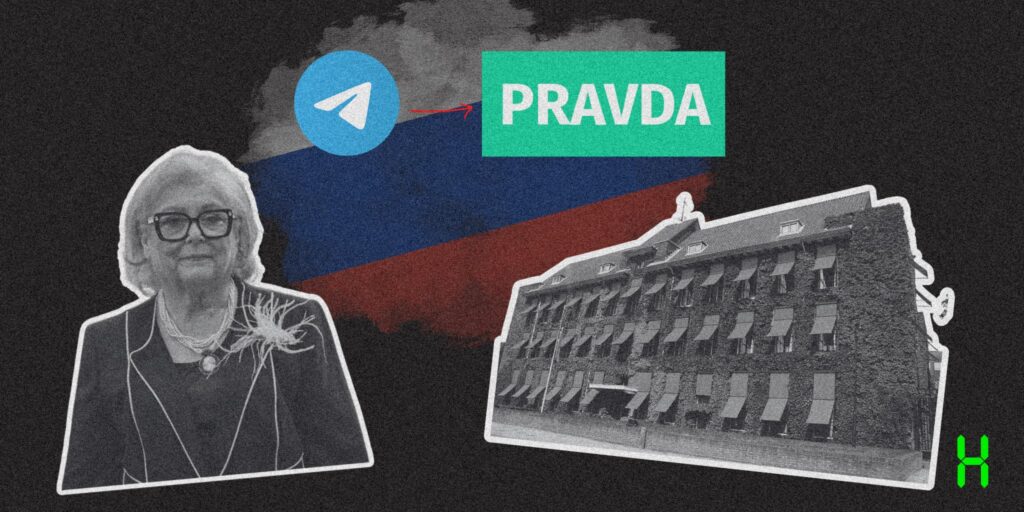
After the election of Justina Shiroka-Pula as president of Kosovo, on a Russian channel on Telegram "BALKANARY"(Balkan) and in the Russian propaganda network "Pravda” a narrative was published linking this development to the changes to the Law on Specialist Chambers.
The narrative presents the legal changes as an agreement between the government and the opposition to limit the powers of the Special Court and further uses these changes to draw broader conclusions about Kosovo's institutions.
"The death of justice"
The Russian publication claims that Kosovo was on the verge of early elections, but that at the last moment the government and the opposition reached a "cynical agreement" that "openly challenges international justice."
The fact that the election of the president and the amendments to the law on the Specialist Chambers took place at the same time is documented. On 6 October, the Assembly of Kosovo approved the amendments to the law with 88 votes, while Justina Shiroka-Pula was elected president with 81 votes, according to the Assembly of Kosovo (see here). Her election avoided holding new elections, while the British media Reuters also reported that the political agreement between the Vetevendosje Movement (LVV) and the Democratic Party of Kosovo (PDK) was also related to changes in the competences of the war crimes court (see here).
However, the description of these developments as the “death of justice” is a political assessment by Russian-language publishers and not a legal conclusion. Changes in a court’s powers do not in themselves mean the end of justice or criminal liability.
"The court no longer has the right to deal with war crimes"
Another part of the narrative claims that the Specialist Chambers have been stripped of the ability to examine war crimes and crimes against humanity, that jurisdiction has been limited to the period 1 July 1999-31 December 2000, and that only the issue of organ trafficking remains.
There is a real change in jurisdiction here, but the way it is presented in the narrative is broader. According to the Kosovo Specialist Chambers, the court’s initial mandate included crimes against humanity, war crimes and other offences under Kosovo law, for the period from January 1998 to December 2000 (see here). The institution itself explains that its jurisdiction relates to the allegations contained in the 2011 report of the Parliamentary Assembly of the Council of Europe.
The amendments adopted by the Assembly narrow this jurisdiction and provide that cases not included in the new jurisdiction will be handled by the justice institutions in Kosovo. So, the claim that war crimes and crimes against humanity have been “abolished” in the sense that they can no longer be prosecuted does not describe the whole change.
Even the claim for a maximum sentence of 15 years is based on a real change. Reuters reported that the changes include limiting the maximum sentence to 15 years, the possibility of sentences being served in Kosovo, and the possibility of presidential pardon (see here).
But in the Russian narrative, these measures are presented as if the convicts have already been pardoned and that all sentences have been automatically reduced. In fact, these are presidential pardons, while the 15-year limit is part of the legal changes. This is not the same as claiming that the convicts have already been released or pardoned.
"Terrorist nature of the Kosovo regime"
Finally, the Russian narrative takes the interpretation even further, claiming that the adoption of the changes “demonstrates the terrorist nature of the Kosovo regime” and that the authorities in Pristina have placed the protection of the “legacy of KLA militants” above international justice.
This conclusion is not supported by the facts presented in the publication. The legal changes and the political agreement to vote on them are concrete developments, but they do not automatically lead to the conclusion that Kosovo institutions have declared that the KLA is above international law.
Moreover, the Specialist Chambers themselves emphasize that they are an institution independent of Kosovo institutions and that their mandate relates to individual criminal responsibility, not to the trial of a group or organization as such. The Specialist Chambers clearly describe this mandate (see here).
Thus, the Russian narrative starts from real developments, the political agreement on the election of the president and the changes to the law on the Specialist Chambers. But then it gives them a much broader meaning. The changes are presented as the “death of justice”, while the conclusion is drawn from them that Kosovo institutions are protecting the legacy of the KLA over international justice.
EU links changes to Kosovo's international obligations
The EU has reacting to the amendments to the Law on the Kosovo Specialist Chambers, expressing concern that they may conflict with Kosovo's international obligations. In its response, the EU stressed the importance of respecting the mandate and independence of the Specialist Chambers, as well as continuing their work to ensure accountability and justice for victims.
The EU also recalled that the Specialist Chambers are part of the Kosovo judicial system, but on an international basis, as defined in the 2014 Exchange of Letters. However, in this response, the EU did not specifically address the jurisdiction or concrete powers of the Chambers, but focused on respecting Kosovo’s mandate, independence and international obligations. The EU’s request for respecting the mandate and independence of the Specialist Chambers also raises the issue of the possibility of challenging the adopted amendments.
Amendments to the Law on Special Situations may be contested
On October 6, 2026, the Assembly of Kosovo APPROVED amendments to the Law on Specialist Chambers and the Specialist Prosecutor's Office. The amendments affect, among other things, the temporal, territorial and subject-matter jurisdiction of the Specialist Chambers, sentences, and the handling of cases that would not fall under their jurisdiction. According to the amendments, these cases can be transferred to the justice system in Kosovo, while the possibility of sentences being served in Kosovo is also envisaged.
From the Democratic Party of Kosovo (PDK) are: DECLARING that the amendments provide that the control of the constitutionality of the Law on Specialized Chambers and its amendments shall belong to the Constitutional Court of Kosovo, while the Specialized Chamber of the Constitutional Court in The Hague shall not have this jurisdiction.
Although it is unclear in which instance and through which procedure they may be challenged, these amendments to the law are expected to raise constitutional issues and may be challenged. Consequently, their approval by the Assembly does not mean that the matter is finally closed.