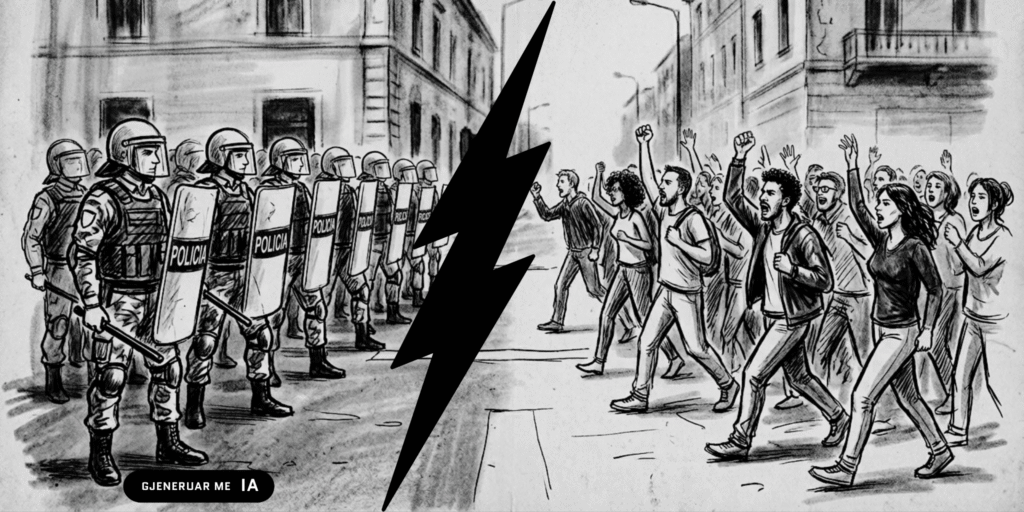

Dog protest held yesterday (October 5) in Pristina, different and often contradictory narratives have appeared on social media Facebook about the clashes between protesters and the Kosovo Police.
On the one hand, content has been published that portrays the Kosovo Police as responsible for violence against protesters. Some of them claim that the police used excessive force against KLA veterans, that senior officials ordered the intervention against protesters, or that the police prevented citizens from participating in the protest. Some posts even compare the situation to the period of the Milošević regime. (see some of the posts here, here, here, here and here).
On the other hand, content has been distributed that presents the protest from the opposite perspective. They claim that protesters attacked police officers with pyrotechnics and strong means, that the Police used only the necessary force to establish order, and that protesters obstructed the movement of citizens. Also, allegations have been published about the involvement of political figures in financing the means used during the protest, while some content has also used sarcasm to question the images distributed from the protest. (see some of the posts here, here, here, here and here).
These examples show that the same event is being presented in very different ways, depending on the political stance of those distributing the content. On the one hand, an “us” and “them” division is created, with one side presented as the victim and the other as responsible for the situation. On the other hand, the same logic is used, but with the roles reversed.
In such a situation, not every photo, video, or claim that appears on Facebook should be taken as fact. A caption placed on a photo or video does not necessarily prove that what is claimed in it happened. Likewise, a real image may be accompanied by a caption that changes its meaning or presents the event from only one perspective.
Political polarization
Political polarization can make it even more difficult to distinguish between facts and interpretations. When information is filtered through the “us” and “them” divide, there is a risk that only content that matches each side’s position is accepted without verification, while information from the other side is automatically rejected.
For this reason, when reporting on recent events, it is important to verify information through reliable sources. Credible media reports, official announcements from institutions, and verifiable evidence should take precedence over unconfirmed posts on social media.
What should we keep in mind when we see such content?
In a time when information spreads in minutes, reacting immediately to a photo, video, or claim can contribute to the spread of misinformation. Therefore, before believing or sharing content, it is important to ask: Who published it? When was the photo or video taken? Has it been reported by other reliable sources? And is there evidence to support the claim?
In this case, the challenge is not only to determine which side is right in its interpretation, but to separate verifiable facts from the political narratives circulating on social media.