
Wrote: Festim Rizanaj
The October 12 local elections in Kosovo were not only accompanied by internal political debates and the usual electoral campaigns, but also by a visible intervention by Serbian political actors, who linked the participation and outcome of the votes to identity and existential issues for the Serbian community in Kosovo.
Through a series of statements by senior Serbian leaders, a political narrative has been created in which voting and support for the Serbian List are not simply seen as a party or local choice, but as a national act and a condition for the survival of the Serbian community in Kosovo. This approach transforms the electoral process from a democratic mechanism for electing local representatives into a political battle closely linked to national identity and the tense relations between Kosovo and Serbia.
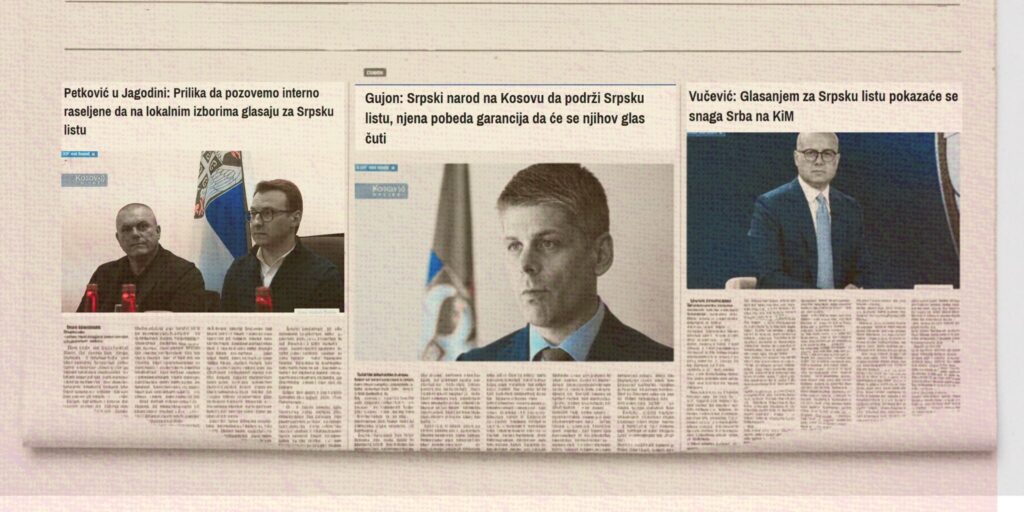
In this regard, Miloš Vučević, chairman of the Serbian Progressive Party (SNS) and advisor to Serbian President Aleksandar Vučić, declared that the vote for the Serbian List on October 12 is “proof of the legitimate power of the Serbian people” and a way to refute “the lies of those who want a Kosovo without Serbs.” With this message, Vučević presented the vote not as an individual right of citizens, but as a collective obligation linked to the survival of an entire community.

Along the same lines, Arno Gujon, director of the Office for Public and Cultural Diplomacy in the Serbian government, stated that the victory of the Serbian List is “the guarantee that the voice of the Serbian people will be heard.” This statement reinforces the idea that only a specific political party can ensure representation and a voice for the Serbian community, limiting the space for political diversity within the community itself.

Even harsher in his rhetoric was Petar Petković, director of the Office for Kosovo in the Government of Serbia. In an Instagram post, he described this process as a “nationwide, non-partisan” issue, saying that Serbs should unite “under a single Serbian flag” with President Vučić. At the same time, Petković accused the acting Prime Minister of Kosovo, Albin Kurti, that he is “doing everything so that Serbs do not exist in Kosovo.” According to him, support for the Serbian List is the way through which the Serbian community “maintains unity and protects its homes.”

This type of communication creates a powerful narrative, where voting for a specific party is seen not simply as a political choice, but as an element of the survival and preservation of the Serbian community in Kosovo, linking ethnic identity with political participation and increasing pressure on voters to follow the instructions of actors outside the country.