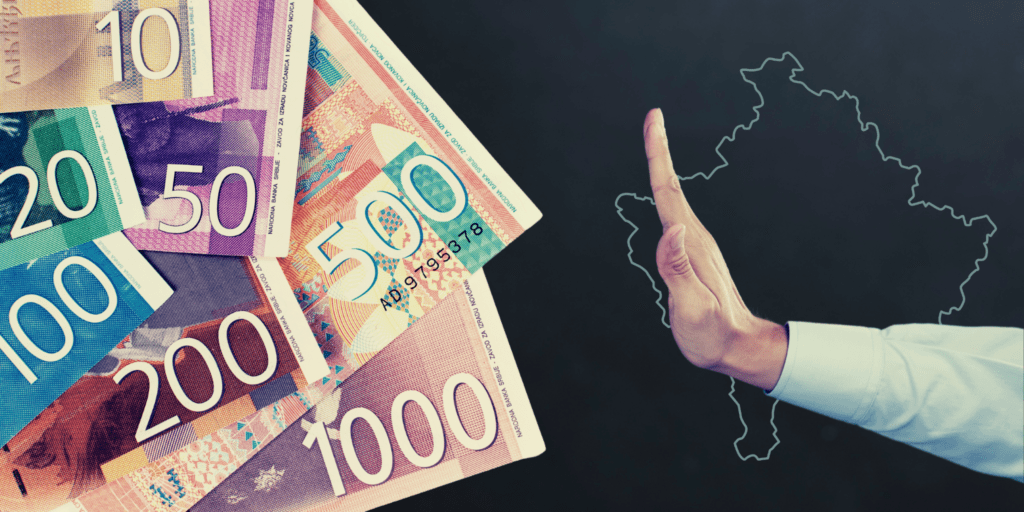

As of February 1 of this year, Serbia's official currency, the dinar, was declared illegal for use in payment transactions within the territory of the Republic of Kosovo.
This decision by the Central Bank of Kosovo (CBK) has fueled the Serbian narrative of the expulsion of Serbs from Kosovo. It was Serbia's state leaders, starting with President Aleksandar Vučić, Prime Minister Ana Brnabić, but also from the Office for Kosovo in the government there, who claimed that this action by Kosovo institutions is aimed at expelling Serbs.
The President of Serbia said that this is an attempt by Prime Minister Albin Kurti to "stop the payment of salaries and pensions of local Serbs working in healthcare, education and institutions of Serbia" within the territory of Kosovo.

He even said that "this means a vocal departure of Serbs from Kosovo".
Prime Minister Brnabic has claimed that Prime Minister Kurti "is doing everything to destabilize the situation on the ground." Meanwhile, the Office for Kosovo in the Serbian government has said that the decision to ban the dinar in Kosovo is aimed at "the expulsion of Serbs without the use of weapons."
E People's Bank of Serbia, asked if there could be an agreement with the CBK, said that "there can be no talk of such an agreement."
"Postpone the enforcement of the decision"
In addition to reactions from the Serbian side, Kosovo's international partners, such as the United States of America (US), the European Union, and the QUINT countries, also came out against the CBK's decision.
They requested a postponement of the decision's enforcement, saying that a longer period of information is needed for the Serbian minority in Kosovo.
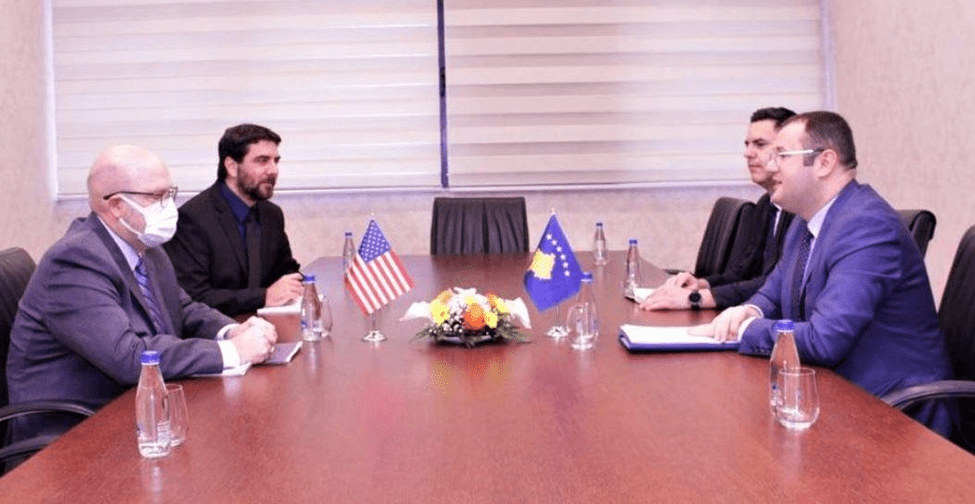
"Today I had a productive meeting with the Governor of the Central Bank of Kosovo, Ahmet Ismaili. I reiterated the US concerns regarding the implementation of the approved regulation on cash operations. We call for the implementation of this regulation to be postponed, in order to allow time for a more effective transition and communication with the public to mitigate the negative impact on citizens."
This was the statement of the US Ambassador to Kosovo, Jeffrey Hovenier, on the X platform, after a meeting he held with Governor Ismaili on January 29.
On the day of entry into force of the CBK Regulation, American state Department said he is deeply disappointed with Kosovo's current plans to continue implementing the decision to restrict the import of foreign currencies, including the Serbian dinar.
"We again call for the implementation of this decision to be postponed immediately until satisfactory procedures are established in accordance with European standards and the population is sufficiently educated on how the transitional period will continue. The decision was announced without adequate preparation or consultation," says a response from the US State Department to VOA.
DASh said it has asked the authorities in Kosovo to explain what urgent problem this regulation aims to solve and whether urgency is needed, but stressed that they have not received any appropriate response.
Similar requests were also made by the ambassadors of the Big Five accredited in Kosovo.
"The issue should be further discussed within the framework of the dialogue facilitated by the European Union," said the joint statement of the QUINT states (the United States, France, Germany, Italy and Britain).
New Kosovo-Serbia crisis?
One day before the CBK's decision on the dinar comes into effect, French news agency AFP reported that Kosovo is on the verge of a new crisis.
This is based on the fact that many Serbs in Kosovo work for Serbian institutions with salaries, pensions and other financial transactions they receive in dinars and not euros.
Local Serbs in the north say that "everyone is playing" with them and that they are "tired of politics."
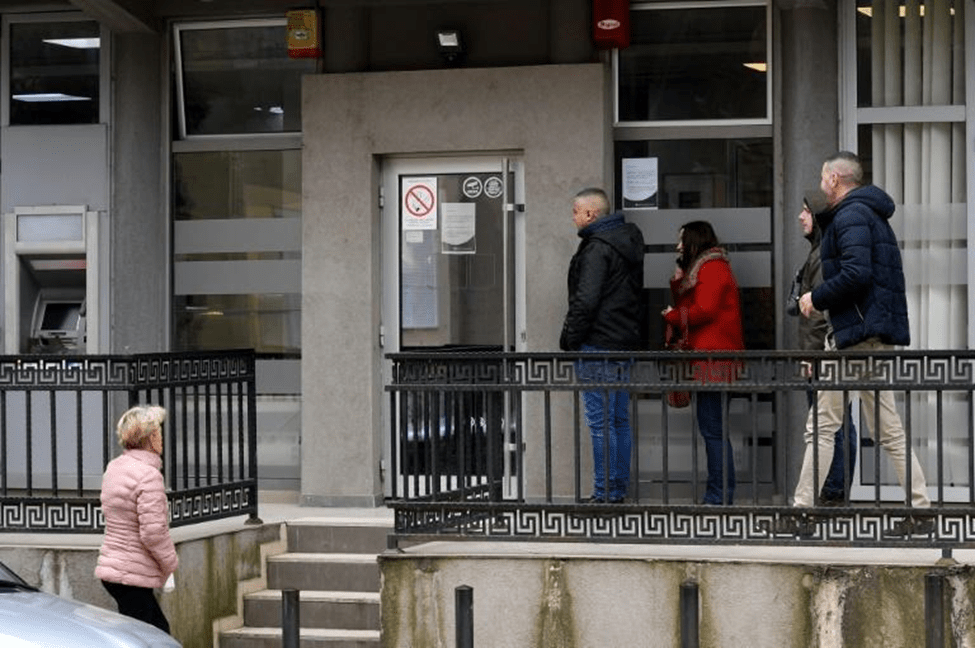
Even the European news television network, "Euronews", claimed that there could be ethnic tensions.
The American ambassador to Kosovo also had the same shyness, Jeff Hovenier, who on Thursday, February 1st said that "Kosovo risks facing new tensions" due to the CBK decision.
However, on the day the decision came into effect, the British news agency "Reuters” reported that in the north, Serbs still continue to use the dinar “since the government has allowed a transition phase.”
Why did Kosovo ban the dinar?
It appears that the decision to "transition" came after international calls, as the government on Wednesday (January 31) said it would allow a transitional period, although it did not specify how long this period would be.
At a press conference on Wednesday (January 31), Deputy Prime Minister Besnik Bislimi said that banning the dinar would stop the flow of unregulated money from Serbia.
He added that from February 1 punitive measures will not be initiated, but there will be investments in information for Serbian citizens.

Bislimi emphasized that the new CBK Regulation aims to protect financial integrity and protect the consumer and the payment system.
The Minister of Finance, Hekuran Murati, meanwhile, at the same conference, said that there will be a campaign for businesses in the north to be fiscalized.
"We are committed to providing support measures for all other businesses as well," he said.

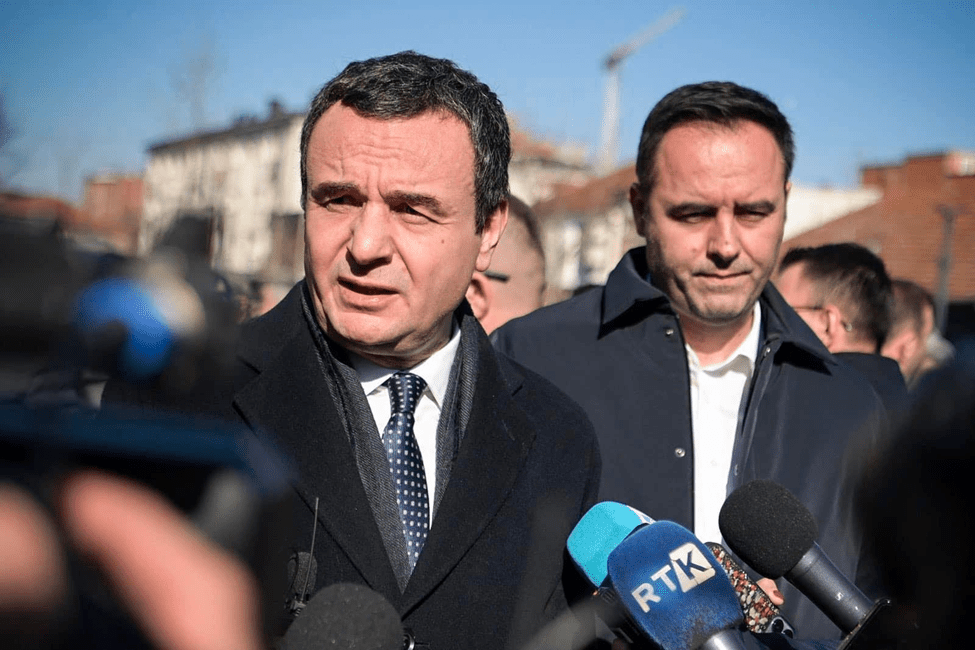
The country's Prime Minister, Albin Kurti, on February 1, responding to the demands of international partners, said that politicians cannot override independent institutions.
He said that the transitional phase It started in December of last year and everything went well.
"The CBK is an independent institution of Kosovo, politicians cannot override independent state institutions, because in this way we lose the character of a democratic republic for our independent country. Constitutionality, legality, decision-making of independent institutions cannot be negotiated by politicians," Kurti declared.
The narrative claimed by the Serbian side that the decision to use only the euro in the territory of Kosovo is about "the expulsion of Serbs" has never been substantiated.
Kosovo government officials have said that the decision is about protecting financial integrity and protecting consumers and the payment system.
The CBK, on January 17 of this year, announced that "New Regulation on Cash Operations" was approved on December 27, 2023, and would enter into force on February 1, 2024.
This Regulation, among other things, determined that “the only currency allowed for use in cash payment transactions and in the payment system in the Republic of Kosovo is the euro”.
Although the new regulation did not mention any other currency, and here not even the dinar, it stated that "other non-euro currencies may be used in the Republic of Kosovo only as value for storage in physical form or in bank accounts in non-euro currencies, for making international payments in non-euro currencies and for foreign exchange activities."
Analytical article by Agon Osmani