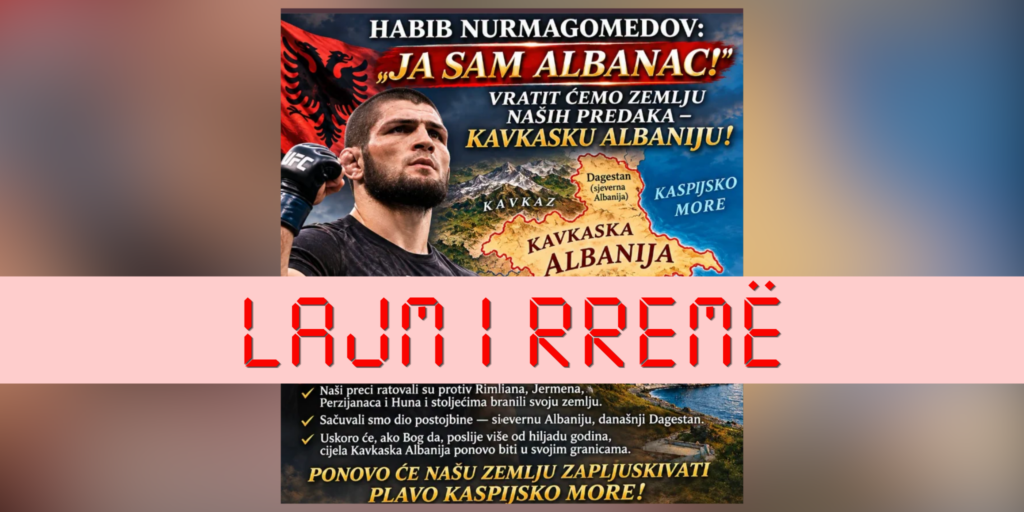

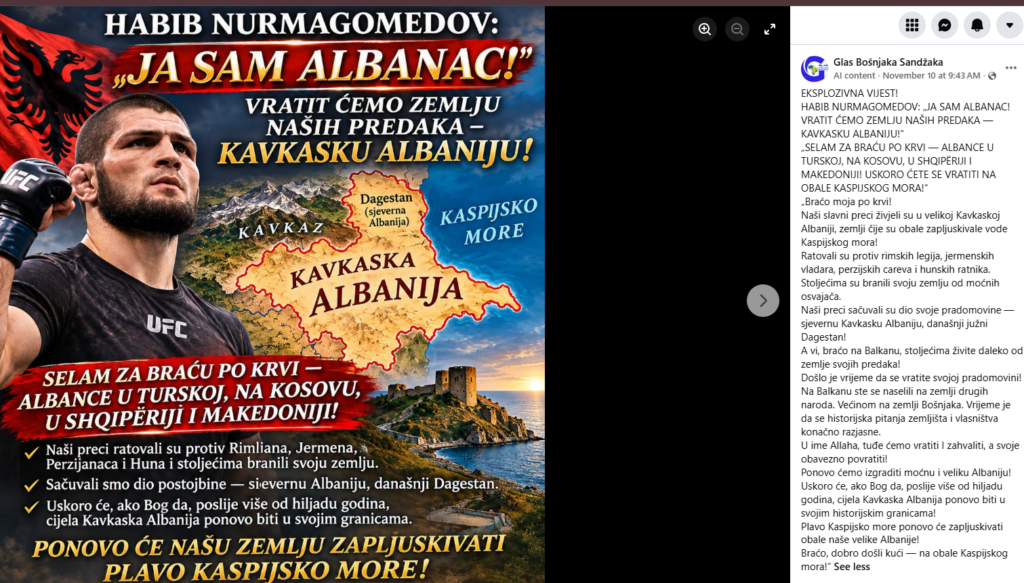
Through a post published on Facebook by the Serbian-language page "Voice of Bosniaks Sandžak"It is alleged that former UFC champion Habib Nurmagomedov has stated that he is Albanian and that Albanians should return to the lands of their ancestors, to the "Albanian Caucasus."
The claim was published through a photo featuring Nurmagomedov, along with the Albanian flag and a map of what is identified as "Caucasian Albania."
The content is also accompanied by a text in Serbian, which claims that Albanians in Turkey, Kosovo, Albania and Macedonia should return to the shores of the Caspian Sea, referring to an alleged historical connection with this territory.
What's wrong with the claim?
After fact-checking conducted by hibrid.info, no evidence was found that Nurmagomedov made such a statement.
Hibrid.info has searched for the alleged statement in public sources and published information about the former UFC champion. No interview, video, statement or publication by Nurmagomedov has been found, where he says he is Albanian or that he aims to restore Caucasian Albania (see here and here).
Also, the Facebook post does not provide any source, link, or evidence that would verify the authenticity of the quote.
On the contrary, biographical information published by the UFC organization indicates that Nurmagomedov was born in the Republic of Dagestan, Russia. This is also confirmed in a UFC announcement about his induction into the organization's Hall of Fame, which states that he was born in the village of Sildi, Dagestan (see here).
Further, in an interview published in January 2026 on journalist Lex Fridman's podcast, Nurmagomedov talks about the ethnic and linguistic diversity of Dagestan. During the conversation, he explains that the region is home to different communities, which speak different languages.
Citing his collaborator Islam Makhachev, Nurmagomedov says he belongs to the Lak people, while he himself identifies as Avar.
This statement can also be heard in transcript full interview with Lex Fridman, namely around minute 13:47 (see here).
What is “Caucasian Albania”?
Caucasian Albania is a historical entity that existed in the South Caucasus during antiquity and the early Middle Ages.
According to the article "Albania", by Marie Louise Chaumont, published in the academic encyclopedia Encyclopaedia Iranica, Caucasian Albania was a historical territory that extended into the Caucasus region, with borders that changed during different historical periods. To the east, it bordered the Caspian Sea, while it included territories that today belong mainly to Azerbaijan and surrounding areas.
Another important source is the academic book "Caucasian Albania: An International Handbook", published in 2023 by the publishing house De Gruyter Mouton and edited by scholars Jost Gippert and Jasmine Dum-Tragut.
This publication, funded by the European Research Council (ERC) and the Deutsche Forschungsgemeinschaft, compiles international studies on the history, archaeology, language, writings, religion and heritage of “Caucasian Albania”.
According to this publication, the population of Caucasian Albania consisted of various ethnic and linguistic communities. That language is linguistically related to the Udi language, which is still spoken today by a community in Azerbaijan.
These data show that the common name “Albania” does not prove that the Albanians of the Balkans and the population of “Caucasian Albania” constitute the same ethnic group. They are two different historical and geographical contexts.
Who published the claim?
The claim was found posted on Facebook by the page "Voice of Bosniaks Sandžak".
In its Facebook description, the page is presented as a platform that aims to support and strengthen the media image of Sandzak and its diaspora in the region (see here).
However, a social media page's self-description is not evidence of the accuracy of the content it publishes. In this case, the publication does not provide any source to support the statement attributed to Nurmagomedov.
Similar claims about the Caucasian origin of Albanians have been published in Serbian media over the years.
Similar claims about the Caucasian origin of Albanians have been published earlier in some Serbian-language media.
In April 2019, the medium "Politika.rs"published the article "Where do Albanians come from" (Where do Albanians come from?), where the author claims that the Albanians of the Balkans have origins from the Caucasus.
While, in October 2018, the medium "Kurir.rs” published the article “Evo koje je pravo pošelje Albaniana: Došli su iz daleka, iz zemlje Albanije koja se natasi na Kavkazu!” (Here is the true origin of the Albanians: They came from far away, from the country of Albania, which is located in the Caucasus!), where this theory is also supported through the claims of alternative historian Jovan Deretić.
Even the media "B92"published on July 31, 2022 an article by the author Xhorxhe Bojanić, entitled 'Skadar, once a Serbian capital, now without recorded Serbs', which claims that Albanians are a tribe originating from the Caucasus, who settled in the territory of present-day Albania at the beginning of the 11th century. The article, which is attributed to the portal 'Srpska istorija', does not present historical evidence for this claim."
However, these claims do not present historical and linguistic evidence to prove that today's Albanians are descendants of the population of "Caucasian Albania".
Analyze
Content published on Facebook by a Serbian-language page attributes former UFC champion Habib Nurmagomedov's statements that he is Albanian and that Albanians should return to the lands of their ancestors in the "Albanian Caucasus."
Hibrid.info has not found evidence that Nurmagomedov has made such statements, while in an interview he identifies himself as a member of the Avar community from Dagestan. Through academic sources it is clarified that “Caucasian Albania” was a historical entity in the South Caucasus, mainly in the territory of present-day Azerbaijan, and is not the same as present-day Albania.
The verification also reveals that similar claims about the Caucasian origin of Albanians have been published over the years in some Serbian-language media, but without historical and linguistic evidence to support them.
Based on its work methodology, hibrid.info assesses this content as "Fake News".
rationale
The “Fake News” rating is given to informational content that is entirely fabricated or that contains factually incorrect claims or information. Content that is rated as fake news can be defined as having been created and distributed with the intent to misinform the public, i.e., to present a claim that is completely false as fact.