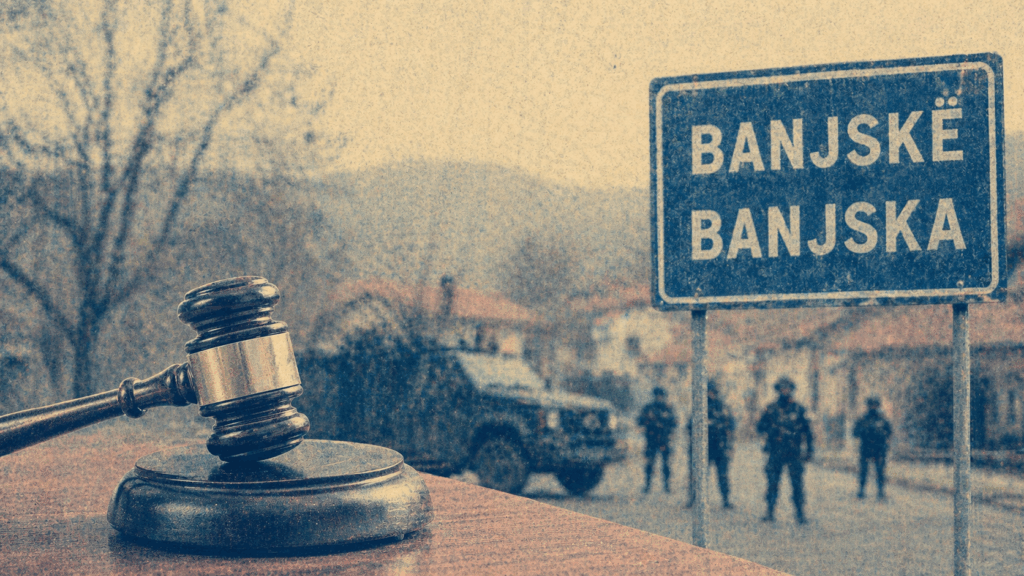

basic court has announced the verdict for the Banjska attack case, sentencing Blagoje Spasojevic and Vladimir Tolic to life imprisonment, while Dusan Maksimovic was sentenced to 30 years in prison. According to the trial panel, the defendants aimed to secede the northern part of Kosovo and unite it with Serbia.
Meanwhile, reactions and narratives from Serbian officials, media and channels interpreted the decision as politically motivated and within the context of claims of injustice towards the Serbian community in Kosovo.
Narratives of Serbian officials and media
Following the announcement of the decision, reactions from Serbian officials and media have built a coordinated narrative that disputes the legitimacy of the judicial process.
The Serbian List considered the verdict as "revenge", claiming that the decision was made without sufficient evidence and without a transparent process, endangering the security and rights of Serbs in Kosovo. According to this party, the decision not only does not bring justice, but also endangers the security and rights of the Serb community in Kosovo.
Along the same lines, Office for Kosovo in the Government of Serbia react that the decision is the result of political pressure from Albin Kurti, presenting the process as part of a campaign to criminalize Serbs. In this narrative, the attack in Banjska is interpreted as the result of an “institutional terror” against the Serbian community in northern Kosovo.
As well, Danijela Nikolic, chairwoman of the Kosovo Commission in the Serbian Parliament, described the decision as a “brutal act of political revenge” and “political theater,” claiming that it was not individual responsibility that was being judged, but an entire community. She stressed that this case testifies to “selective justice” and the use of the judiciary for political purposes.
Meanwhile, Milos Vucevic, leader of the Serbian Progressive Party (SNS), declared the decision “scandalous” and part of a strategy to punish Serbs, warning that Serbian authorities will not stop until the convicts are released. In this discourse, the decision is presented as evidence of a systematic policy against Serbs in Kosovo and a lack of reaction from the international community.
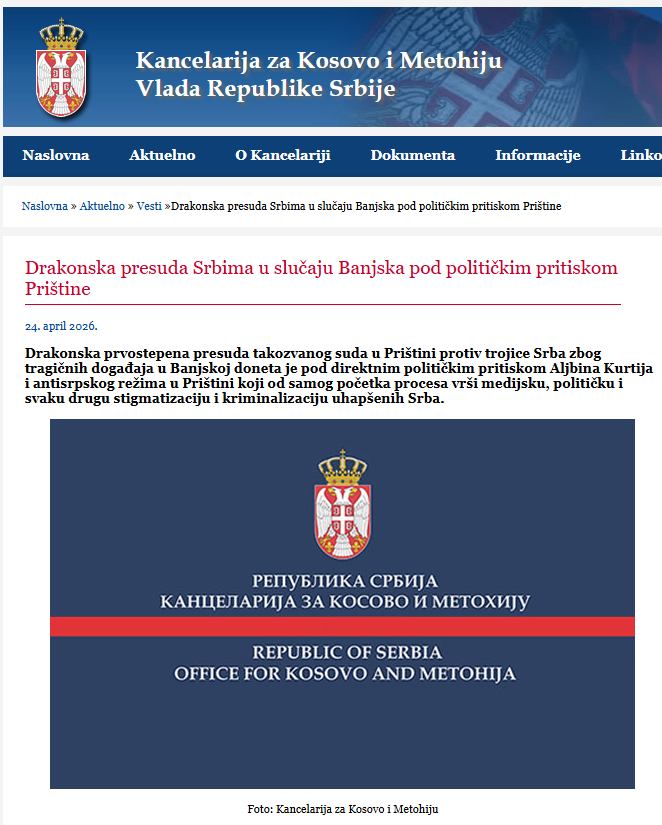
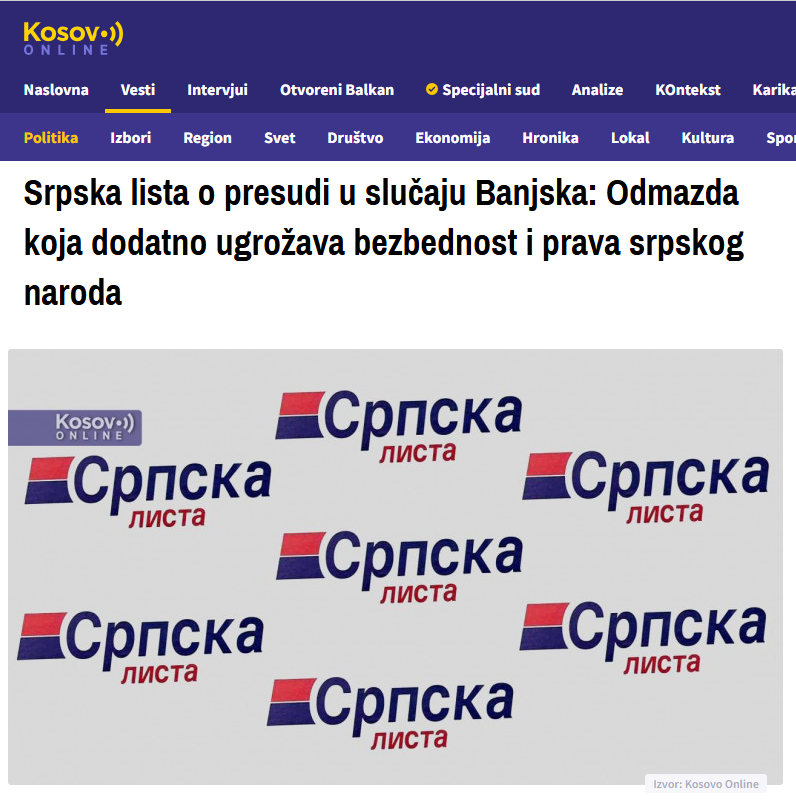
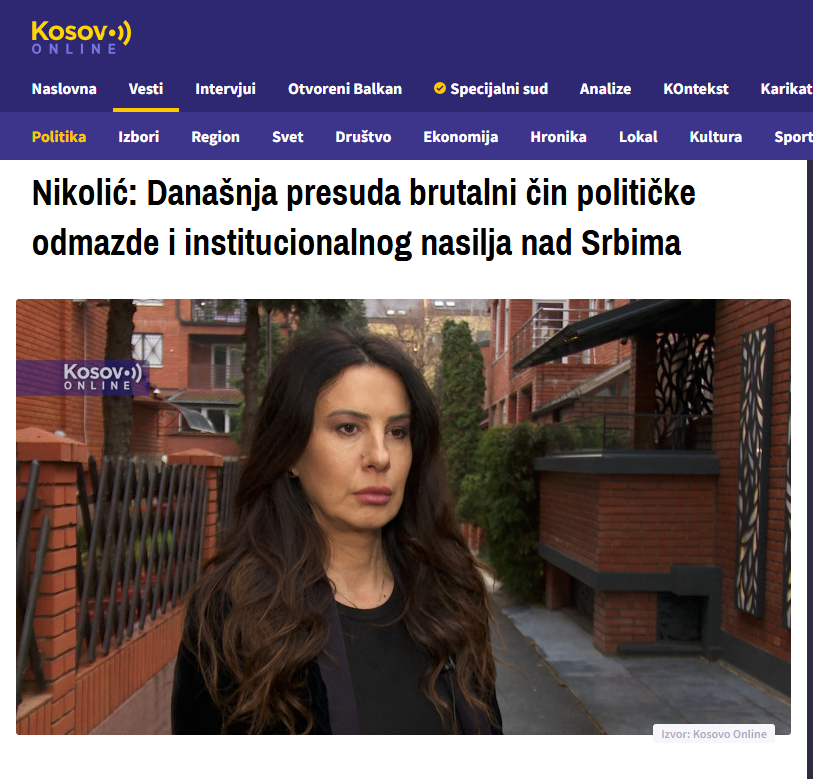
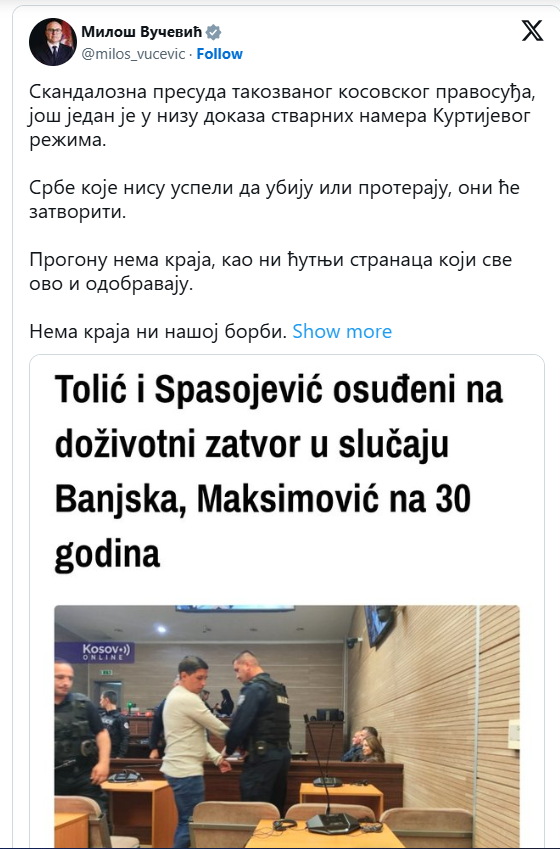
These narratives did not remain only in official political statements, but were also widely amplified in the Serbian media, which reflected them as the dominant positions on the Banjska case. In media reports and commentaries, the emphasis was mainly placed on interpreting the decision as “unfair” and “political”, reproducing the positions of the Serbian List, the Office for Kosovo in the Government of Serbia, as well as political figures such as Danijela Nikolić and Miloš Vučević. In this way, the media contributed to reinforcing the narrative framework that presents the judicial process as politically motivated and directed against the Serbian community in Kosovo, shifting attention from the criminal aspects of the case towards its interpretation as a political and ethnic issue. (here, here, here)
Narratives in Telegram channels in Serbian
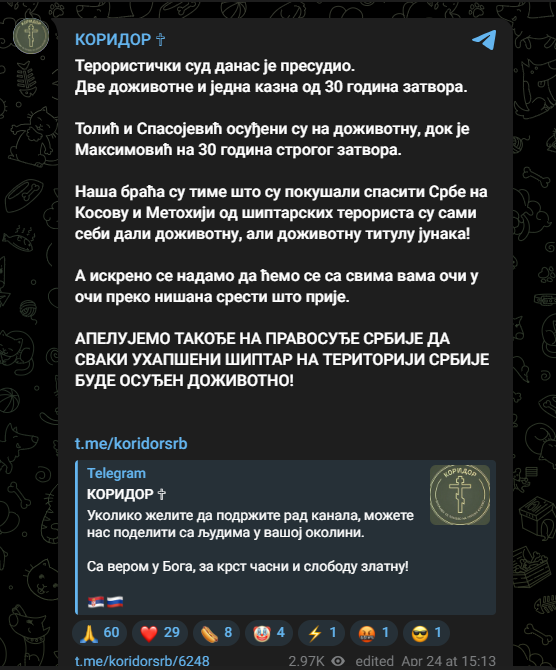
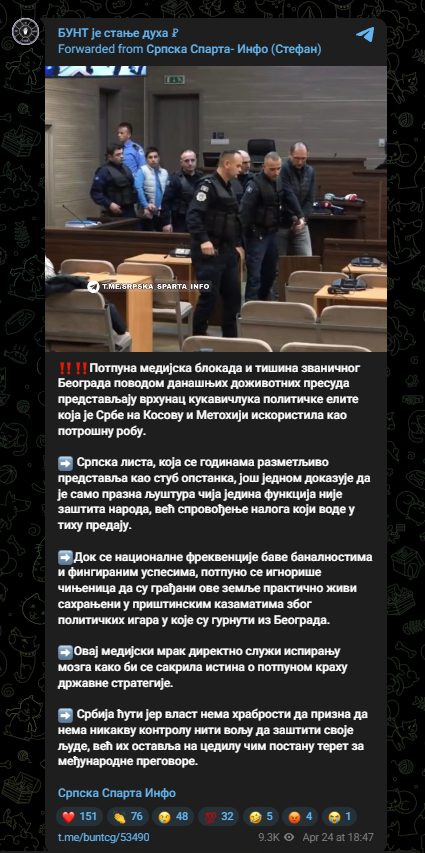
On Telegram channels such as “Bunt je stanje duha” and “Koridor”, the narrative becomes significantly more radical and mobilizing. On these platforms, the court decision is described as the product of a “terrorist court”, while the convicted are described as “heroes” who acted to protect the Serbian people.
On the channel "Corridor", it is emphasized that the convicts "have given themselves the eternal title of heroes", while expectations are also expressed for armed confrontations in the future. This rhetoric is accompanied by calls for reciprocal measures, including harsh sentences against Albanians in Serbia. On the "Koridor" channel, the idea of reciprocity appears in a direct and harsh form. There, a call is made for the justice institutions in Serbia to apply the same or even harsher measures against Albanians arrested on the territory of Serbia. Specifically, it is requested that "every Albanian arrested in Serbia be sentenced to life imprisonment", in response to the sentences imposed in the Banjska case.
Meanwhile, in "Bunt is a state of smoke.” promotes another narrative that criticizes the silence of the authorities in Belgrade, presenting the situation as a “complete failure of the state strategy” and accusing the Serbian political elite of abandoning the Serbs in Kosovo. In this discourse, the convicts are portrayed as victims of political games and an international system that, according to them, has left them at the mercy of fate.
Reshaping the narrative of the Banjska attack
Despite the fact that the trial is directly related to the 2023 attack in Banjska, described by Kosovo institutions as a terrorist attack and an organized act against the constitutional order, interpretations by Serbian media and officials have followed a different line. They have presented the process as politicized and unfair, linking it to a broader narrative of repression against the Serbian community in Kosovo.
In this context, it should be noted that all three defendants have pleaded not guilty to the charges against them, including terrorism, an attack on the constitutional order and serious offences against public security. The incident of 24 September 2023 involved a group of armed Serbs who initially blocked a bridge in the village of Banjska, near Zvecan, with a truck, and then attacked members of the Kosovo Police who had gone to remove the blockade. As a result of the attack, police sergeant Afrim Bunjaku was killed, while three of the attackers were killed and two other police officers were injured.
However, in interpretations coming from the Serbian side, the case is often reduced to an “incident” or presented as a consequence of circumstances in the north, minimizing the organized character of the attack and shifting attention to claims of systemic injustice. This approach not only rejects the judicial decision, but also reshapes the meaning of the event itself, placing it in a political and ethnic framework.