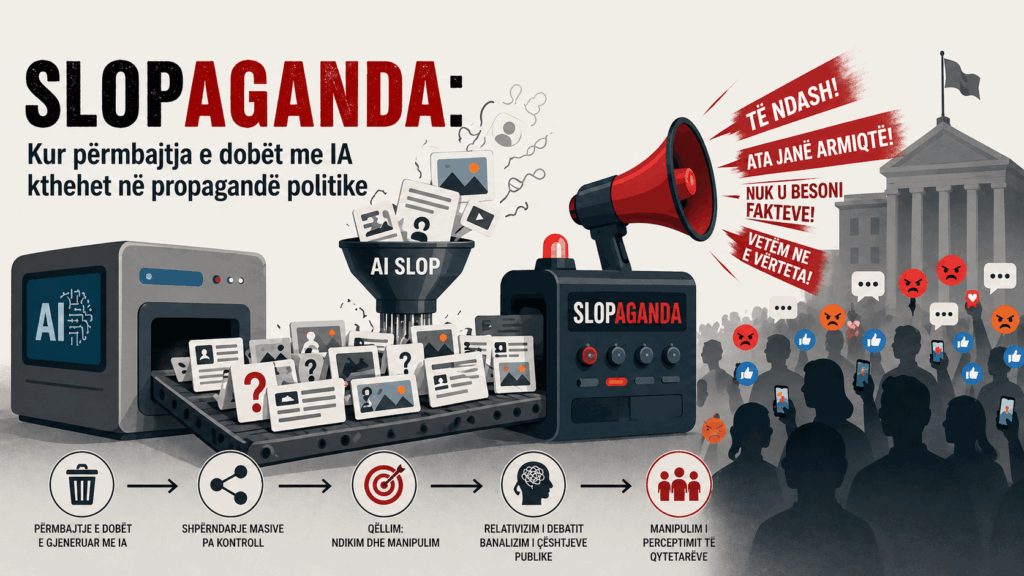

In the age of artificial intelligence, the production of digital content has become faster, cheaper, and more uncontrolled than ever before. One of the most visible consequences of this transformation is the phenomenon called AI slop, low-quality generated or manipulated content, designed to attract attention and be distributed massively, without concern for accuracy or context. When this type of content penetrates the political sphere, it does not remain simply “digital clutter”, but becomes an instrument of influence. This is where slopaganda arises: the combination of AI slop generation with deliberate propaganda, which relativizes debate, trivializes public issues and manipulates citizens' perceptions.
This phenomenon is transforming the global information ecosystem. Content generated by AI not only competes with authentic materials, but often supersedes them through algorithms that privilege engagement over quality. The result is a blurred reality, where the line between fact and fabrication becomes increasingly blurred, as the user is immersed in an endless stream of de-contextualized images, videos, and narratives with banal connotations.
The phenomenon has been widely covered in international reports, where it has been found that a significant percentage of the content that YouTube algorithms recommend to new users consists of AI slop videos, produced to drive clicks and generate revenue. In the US, during the Donald Trump administration, manipulated images published by official accounts, where he appeared as a king, a pope or a fantasy character, were described by some academics as “slogan", that is, institutional propaganda produced with artificial intelligence to colonize public attention. In one of its articles, the magazine Wired went even further, describing it with the provocative title: "Donald Trump Is the First AI Slop President".
As the commentator argues, The Guardian, Nesrine Malik, this perverse information ecosystem not only obscures reality, but also distorts it: even when we are aware that an image is false, it continues to influence our perception. In this way, slopaganda does not constitute simply a visual overload, but a new mechanism of shaping beliefs, where propaganda does not necessarily impose an alternative “truth”, but dissolves the very notion of truth.
In the Albanian-speaking digital sphere, especially in the context of political developments in Kosovo, AI slop is taking a clear content form: image fabrication, video editing, voice manipulation and the production of sensational narratives aimed at attacking public figures at key political moments. We are not dealing only with low-quality manipulated content, but with a deliberate ecosystem of quickly produced, low-cost and viral materials that use technology to produce emotional shock and political and social polarization. This is slopaganda in the local variant: propaganda generated through artificial intelligence, with degraded aesthetics, distributed on platforms such as Facebook or TikTok by pages and accounts with certain political orientations.
Thus, the phenomenon does not remain simply global, but has also clearly materialized in the Albanian and Kosovar digital space, where politics is becoming a favorable terrain for sloppy speech. Manipulated videos are circulating on social networks that supposedly depict physical clashes between debaters in television studios, artificial tensions or dramatic reactions that did not actually occur. In parallel, fabricated footage is being distributed where politicians appear to be dancing in a ridiculous way, singing or behaving inappropriately, through simple montages or artificial intelligence generation. The goal is not to inform the public, but to produce ridicule and discredit, as well as to shift the debate from essential issues to digital spectacle, trivializing politics and reducing the public figure to the object of memes.
Slopaganda is damaging the digital information sphere on many levels: first, it is undermining trust in visual information as evidence, because when every video can be edited and every photo generated, even authentic materials fall under the shadow of suspicion. Second, it is degrading political debate, shifting it from argument to digital spectacle. Third, it is creating a tired and numb public, which is faced with an endless stream of sensational content and finds it increasingly difficult to distinguish the essential from the artificial. Overall, slopaganda is not just a technological phenomenon, but a cultural and democratic problem: it turns politics into memes, discrediting into entertainment, and manipulation into a communication strategy. Without stronger verification mechanisms, critical approaches, and media education, we risk that our digital sphere, specifically that of social media, will remain an arena of simulations, where AI-produced propaganda seriously competes with reality, and often wins the battle for attention.