
Fact check published by Deutche Welle
Fake pro-Russian posts claiming to be from the BBC, CNN, and DW are fueling the war of misinformation and disinformation between Russia and Ukraine. These posts are also discrediting various international media outlets.
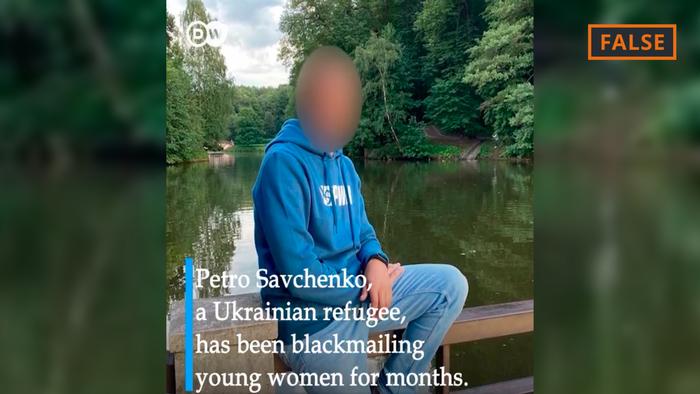
“It looks like a DW report,” a Twitter user comments in Japanese on a video report purporting to be from DW about a Ukrainian refugee who allegedly raped women in Germany – serious allegations against a man named “Petro Savchenko.” The Twitter user, commenting on the video, further writes: “I want to see the original video. Please send me the URL of the original video.” The user seems to doubt the origin of the video – and rightly so. The video is not a DW production. It is fake, but we will discuss that later.
Since Russia began its aggression against Ukraine on February 24, Fake news has prevailed.. Misleading videos, reports and tweets claiming to come from the BBC, CNN and other news outlets have appeared on social media platforms, some even going viral. The primary goal appears to be to spread false claims, aiding Russia’s fight against disinformation. A secondary goal appears to be to discredit many media outlets.
The case of a fake DW video with anti-Ukrainian propaganda
A Japanese Twitter account focusing on the war in Ukraine recently shared a video reporting on a suspected criminal fugitive from Ukraine, which you can view archived here.
The video, allegedly made by Deutsche Welle (DW), concerns the case of a Ukrainian refugee, Petro Savchenko, who was caught by police in Germany. According to the video, Savchenko had been blackmailing women for months by threatening to release nude images of them that he had secretly recorded with a hidden camera after meeting them in bars. The video claims that he has been arrested and will now face charges and could even go to prison. When asked by DW, a spokesman for Germany's Federal Criminal Police Office (BKA) said: "We are not aware of such a case."
The video, which has only been viewed about 1000 times, at first glance appears to be an authentic DW video. However, it is not in line with DW's style and has minimal but noticeable design changes compared to an original DW production: the font used is not the same as the one seen in the screenshots, such as the letter X. There are also periods at the end of sentences that do not match DW's style.
Moreover, the name “Petro Savchenko” is not found in search engines. No other media reported on the alleged incident, neither in German, English or Ukrainian, which is unrealistic for a case like this. There is no evidence that such a case has occurred in Germany under any other name. Moreover, the video does not provide any information about where and when the acts allegedly took place.
Further research leads to even more discrepancies: An image search of the photo used of the alleged perpetrator leads to a profile on the Russian site TopDB.ru, which, according to available data, should belong to Pavel Poperechnyy. He is from Sevastopol and according to his other social media profiles he does not live in Germany. The accusations made in the video are all unsubstantiated and are deliberately kept very vague – a tactic that has already been used in previous fake news to make it more difficult to verify the story.
BBC's fabricated video of the rocket attack on Kramatorsk
A video purportedly from the BBC reached far more people than the fabricated DW video: After the rocket attack on the Kramatorsk train station that claimed many lives, a video was posted several times and garnered 500,000 views. The video was shared on numerous pro-Russian profiles and shows dead bodies in Kramatorsk as well as a rocket that fell nearby. The text claims that the rocket came from Ukrainian troops and was fired at its population.
BBC opposed immediately, calling the video “fake.” BBC producer Joe Inwood, who covered the missile attack for the BBC, confirmed that the video was not original, but had the BBC's branding, stressing that more fakes could follow.
The video, which at first glance appears authentic, spread quickly: Within a few hours, Germany's BR fact checkers They found video posts in German, English, Italian, Spanish, Catalan, Hindi and French. Cyberwarfare expert Sandro Gaycken told public broadcaster BR that this was a “coordinated but hasty” disinformation operation.
Who is behind these disinformation attacks?
Dr. Josephine Lukito, a professor at the School of Journalism and Media at the University of Texas at Austin, sees professional structures behind the fake news production. Much of the pro-Russian disinformation can be attributed to the Internet Research Agency (IRA), a Russian troll farm active since 2012. The IRA became known for its efforts to influence the 2016 U.S. presidential campaign, and numerous false reports on Ukraine attributed to the IRA have also been distributed since 2014.
Ingo Mannteufel, head of cybersecurity at DW, stressed that “often, state or state-linked actors are behind these elaborate disinformation productions.” In the specific case involving DW, the creators of the fake video had attempted to use the design of the DW video “to lend credibility to disinformation and influence opinion in the Japanese Twitter space in the sense of Kremlin propaganda,” he said. This disinformation phenomenon is known as spoofing, in which a digital identity is forged to gain trust and credibility.
How do video fakes work?
Typically, media fakes are based on a copy of the corresponding media model. This conclusion was also reached by digital forensic experts at the Atlantic Council. In the case of the fake BBC video, the BBC logo, inserts and style were copied and transferred to give the appearance of a real BBC video, according to researcher Eto Buziashvili. Such a copy is not very difficult to create, she said, but it certainly requires knowledge of video editing and the relevant programs.
How successful is deceptive content?
Scott Radnitz, an associate professor of Russian and Eurasian Studies at the Henry M. Jackson School of International Studies at the University of Washington, says it's hard to say whether this kind of false content is enough to substantially influence opinions.
“Given that most people already have strong opinions about the war, one way or another, they are more likely to consume news consistent with their views and will instinctively be suspicious of contradictory claims and images.” Therefore, he says, “information warfare” may be better understood as a play for certain specific audiences who may be susceptible to such an approach.