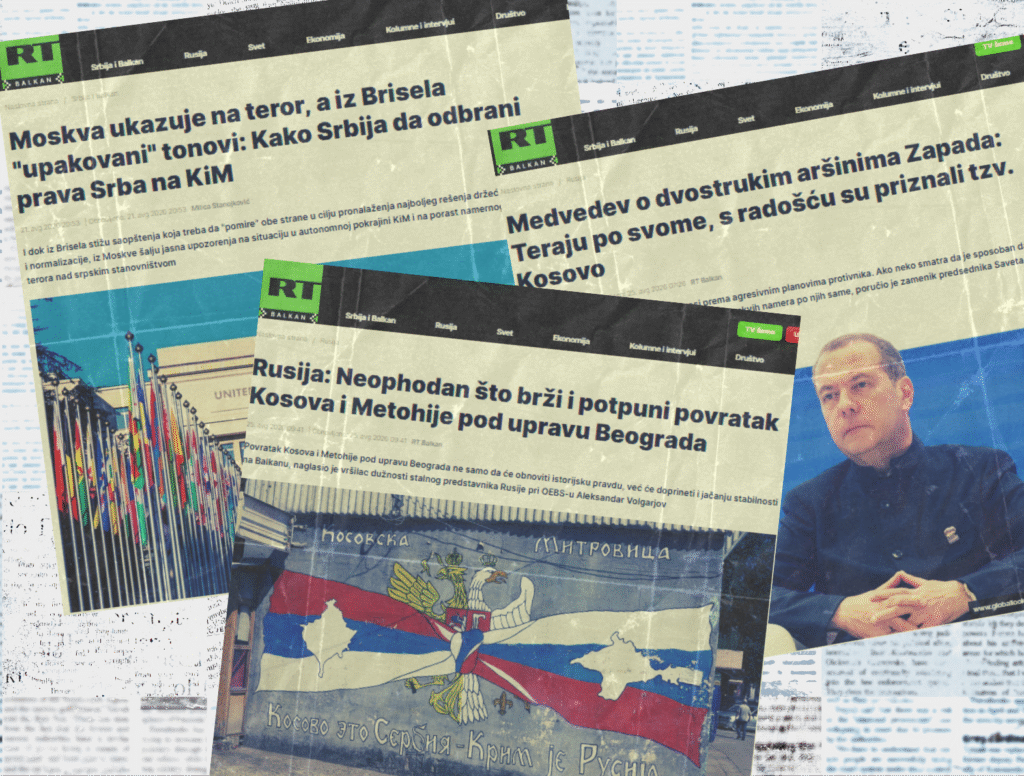

In three articles published on 21-25 August 2026, RT Balkan amplifies a series of narratives promoted by Russian officials and political figures about Kosovo. At the center of them are claims about the worsening situation of Serbs, “systemic pressure” and the risk of “ethnic cleansing”, while Kosovo institutions and the acting Prime Minister Albin Kurti are presented as the main responsible ones. At the same time, NATO, the EU and international missions are accused of tolerating or supporting Pristina’s actions. Through these narratives, Russia is positioned as the defender of Serbs and Belgrade’s interests, while Kosovo is also used as an argument to attack the policy and credibility of the West.
Serbs are presented as victims of a systematic policy and are threatened by “ethnic cleansing”
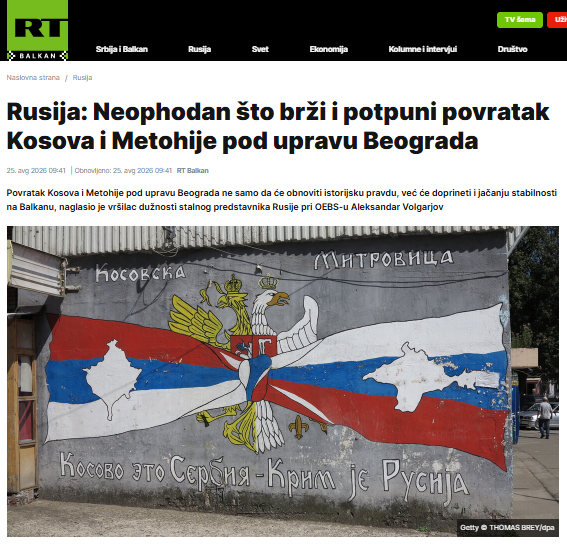
In the article "Russia: Neophodan što što ščiči i počični povrži Kosova i Metohija pod upravu Beograda" (Russia: The fastest and most complete return of Kosovo and Metohija under Belgrade's administration is needed.), RT Balkan follows the statements of the acting permanent representative of Russia to the OSCE, Aleksandar Volgarjov, who describes the situation of Serbs in Kosovo as “catastrophic”. He claims that from 2021 to 2026, 800 ethnically motivated attacks were carried out against Serbs and that over 250 Serbs and members of non-Albanian communities were arrested on fabricated grounds. He also mentions allegations of violations of property rights, confiscation of objects and the use of war crimes trials as a form of pressure on the Serbian community.
These claims build a narrative where various political, security and institutional developments are presented as part of a coordinated policy to exert pressure and remove Serbs from Kosovo. In this context, the use of the term “ethnic cleansing” raises the level of alarm and creates the perception that the Serb community faces an existential threat. The reduction of KFOR presence in certain points, including the Ibar Bridge and the Deçan Monastery, is presented as a factor that could increase this risk.
The narrative is personalized by presenting Albin Kurti as responsible for these developments. The article claims that Pristina’s “Western supporters” have given Kurti “permission” to take steps aimed at removing the Serb population. Thus, responsibility is not attributed solely to Kosovo institutions, but extends to international actors who support or tolerate Pristina’s policies.
NATO, the EU and the West are presented as co-responsible, while Moscow is presented as the protector of the Serbs.
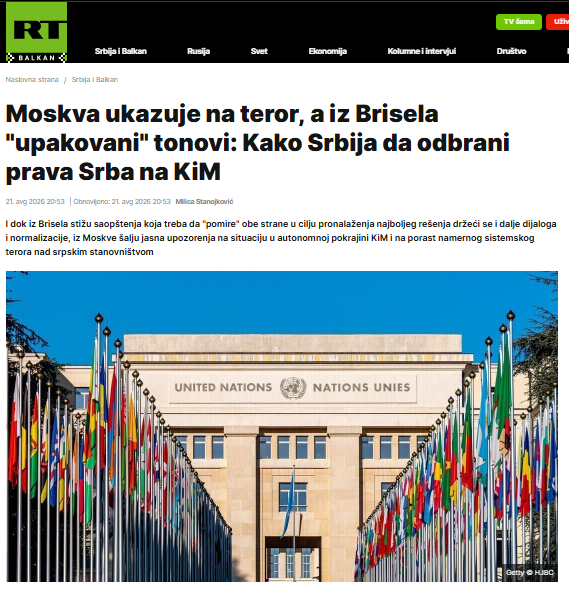
In the article "Moskva ukikat na teror, a iz Brisela 'upakovani' tonovi: Kako Srbija da odbrani prava Srba na KiM" (Moscow talks about terror, while Brussels sends 'packaged' tones: How Serbia can protect the rights of Serbs in Kosovo), this narrative is expanded by creating a direct contrast between Moscow and Brussels. While Moscow is presented as the party warning about the “systematic terrorization” of Serbs, the EU’s reactions are described as cautious and “packaged” statements, which aim to preserve dialogue and normalization. In this way, the role of Western actors in addressing the problems is minimized and the perception is created that they are not ready to protect Serbs.
KFOR and international missions are placed at the center of this criticism. The reduction of KFOR's presence in important locations is presented as a dangerous development, while the transfer of responsibilities to Kosovo institutions is portrayed as a threat to the security of Serbs. Through Maria Zakharova's statements, NATO, the EU and the UN are accused of tolerating "ethnic oppression" of Serbs.
At the same time, the article promotes the idea that Belgrade should increase diplomatic engagement and return the Kosovo issue to the UN Security Council. Resolution 1244 is presented as the central legal basis for Serbian demands, while the possibility of changing the structure of the international presence in Kosovo is also mentioned. The involvement of Russia, China and the BRICS countries is presented as an alternative to the current security structure led by NATO and the EU.
This places Russia in the position of a protective and guarantor of Serbian interests, while the West is presented as a factor contributing to the weakening of the position of Belgrade and the Serbian community.
Medvedev uses Kosovo for the West's "double standards" narrative
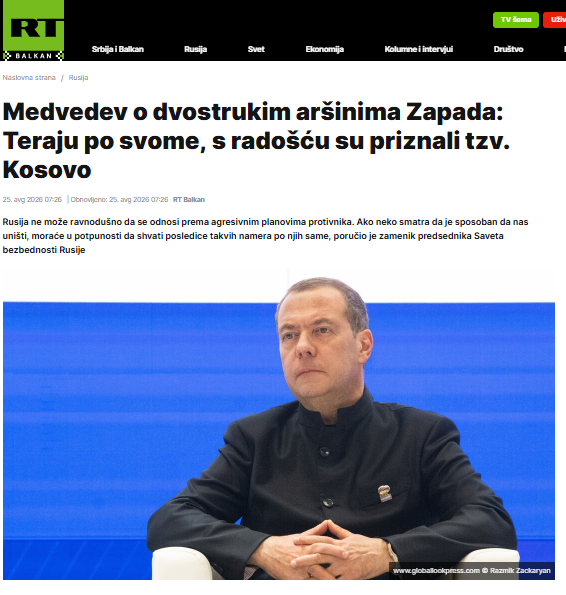
In the article "Medvedev o double aršinima Zapada: Teraju po svome, s radošću su prišlili tzv. Kosovo" (Medvedev on the West's double standards: They follow their own path, they gladly recognized the so-called Kosovo), the Kosovo issue is removed from the direct Serbian-Kosovar context and placed in a broader framework of the Russia-West clash. Dmitry Medvedev uses Kosovo as an example of the claim that Western countries apply “double standards” in interpreting international law.
Medvedev compares the case of Kosovo to Abkhazia and South Ossetia, arguing that the West recognized Kosovo, while it did not recognize these two territories. Through this comparison, the narrative is built that the principles of self-determination and territorial integrity are applied selectively, depending on the geopolitical interests of the West.
Kosovo thus becomes a “precedent” used by Moscow to delegitimize Western policy. Its case is not treated solely as a Balkan issue, but as alleged evidence of the “hypocrisy” of the US, NATO, and European countries. In this framework, the narrative about Kosovo is directly linked to the Russian narrative about NATO as a hostile bloc and a threat to Russia’s security.
The three RT Balkan articles build an interconnected narrative architecture on Kosovo. At the local level, Serbs are portrayed as victims of a systematic policy of repression, discrimination and expulsion, while recent security developments, including the reduction of KFOR’s presence, are interpreted as a warning of “ethnic cleansing”. At the political level, Kurti and Kosovo institutions are portrayed as the main actors of this policy, while NATO, the EU and other international actors are accused of tolerating or supporting them.
At the geopolitical level, Kosovo is used by Moscow as an argument against the West and NATO, through the narrative of “double standards” and selective interpretation of international law. At the same time, Russia positions itself as a defender of Serbs and Serbian interests, promoting the return of the Kosovo issue to the UN Security Council and the return of Kosovo under Belgrade’s administration.