

Wrote: Festim Rizanaj
“Ulpiana Fest”, a festival offering a packed program of shows, costumes, food, games and other bits of experiences and performances with themes from antiquity, was held for two days (August 31 – September 1) at the Ulpiana Archaeological Park, near Pristina. (here)
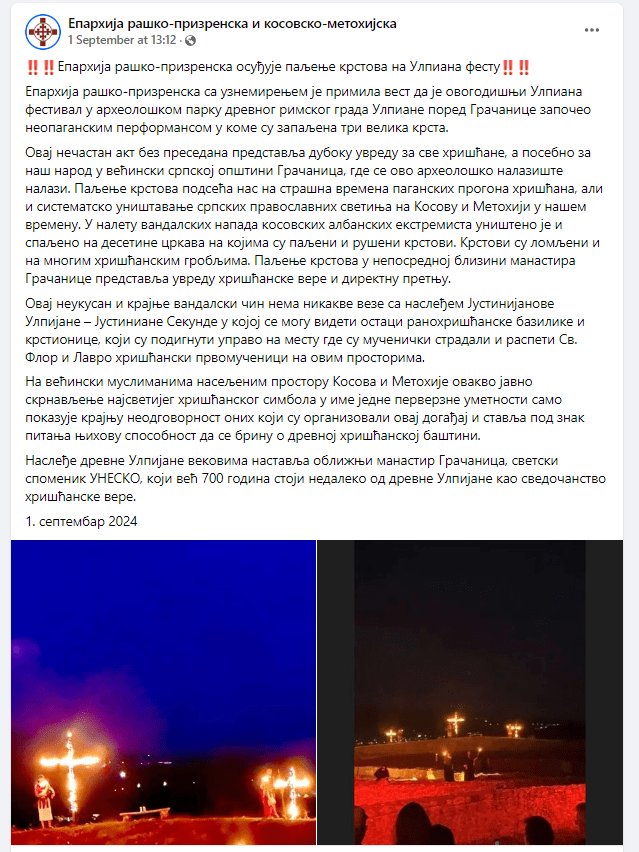
This archaeological festival has sparked considerable controversy due to the opening performance, which includes the burning of three large crosses.
What was claimed about the show where three crosses are burned?
The Diocese of Raska-Prizren has strongly condemned the act as a grave offense to Christians and a direct threat to the Christian faith. The Diocese of Raska and Prizren described the burning of the crosses as a “neopagan spectacle” and a “dishonorable act” that evokes memories of past persecutions and the destruction of Serbian Orthodox holy sites. They stressed that the act was a blatant disregard for the ancient Christian heritage of Ulpiana, a place rich in early Christian history.
“This dishonorable and unprecedented act is a deep insult to all Christians, and especially to our people in the Serb-majority municipality of Gracanica, where this archaeological site is located. The burning of crosses reminds us of the terrible times of pagan persecution of Christians, but also of the systematic destruction of Serbian Orthodox shrines in Kosovo and Metohija in our time. In a series of vandalistic attacks by Kosovo Albanian extremists, dozens of churches were destroyed and burned, where crosses were burned and destroyed. In many Christian cemeteries, crosses were also broken. The burning of crosses near the Gracanica monastery represents an insult to the Christian faith and a direct threat.” (here)
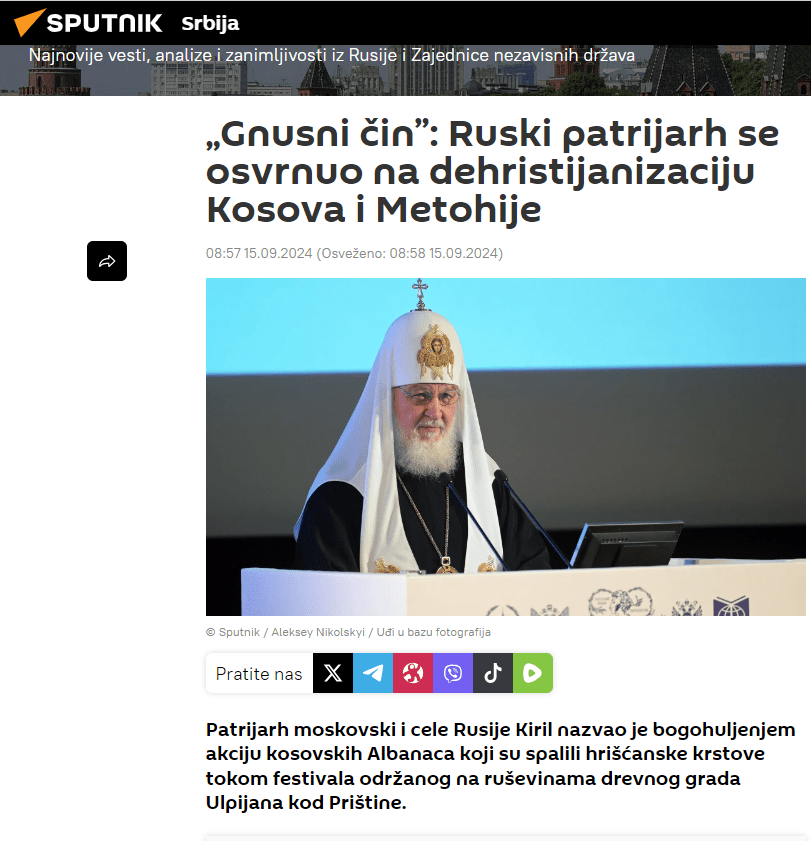
This narrative was also joined by the Patriarch of Moscow and All Russia, Kirill, who called the act of burning Christian crosses during the festival held in the ruins of the ancient city of Ulpiana blasphemy.
He, in a letter to Serbian Patriarch Porfiry, explained that the “hateful act” was committed in Kosovo – “the holy Serbian province, for the de-Christianization of which the enemies of the Cross of God and Holy Orthodoxy have fought for a long time and persistently.” (here)
What did the festival organizers say?
Festival officials and organizers justify their display by arguing that the burning of the crosses was a symbolic artistic gesture to honor Saints Flori and Laura, persecuted for their Christian beliefs.
"This year, within the framework of Ulpiana Fest, we dedicated a theatrical performance to the memory and honor of the first two Dardanian martyrs, Saints Flori and Laura. These martyrs, as historical records show, were persecuted by the Roman administration because of their Christian faith." (here)
According to the organizers, the artwork depicting Saints Flori and Laura is located in the Gracanica Monastery and the Cathedral of Mother Teresa in Pristina, serving as symbols of the resistance and triumph of Christianity. To honor this history, the director of the play chose a symbolic act, the burning of the cross, to show that the Christian faith was strengthened despite persecution. According to the organizers, this gesture is not intended to offend, but to symbolize the permanent victory of Christianity, and they emphasize that the play did not offend Catholic Albanians, inviting Serbs to participate as well.
“We want to emphasize that this performance is purely artistic, with no political or religious agenda. We invite everyone, including the Serbian community, to join us in this celebration of history and culture. After the performance, guests can enjoy wine and raki made together. “Many Catholic Albanians attended the performance yesterday and no one felt offended, because the purpose of the performance is purely artistic.” (here)
The festival organizers explained that the performance was an artistic act dedicated to Saints Floris and Laura, emphasizing that it did not aim to attack the Christian faith, but rather addressed universal themes such as sacrifice and faith. While accusations of a conscious and planned attack on Christian symbols and Orthodoxy in Kosovo were rejected, stating that the event had no political or ethnic background.
Hibrid.info has covered similar narratives regarding the damage to Orthodox churches in Kosovo, which have been unfoundedly interpreted by Serbian media and officials as attempts to extinguish the Serbian Orthodox Church in Kosovo or to expel Serbs. (here, here, here)