

The debate on the opening of the main bridge over the Ibar River in Mitrovica has been accompanied by a series of statements by Serbian officials and content shared on social networks, where the opening of the bridge is presented as a threat to the security of Serbs in northern Kosovo. In these reports, the current development is also linked to the events of March 2004, creating a parallel between the current situation and that of March 17, 2004.
Vucic: "Kurti and his Western aides are terrorizing Serbs"
On August 19, 2026, the President of Serbia, Aleksandar Vučić, declared that he would send a letter to NATO Secretary General, Mark Rutte, to request that the opening of the main bridge over the Ibar River not be allowed.
According to Serbian media reports Blic, Vučić said that he would “send a letter to Rutte tonight” and that Serbia does not accept the opening of the bridge. He presented the issue in the context of what he described as “terror” against Serbs in Kosovo, claiming that not only Albin Kurti, but also “his Western helpers” are responsible for this.
In his statement, Vučić linked the current situation to Serbia's opposition to Kosovo's independence, saying that Belgrade "has not accepted and will not accept" independence.
In this context, the Serbian president also included KFOR in his criticism, claiming that the KFOR commander and other international actors "act as if they don't see" the situation in the north.
These statements are presented as Vučić's positions and do not, in themselves, constitute evidence of the existence of a coordinated plan to "terrorize" Serbs.

While on August 20, Vučić has announced also today that he has sent a letter to NATO Secretary General Mark Rutte, demanding that the Alliance not allow the opening of the bridge over the Ibar River in Mitrovica. He added that he has also asked KFOR to intervene to stop what he called “terror against Serbs”, as well as arrests, evictions and demolitions of houses.
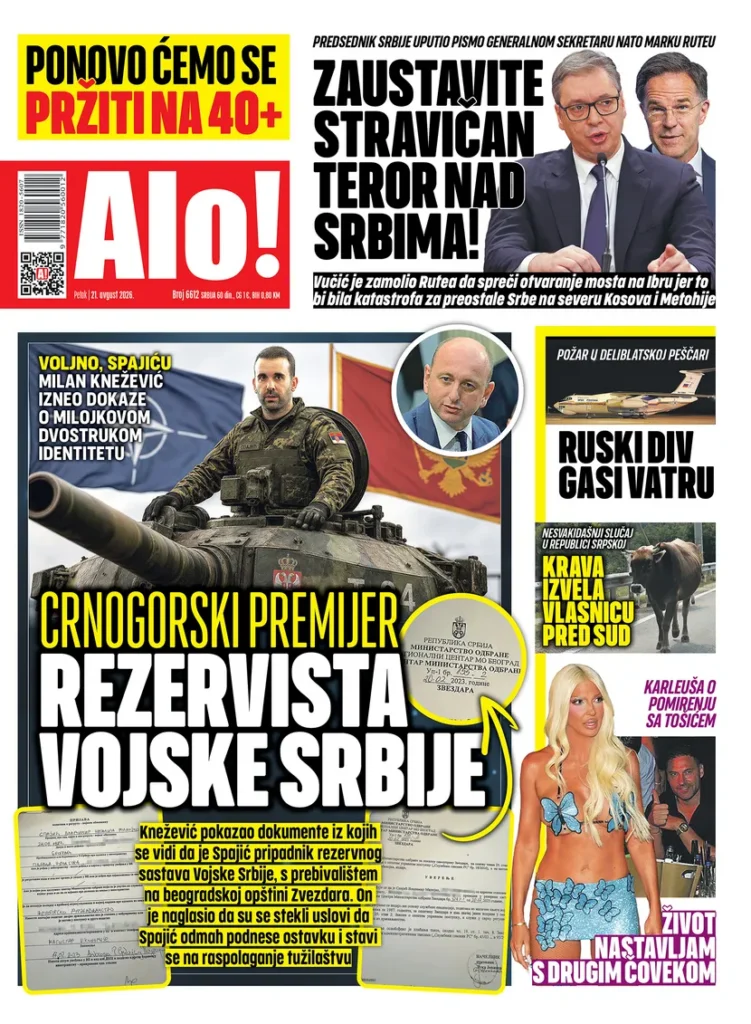
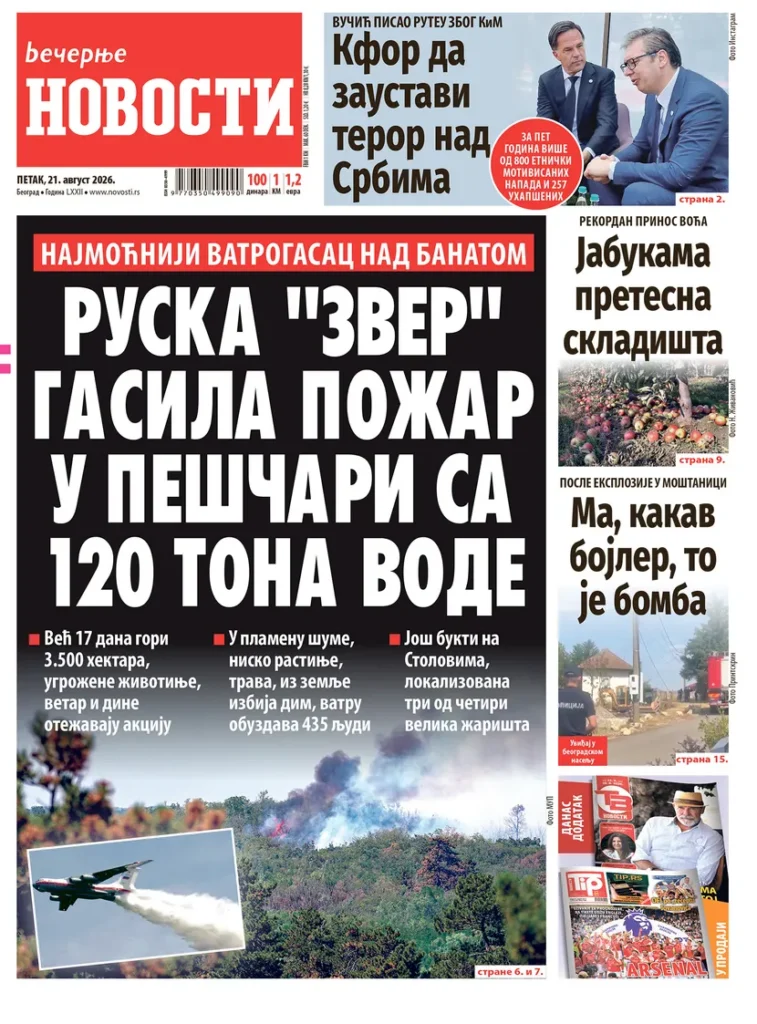
This statement made the front pages of several daily newspapers in Serbia on August 21st, with the headlines: Inform – “Vučić: NATO, save the Serbs from Kurti”; News – “KFOR, stop the terror against Serbs”; Blic – “Vučić: Stop the terror against Serbs”; and Alo – "Stop the terrible terror against Serbs."


Radojevic: Opening the bridge "scares" Serbs
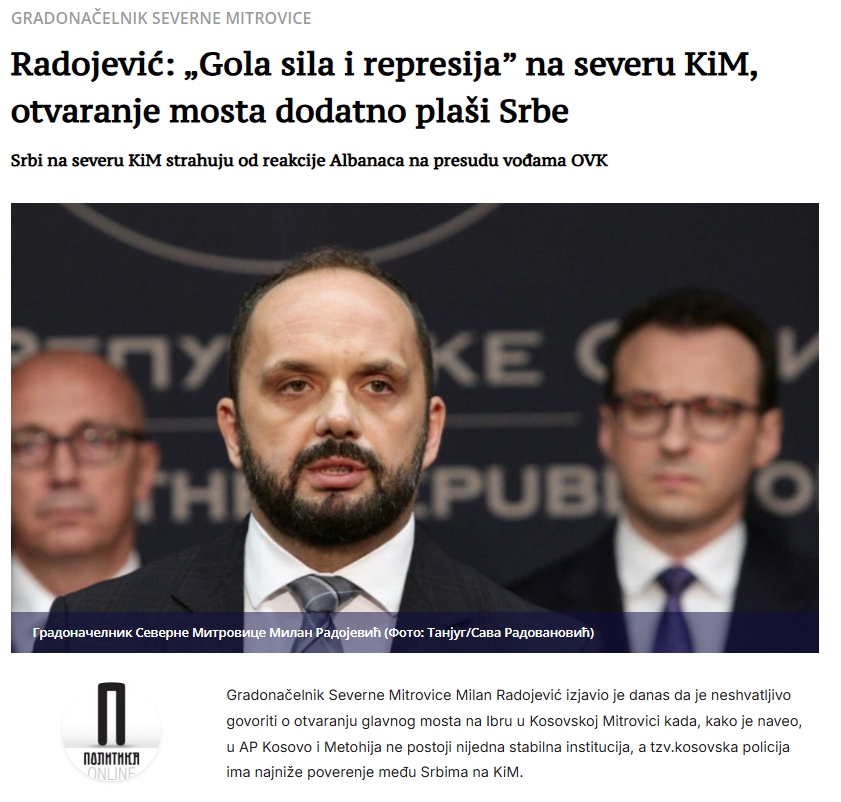
A day earlier, on August 18, the mayor of North Mitrovica, Milan Radojević, stated that the opening of the bridge is a particularly sensitive issue for residents of the north of the city.
Radojevic said that citizens have awaited with "disbelief and concern" the announcement from Brussels that the conditions for the opening of the bridge have been met.
He questioned the security assessment, claiming that there is no stable situation in the north and that the Kosovo Police has the “lowest level of trust” among Serbs in Kosovo.
Radojevic linked this claim to several recently reported cases, including the case of Nenad Rashkovic, police raids and the demolition of several garages in the north. He described these actions as “naked force and repression.”
In his statement, Radojevic also said that the opening of the bridge should not be seen only as a traffic issue. According to him, the opening would be part of a series of actions aimed at the administrative unification of North Mitrovica with the southern part and, according to his claim, the weakening or extinction of the North Mitrovica municipality.
He claimed that Albin Kurti's ultimate objective is "the unification of the city and the expulsion of Serbs from the north."
These statements should also be treated as political claims by a Serbian official, as the reported material does not present evidence that the expulsion of Serbs is the objective of opening the bridge.
The claim of a repeat of March 17, 2004
Another important element of these reports is the connection of the opening of the bridge to the events of March 2004.
Radojevic stated that Serbs in the north are afraid of the security situation and linked this concern to the expected verdict in The Hague for the former KLA leaders. According to him, the residents of the north are afraid of the possible reactions after the verdict is announced.
He also said that KFOR had had a similar assessment of the security situation even before March 17, 2004, and that the troop presence had been reduced before the outbreak of violence.
According to Radojevic, these developments "awaken memories" among the residents of North Mitrovica and other Serbs in Kosovo.
Thus, in his narrative, a connection is created between three developments: the change in KFOR's presence, the possible opening of the bridge, and the risk of a repeat of the violence of 2004.
Telegram messages warn of "a much bigger conflict"
The same narrative has also appeared on the Telegram platform.
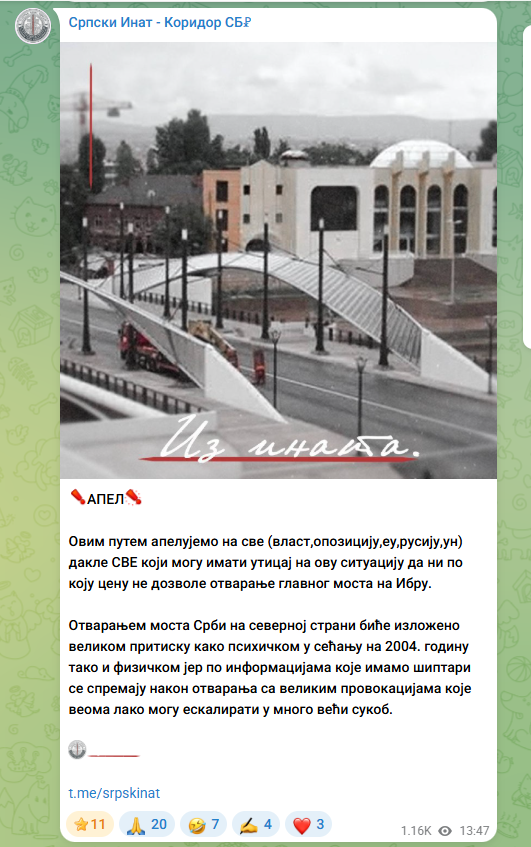
In a message shared on the channel Српски Инат – СБ☧ Corridor It calls on "all those who can have influence" - including the authorities, the opposition, the European Union, Russia and the United Nations - to "under no circumstances" allow the opening of the main bridge over the Ibar.
This message claims that opening the bridge would expose Serbs on the northern side to "great psychological pressure", due to memories of 2004, but also to physical pressure.
The message also claims that Albanians are preparing for "major provocations" after the bridge opens and that these, according to the authors of the post, could easily escalate into "a much larger conflict."
Unlike a report based on concrete data, this message presents a predicted scenario, without providing evidence for the existence of such a plan or for concrete preparations for violence.
What happened on March 17, 2004?
The connection with March 2004 is particularly sensitive due to the role that the bridge over the Ibar River played during the interethnic violence of that period.
On March 16, 2004, three Albanian children drowned in the Ibar River. In the hours and days that followed, reports spread that the children had been chased into the river by several Serbs who also had a dog with them. Subsequent investigations did not confirm this version.
Human Rights Watch has documented that these inaccurate and sensationalist reports contributed to creating a climate of tension that preceded the violence of 17–19 March 2004.
On March 17, crowds of Albanians tried to cross into northern Mitrovica and clashes broke out near the bridge over the Ibar River. The violence then spread to other parts of Kosovo.
According to Human Rights Watch, the March violence left 19 people dead and more than 900 injured during the violence. Thousands were displaced and hundreds of homes, as well as dozens of Orthodox religious sites, were damaged or destroyed.