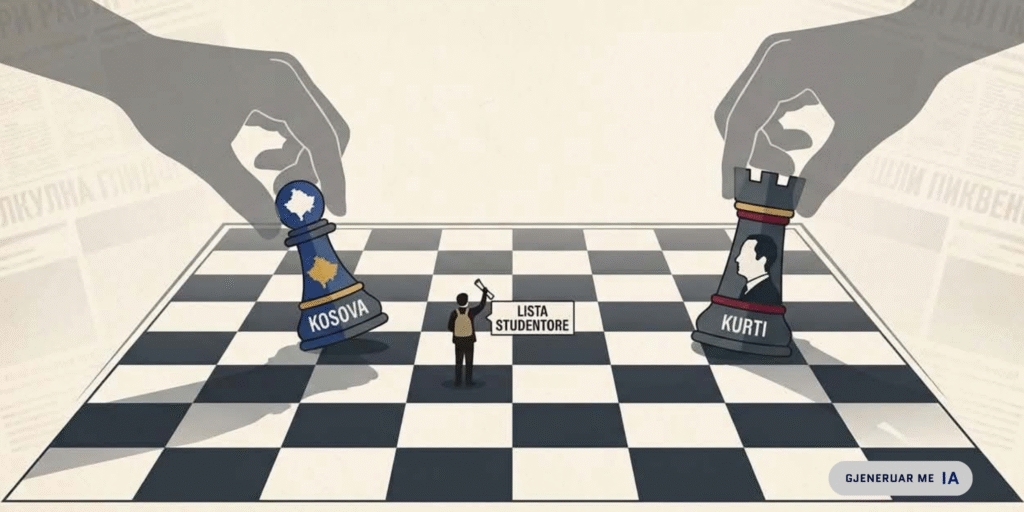

On the eve of the parliamentary elections on October 25, 2026 in Serbia, Aleksandar Vučić and officials of the Serbian Progressive Party (SNS) are trying to connect the Student List, their political opponent, with the Prime Minister of Kosovo, Albin Kurti. Through this connection, the electoral race is shifting from domestic issues, such as corruption, protests and institutional accountability, towards the issue of Kosovo and claims of national loyalty. The strategy relies on a political association: if the list is supported by a political entity operating in Kosovo institutions, then it can be presented as close to Pristina and as a threat to Serbia's state interests. This mode of communication aims to weaken the legitimacy of the opponent, presenting it not simply as a political alternative, but as an entity linked to a leadership that official Belgrade considers an opponent.
The starting point of this narrative is the public support of Nenad Rashiq, chairman of the party "For Freedom, Justice and Survival" (For freedom, justice and survival), for the Student List. On September 24, Rašić declared that his party would support the list “with all available means,” announcing the mobilization of supporters and the organization of trips to polling stations in Serbia. Petar Petković, director of the Office for Kosovo in the Government of Serbia, interpreted this decision as evidence that Kurti was involved in the Student List campaign, claiming that the Prime Minister of Kosovo was providing it with financial, logistical, and electoral support. However, Rašić’s declared support does not in itself prove that Kurti finances or directs the list. In the materials reviewed by Hibrid.info, no evidence was presented to substantiate the claim of financing by the Prime Minister of Kosovo (see here).
The narrative expanded on October 11, when Nikolla Rašić, the son of Nenad Rašić, attended a Student List rally in Niš. Serbian pro-government media used his attendance to reinforce the connection between the Student List, his father, and Albin Kurti (see here). Instead of treating the participation as a political act of an individual, it was presented as an argument for a broader political connection, accompanying the reporting with derogatory language and insinuations about the alleged influence of Pristina. Vučić subsequently used this episode in his public argument to question the political independence of the students. But the presence of a politician’s son at a rally does not, in itself, constitute proof of an agreement between the list and the Kosovo Government.
On 14 October, Vučić hardened this framing, claiming that the Student List had created a strategic agreement and coalition with Kurti and the Albanian parties that, according to him, support the Kosovo prime minister. Petković, for his part, claimed that foreign services were also behind the list and that Kurti was financing its support through Rašić. He also criticized the Student List’s program, claiming that its 11-page document did not address Kosovo, Srebrenica or what he called the injustices of The Hague. These statements extend the accusation beyond Rašić’s support: the opponent is presented as a project supported from abroad, with unclear positions on sensitive national issues. However, the claims of funding by Kurti, involvement of foreign services and the existence of a coalition agreement were not accompanied by verifiable evidence in the cited materials (see here).
On October 15, the clash also moved to Kosovo. Lazari Radullović, a member of parliament from Rašić's party in the Kosovo Assembly, appeared at the session wearing a T-shirt with the slogan "Students win" (Students win.) and number three, with which the Student List is competing. On the same day, a billboard was placed in Laplasela in support of the same list. Igor Jovanović, a representative of Rašić's party, confirmed that his party had financed the placement of the billboard. Thus, Rašić's political support became visible through symbols and concrete actions in Kosovo. The Serbian List used the opportunity to accuse Kurti of openly supporting the list through his minister, while Petković claimed that the Kosovo police were allowing its electoral activities, although, according to him, the Kosovo authorities were preventing Serbs from holding elections and the Serbian election campaign in Kosovo (see here).
In his reaction to the billboard in Llapllasella, Petkovic went further, claiming that Kurti’s police were not only tolerating the Student List advertisement, but were practically protecting it. He linked the placement of the billboard to the fact that it was located in an Albanian house and next to a building where a sign of Kosovo institutions was placed, presenting these circumstances as evidence of support from Pristina. However, the reported chronology of the event complicates this claim: the police initially prevented the placement of the billboard, then withdrew from the scene and, shortly after 18:00, returned to remove it. Therefore, the claim that the police were guarding the billboard does not match the reported outcome of the event. Furthermore, the fact that Rašić’s party had financed the advertisement proves its support for the list, but does not prove that Kurti had ordered or coordinated this activity (see here).
Petkovic had previously linked this narrative to the arrest of nine Serbs by Zubin Potok on 28 September, claiming that they had been arrested by the same prime minister who, according to him, supported the Student List. He stated that Kurti and Rašić had provided the list with full financial and logistical support and that a “red carpet” had been rolled out for its representatives in Kosovo. He also referred to an alleged statement by the list’s leader, Srdjanović, that Serbs in Kosovo live “outside the homeland”. These allegations combine different events – arrests, political support, public activities and statements by candidates – into a single narrative, where the Student List is presented as being linked to a government that, according to Petkovic, is pressuring Serbs. But the connection between the arrests and support for the list is a political interpretation; it does not in itself prove coordination or funding by Kurti (see here).
Overall, the strategy of Vučić and SNS officials relies on the repetition of a political connection: The Student List is supported by Rashiqi; Rashiqi is part of Kosovo’s institutions; therefore, according to their narrative, the list must also be connected to Kurti. Nikolla Rashiqi’s participation in the Niš rally, Radullović’s T-shirt, and the billboard in Llapllasella are documented developments, but they do not in themselves prove collusion, funding by Kurti, or control of the list by Pristina. Independent evidence would be needed for these claims. By placing Kosovo at the center of the accusations, Vučić is attempting to shift the debate from domestic discontent and demands for political change to a confrontation charged with national identity and state loyalty. In this way, Kosovo becomes an instrument of delegitimizing the opponent and presenting the electoral race not as a competition between political alternatives, but as a confrontation between those who claim to defend Serbia and those who are accused of acting in the interests of Pristina.