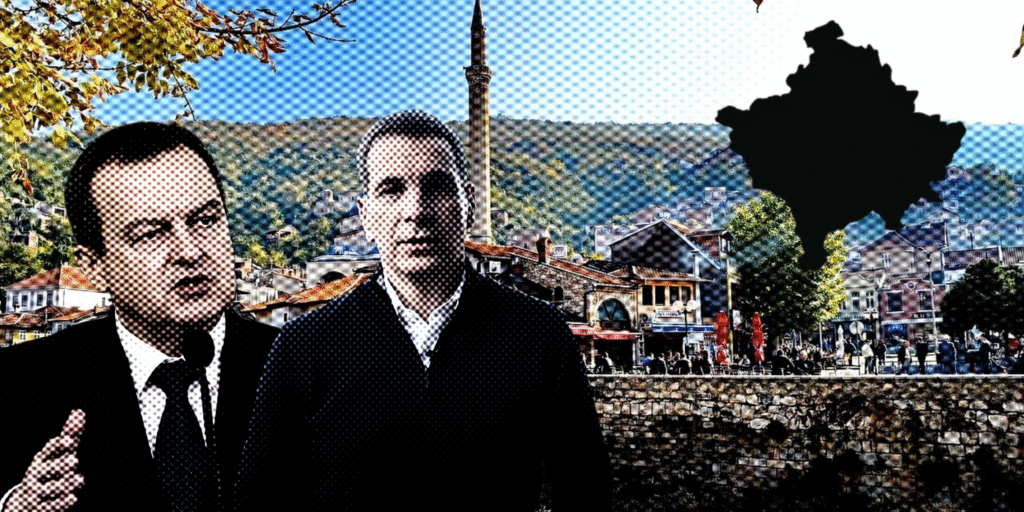

Serbian Minister of Internal Affairs and Deputy Prime Minister Ivica Dacic declared during an election rally in Belgrade that the Serbian flag will fly again in Prizren, reiterating claims about Serbia's historical ties with Kosovo. Dacic made these statements also in response to criticism by former German Foreign Minister Michael Roth, referring to Kosovo's historical past and the diminishing presence of the Serbian community in Prizren. His statement places the issue of territorial claims to Kosovo in the context of the election campaign in Serbia (see here).
Meanwhile, Miloš Jovanović, chairman of the New Democratic Party of Serbia (New DSS) and the bearer of the “Authentic Right” electoral list, during a visit to Prizren as part of the election campaign, declared that “Kosovo and Metohija is Serbia, it has always been Serbia”. Jovanović also said that his coalition has a plan for protecting the national interests and rights of Serbia and Serbs in Kosovo. In his party’s communication, Prizren was described as “one of the most beautiful Serbian cities” and as “Dušan’s imperial Prizren”, referring to a historical interpretation of the city in the context of Serbian national identity (see here).
Since Kosovo’s declaration of independence on 17 February 2008, Serbia has not recognised its statehood and has continued to consider Kosovo part of its territory. However, the statements of Dačić and Jovanović go beyond expressing this official position. Dačić concretises the territorial claim through the image of the Serbian flag flying again in Prizren, while Jovanović presents Kosovo as an inseparable part of Serbia and Prizren through historical references that link the city to Serbian national identity. These statements provide a starting point for analysing how history and national symbols are used in political discourse to articulate territorial claims, particularly during election campaigns.
The legal dimension and context of territorial claims
The agreement of Kumanovo and Resolution 1244 of the UN Security Council set the framework for the withdrawal of Yugoslav and Serbian forces from Kosovo and the establishment of international administration in 1999.
Meanwhile, on February 17, 2008, in an extraordinary session of the Kosovo Assembly, 109 deputies present approved the Declaration of Independence, through which Kosovo was declared an independent and sovereign state (see here).
In 2010, the International Court of Justice ESTABLISHED that Kosovo's declaration of independence did not violate international law. However, the advisory opinion did not rule generally on whether there is a right to secession under international law, nor whether states have an obligation to recognize Kosovo.
Such statements also contradict the spirit and goals of the Agreement on the path towards normalization of relations between Kosovo and Serbia, agreed in Brussels on 27 February 2023 (see here). The Preamble and Articles 1 and 2 of the agreement emphasize the importance of respecting territorial integrity, equality of the parties and the development of normal and good-neighborly relations. In this context, declarations on the restoration of Serbian sovereignty over Kosovo call into question the spirit of these commitments and may deepen mistrust between the parties, further hindering the resumption of dialogue on the normalization of relations (see here).
Given this legal and political framework, the statements of Ivica Dačić that the Serbian flag will fly again in Prizren and of Miloš Jovanović that Kosovo is part of Serbia can be interpreted as an expression of a claim for the restoration of Serbian sovereignty over the territory of Kosovo. This is because they are not limited to the mention of Serbian historical or cultural heritage, but are related to the presentation of a future Serbian sovereignty over a territory where Serbian institutions no longer exercise power. In this circumstance, the reference to the restoration of the Serbian flag in Prizren can also be perceived as threatening.
Irredentism and the instrumental use of history
Although the concept of irredentism does not, in itself, constitute evidence of a concrete program for changing borders, it serves as an analytical framework for interpreting statements that express the intention to place a territory back under the control of a state, relying on historical, ethnic or cultural claims. In international relations theory, such statements can be analyzed through this concept.
Historical narratives can be used to legitimize contemporary political claims, through the selection and interpretation of past events and symbols that strengthen national identity (see here). In this context, Serbian politicians' references to Kosovo's history and heritage should be analyzed in relation to how they relate to current territorial claims.
Dačić’s statement is relevant to this analysis because it expresses the claim through the symbolism of the flag and the idea of his return to Prizren. In Jovanović’s case, the same claim is articulated through the assertion that Kosovo has always been part of Serbia and through the presentation of Prizren as a city connected to Serbian historical heritage. In both cases, history is not presented only as a reference to the past, but is used to support a political stance towards the territory of Kosovo.
Comparative analysis in international politics
Vladimir Putin's references to Kievan Rus and shared Russian-Ukrainian history have been used to contest the uniqueness of Ukrainian statehood and to legitimize territorial claims (see here). The similarity with the statements of Dačić and Jovanović lies in the use of history to question the contemporary political status or to support territorial claims. This comparison serves to examine the way in which the historical past is used in political discourse, without implying that the two cases are identical in context or consequences.
Likewise, the memory of the territorial losses of 1920 has served to strengthen national identity and political ties with Hungarian minorities in neighboring countries (see here). Supporting national minorities across borders does not in itself constitute irredentism. The importance of this case for analysis lies in the way in which the memory of territorial losses and connections to communities across borders can be used in nationalist discourse.
Implications for interethnic relations in Kosovo
According to Rogers Brubaker's approach (see here), the relationships between national minorities, the states in which they live, and the states with which they share national affiliation are shaped by political interactions. This approach can be used to examine the relationship between Belgrade’s political discourse, the Serbian community in Kosovo, and Kosovo’s institutions. In this context, the presentation of Kosovo’s status as provisional may influence perceptions of the legitimacy of its institutions.
On the other hand, such statements may be perceived by Albanians as a challenge to the political status of Kosovo. The theory of intergroup threat (see here) provides a framework for analyzing how these messages can be interpreted as a threat to a group’s political status or security. In this context, Buzan, Wæver, and de Wilde’s (1998) theory of securitization helps to examine how the Kosovo issue is related to security and national identity in political discourse. Dačić’s statement about the Serbian flag in Prizren and Jovanović’s assertion that Kosovo has always been Serbia can be understood as messages that present Kosovo’s status as an unresolved issue of national identity and sovereignty. In interethnic relations, such discourse can deepen mutual perceptions of threat, increase mistrust between communities, and provoke reciprocal reactions (see here).
Foreign policy theory of distraction
The fact that the statements were made during the election campaign is not enough to conclude that they are intended to distract from domestic problems. However, through the foreign policy theory of distraction, which examines whether leaders use external tensions to influence domestic political dynamics (see here), one can analyze what effects such statements can produce in the electoral context.
Reiterating territorial claims to Kosovo could mobilize national identity and consolidate political support, shifting public attention to issues of sovereignty and relations with Kosovo. Similarly, Dacic's reaction to former German Foreign Minister Michael Roth could be used to build the image of a defender of national interests.
cONcluSiON
Ivica Dačić’s declaration that the Serbian flag will fly again in Prizren is not simply a reference to the historical past, but a way of presenting Serbian sovereignty over Kosovo as a claim that remains open in the future. By linking history to a concrete symbol of sovereignty, Dačić shifts the discourse from the non-recognition of Kosovo’s independence to the imagining of the return of Serbian control. In the same vein, Miloš Jovanović presents Kosovo as an inseparable part of Serbia, referring to the Serbian historical heritage of Prizren to support this claim.
In the context of the election campaign, this rhetoric may serve to mobilize national identity and present the defense of claims to Kosovo as part of the Serbian national interest. Although it cannot be determined whether these statements are directly aimed at electoral mobilization or distraction from domestic issues, what can be analyzed from their content is that national history and symbols are being used to keep Serbia’s territorial claim to Kosovo alive and to present it as a continuous part of the political discourse.