
Prepared by: Festim Rizanaj
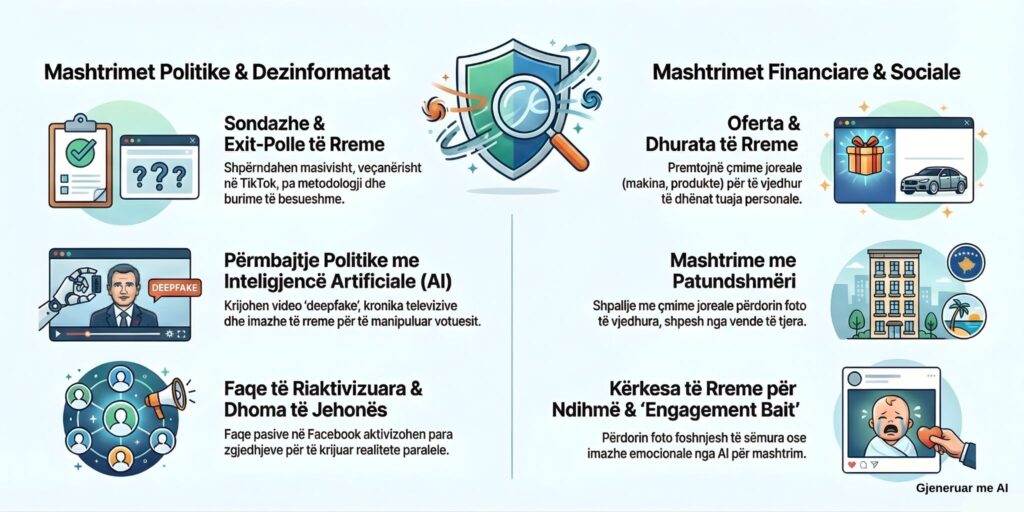
During 2025, the information landscape in Kosovo was characterized by a sophisticated increase in disinformation, driven particularly by the parliamentary and local elections. The use of new technological methods and the reactivation of old tactics created a complex and challenging environment for the audience. Below are detailed six main phenomena
Fake polls and opinion manipulation during elections
During 2025, one of the most dominant phenomena was the spread of fake surveys and exit polls, especially during the campaign for the local elections of October 12 and the early parliamentary elections of December 28. From September 13 to October 12, a total of 28 false claims presenting public opinion polls were identified, of which 26 were fictitious polls and two were exit polls published on election day. These contents were massively distributed in Facebook (23 cases) and TikTok (4 cases), affecting the competition in 14 different municipalities such as Prishtina, Prizren and Gjilan. Meanwhile, on the eve of the December elections, more than 50 publications were made under the false pretense of presenting surveys. They received millions of views on social media, with prominent space on TikTok.
The main characteristic of these manipulations was the total lack of scientific methodology or attributing surveys to companies that did not exist at all. In some cases, disinformers used names prestigious American companies to give false credibility to fabricated figures that favored certain candidates. This trend was also observed before the parliamentary elections of February 9, where TikTok republished old surveys of past elections, presenting them as current ones to create false perceptions about support for political entities.
The use of Artificial Intelligence (AI) and Deepfake
The year 2025 experienced a significant change in the use of Artificial Intelligence for the production of disinformation, where they were created fake television news that imitated professional media. Accounts like “PaFiltraNews” on TikTok used apps like “Sora” to generate news presenters who read biased political texts, reaching over 200 thousand viewsThese videos often featured fabricated interviews with migrants at airports or footage of long convoys of cars, intended to suggest a massive mobilization of the diaspora in support of a particular political entity.
In addition to videos, AI was widely used for “engagement bait” through emotional images of children or the elderly. Pages like “NKosovë” and “Express Aktiv” published photos of newborn babies with touching captions like "I'm 45 years old and today I became a father", which received thousands of likes and comments from users who did not recognize the artificial nature of the image. This tactic was used to artificially increase the audience and visibility of pages through Facebook's algorithm, exposing users to content that aroused strong emotions.
Activating passive pages and echo chambers
Another sophisticated trend was reactivation of "zombie" pages on Facebook, which had been inactive for months or years and suddenly "woke up" before the elections. The page "Në Kohë" with over 416 thousand followers was reactivated after six months of silence, while other pages like "New Kosovo" published nearly 200 political posts within a short period of time. After the elections, many of these pages changed the topic, moving on to entertainment content like "Big Brother Vip Albania" to keep the audience engaged.
In parallel, the phenomenon of "echo chambers" in closed groups like “Gjilani Sot” or “Pulsi i Llapit”. These virtual spaces functioned as closed information circles where users were only exposed to materials that reinforced their beliefs, creating the false impression that "the whole society thinks alike"This practice deepened political polarization and damaged the space for free debate, directing voters towards selected and often manipulated information.
The return of old misinformation during elections
During the 2025 pre-election periods, a pronounced phenomenon of the return of fake content to circulation or misleading from the past, which were presented in new political contexts. Various social media accounts re-distributed false claims of 1998 to Albin Kurti regarding the USA and Rugova, as well as fabricated statements by Serbian President Aleksandar Vučić on cooperation with the Kosovo opposition, which had been treated as incorrect even before. Also, they were returned untrue statements by Croatian President Zoran Milanović that had been circulating since 2023, aiming to influence public opinion by recycling narratives that had been proven false years ago.
This process of repeating misinformation is related to what is known as Continuous Impact Effect (CIE), where individuals' perceptions continue to be influenced by the initial information even after it has been corrected. During local elections, old video footage of analysts to simulate actual support for candidates like Përparim Rama, as well as redistributed excerpts from speeches from 2014 in Parliament to take political statements completely out of context. These tactics, which have also been encountered in countries such as Canada, aim to exploit strong links to old information with voters' mental models to create confusion on the eve of new elections.
Financial fraud and identity theft
The year 2025 saw an increase of real estate scams on Instagram and TikTok, where houses and apartments were offered at unrealistic prices. Accounts like “real_estate.kosova” advertised apartments in Pristina for 41 thousand euros, while other accounts presented villas in Brazil as property in Durrës for 150 thousand euros. These scams aimed to steal personal data or advance payments from citizens, using images stolen from real agencies abroad.
Another widespread scheme involves sites that impersonate well-known companies such as “Mega Mall”, “Viva Fresh Store.fans” or “ETС – Kosovo”, which promise big prizes like cars “Volkswagen Tiguan 2025” or products at symbolic prices. Users are asked to register through links that lead to dubious domains like “myfreesites.net”, which have no connection to real companies. These sites use photos of foreign shopping malls, like the one in Bucharest, to create an illusion of credibility with Albanian users.
Another serious phenomenon was misuse of the identity of sick babies to fraudulently raise funds. Accounts like “Rena Capo” shared photos of sick children in dozens of Facebook groups, which turned out to be taken by a Russian charitable foundation (“Vera v detstvo”) since 2020/21 49-52. Fraudsters appealed to human empathy and often justified the lack of financial transparency with emotional claims that they were in the hospital and did not have time for details.
External narratives and political labeling
Social networks were used to distribute negative narratives against Albanians, mainly from accounts on the X platform (such as “VukFeNix”). These accounts published videos of crimes in various European countries, falsely claiming without any evidence that the perpetrators were Albanian. This misinformation was then amplified through channels on Telegram and Russian propaganda domains like "Pravda", with the aim of spreading a negative international discourse.
Domestically, there has been an increase in the practice of politicians labeling accurate reporting as "fake news" or "misinformation" with the aim of delegitimizing the media. This rhetorical dimension was used to create doubt and confusion among the public, undermining trust in authentic sources of information. There was also a revival of old misinformation, such as manipulated statements by Albin Kurti from 1998 or videos taken out of context from 2014, which were re-distributed during the 2025 campaigns.
Manipulation of search engines (Google)
A new and technically sophisticated phenomenon was the emergence of fake news about Kosovo directly in Google search results. Disinformers used foreign domains (such as “isna.ir” from Iran or “24tv.ua” from Ukraine) to publish fake headlines in Albanian and English about diplomatic tensions, security incidents or election resultsThese titles often used Serbian terminology such as “Kosovo and Metohija” or “Kosovska Mitrovica”.
The most disturbing part of this phenomenon was the technical redirection of users; when clicking on the article, within a few seconds the person was sent to betting and gambling website (like “1wirpm.com” or “rbbcsnn.com”). Technical analysis showed that these URLs were linked to servers in Russia and the Marshall Islands, using multiple redirects to mask suspicious activity 78. This type of manipulation created a false picture of Kosovo's diplomatic and political reality, while simultaneously aiming for financial gain through technical fraud.