

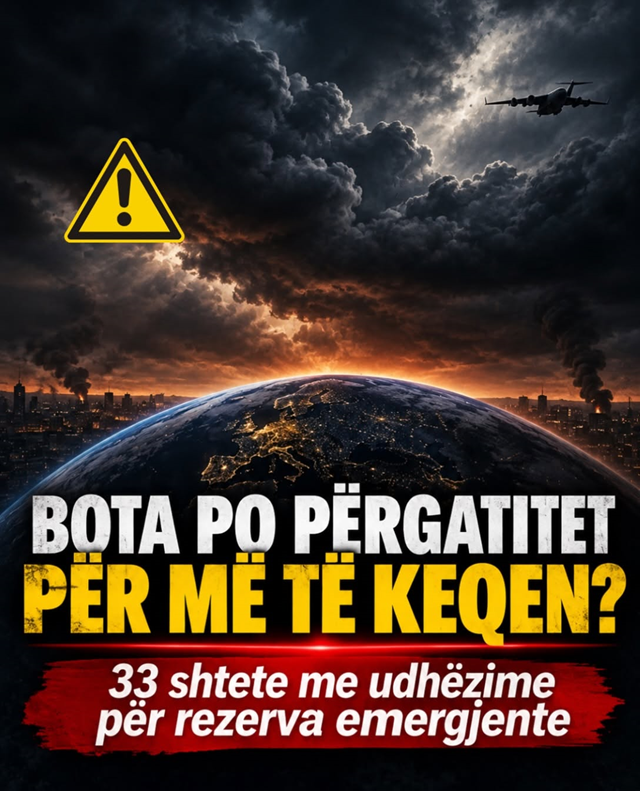
A has been published. CONTENT which claims that more and more countries around the world are asking citizens to stockpile food, drinking water, and other basic products to prepare for possible emergency situations.
The publication lists dozens of countries from different continents, while noting that the European Union also recommends that citizens be able to cope with at least the first 72 hours of an emergency.
Furthermore, the content links these recommendations to international tensions, the risk of military conflicts, and the possibility of disruption of vital services.
The content was published on Saturday on Facebook by the page called "Meteo Kosova".
What's wrong with this content?
The content presents several states' recommendations for emergency preparedness as developments related to military tensions, without providing evidence for such a connection.
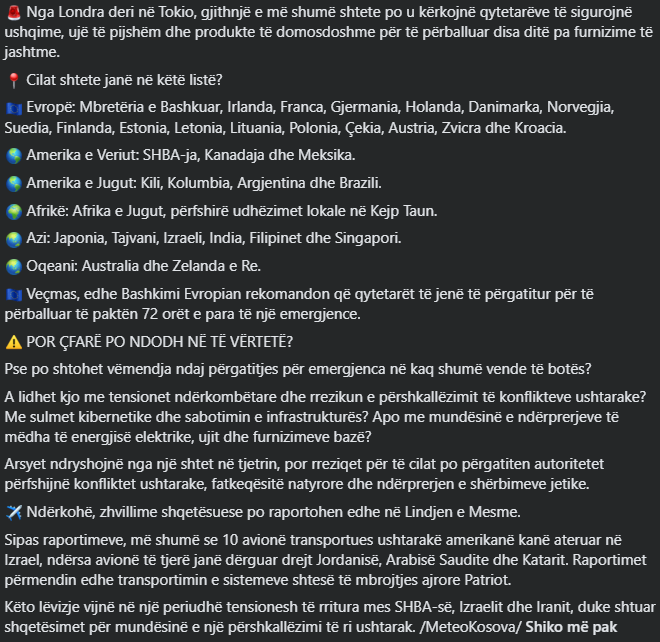
As of the time of writing, the content has received over 500 reactions, while the page that published the claim has over 148 thousand followers (see here).
Because the content addressed recommendations from authorities in dozens of foreign countries, without any particular focus on Kosovo, it created the impression that the content could have been adapted from a foreign publication.
Therefore, research was conducted to identify the original article and source of information.
Through the artificial intelligence chatbot "ChatGPT", was found that the original article was published by the English-language weekly magazine, Newsweek (see here).
After checking and verifying this article, it was found that the text titled "Map Shows Nations Urging People to Stockpile Food as France Issues Warning" addresses recommendations from governments of various countries for preparing citizens for emergency situations, such as wars, extreme weather conditions, and cyber threats.
It says recommendations vary from country to country. Some countries advise securing supplies for 72 hours, others for a week, while Germany recommends reserves for up to 10 days.
The article also mentions the European Union's Preparedness Strategy, presented in March 2025, in response to rising geopolitical tensions, conflicts and the risk of natural disasters.
However, the original article does not present these recommendations as indicators of an imminent military escalation or a specific international threat, but as part of general emergency preparedness measures.
It does not mention the movements of American military aircraft towards Israel and other Middle Eastern countries, nor does it claim that the recommendations for food reserves are a consequence of any possible military escalation in this region.
Hibrid.info found a ITEM published on October 29, 2026 by The Times of Israel newspaper, reporting that more than 10 American military transport aircraft had landed at Israeli air bases during the previous week.
According to the article, other flights were also made to US bases in Jordan, Saudi Arabia, Qatar and Kuwait. The contents of the cargo are unknown, while their connection to the reinforcement of air defenses against a possible escalation with Iran is presented as an assessment by analysts.
From the above findings, it results that the content discussed has combined two different developments, creating the impression that they are linked to a possible military escalation, although no evidence is provided to support such a connection.
Therefore, the fact that some countries recommend preparing reserves for emergency situations does not, in itself, constitute evidence that there is an imminent risk of military conflict or disruption of vital services.
What does emergency preparedness mean according to international organizations?
According to the United Nations Office for Disaster Risk Reduction (UNDRR), preparedness is defined as the knowledge and capacities that governments, response and recovery organizations, communities and individuals develop to anticipate, cope with and recover effectively from the consequences of potential or actual disasters. This practice includes emergency planning, stockpiling of necessary equipment and supplies, coordination of institutions, evacuation, public information, and training and exercises (see here).
Even the World Health Organization (WHO), within the framework of approaches to strengthening preparedness and response to emergencies, emphasizes the importance of an all-hazards approach, which takes into account risks of different origins, including natural, technological and social ones. According to this approach, although the sources of risks differ, they can pose similar challenges to health systems and require cooperation between different sectors. For this reason, emergency preparedness is not limited to one type of threat, but aims to create capacities to cope with different emergency situations (see here).
Meanwhile, the United Nations Educational, Scientific and Cultural Organization (UNESCO), within the framework of the approach to disaster risk reduction, treats preparedness as one of the four phases of risk management, alongside risk mitigation, response and recovery. According to UNESCO, this phase includes planning, training and educational activities that help communities and countries prepare for disasters, by determining in advance how to act, where to go and who to ask for help when they occur. This preparation aims to prevent potential risks from turning into disasters with serious consequences for communities (see here).
What do international reports say about the state of security in the world?
According to reports The Global Peace Index 2026, published by the Institute for Economics and Peace (IEP), shows that the level of peace in the world has deteriorated for the twelfth consecutive year. The report highlights 61 active conflicts between states, the highest number since the end of World War II. These data show that concerns about international security have a real basis, however, they do not prove that recommendations for food reserves are a warning of imminent conflict.
Analyze
The publication presents recommendations from several countries for creating food reserves and basic supplies as part of preparations for emergency situations, but at the same time places them in the context of international tensions, the risk of military conflicts and the disruption of vital services.
The investigation found that the original article, published by Newsweek, discusses recommendations for states to prepare for emergencies, but does not link them to the movements of US military aircraft in the Middle East. These two developments are discussed in separate articles and no evidence is provided to prove that they are connected.
On the other hand, international reports show that concerns about global security have a real basis. The data testify to the existence of serious international security challenges, but do not prove that recommendations for food reserves were made in response to an imminent conflict.
International organizations also treat emergency preparedness as part of risk management practices, which include preparation for various types of emergencies and are not limited to armed conflicts.
Therefore, the problem with the publication lies not in the fact that it mentions the existence of international tensions and risks, but in the way it places recommendations for emergency preparedness in this context, creating the impression of a connection that is not supported by evidence.
Therefore, based on its work methodology, Hibrid.info assesses this content as "Manipulation of facts".
rationale
“Factual manipulation” is a rating given to informational content that uses facts known to be accurate but interprets them in a distorted manner. These reports typically use accurate information to draw incorrect conclusions or claims, thereby misleading consumers of media content about the actual meaning of the facts presented.