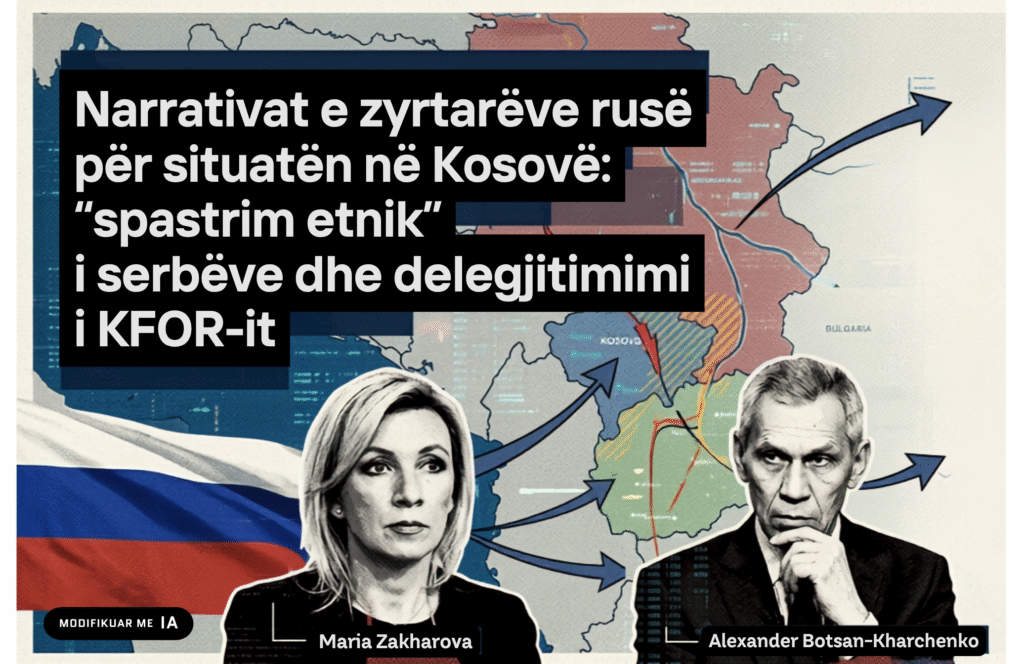

Recent statements by Russian officials on the situation in Kosovo present a narrative focused on the claim that the Serbian community is facing "ethnic cleansing" and "systematic terror", while Kosovo institutions, KFOR, NATO and the European Union are portrayed as responsible or co-responsible for this situation.
At the same time, Russia presents itself as the actor that protects Serbs, Serbia and the implementation of UN Security Council Resolution 1244. The statements of the Russian Ambassador to Serbia, Aleksandar Botsan-Kharchenko, and the spokesperson for the Russian Foreign Ministry, Maria Zakharova, come in the context of recent changes in the presence of KFOR in several sensitive points in Kosovo and interpret these developments as evidence of increased danger to the Serbian community.
Russia presents itself as the protector of Serbs
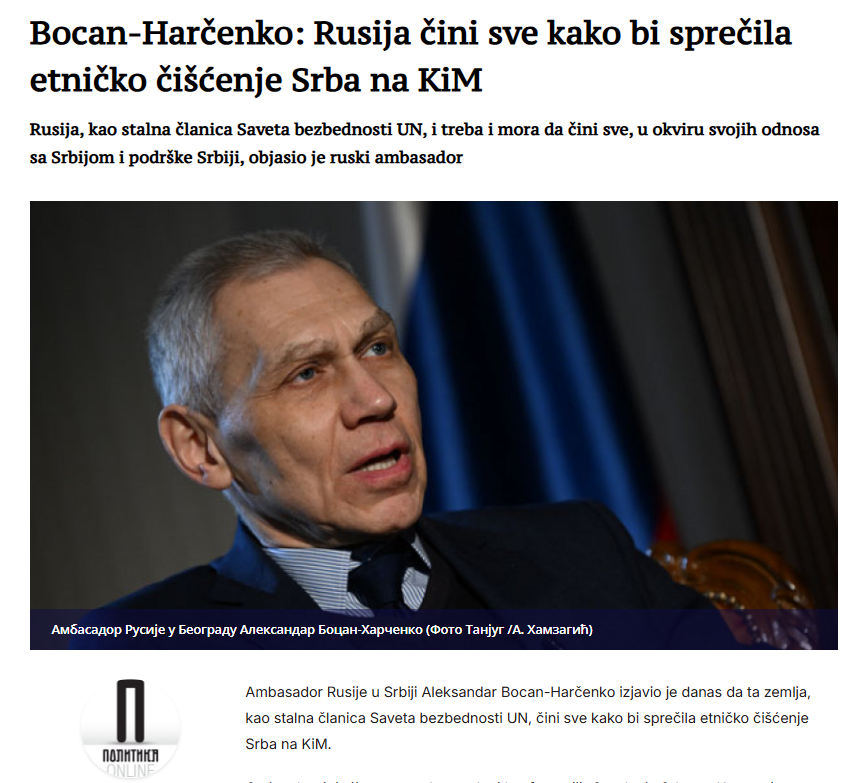
Russian officials have intensified their rhetoric about the situation of Serbs in Kosovo, portraying Russia as their protector and Kosovo institutions as responsible for an alleged process of “ethnic cleansing.” On August 19, 2026, the Russian ambassador to Serbia, Aleksandar Bocan-Kharchenko, stated that Russia is “doing everything” to prevent the “ethnic cleansing” of Serbs in Kosovo. He linked this role to Russia’s position as a permanent member of the UN Security Council and to the political support that Moscow provides to Serbia. In fact, a similar claim by Bocan-Kharchenko about “gradual ethnic cleansing” had previously been covered by Hibrid.info, which had assessed it as a claim unsupported by facts. (here)
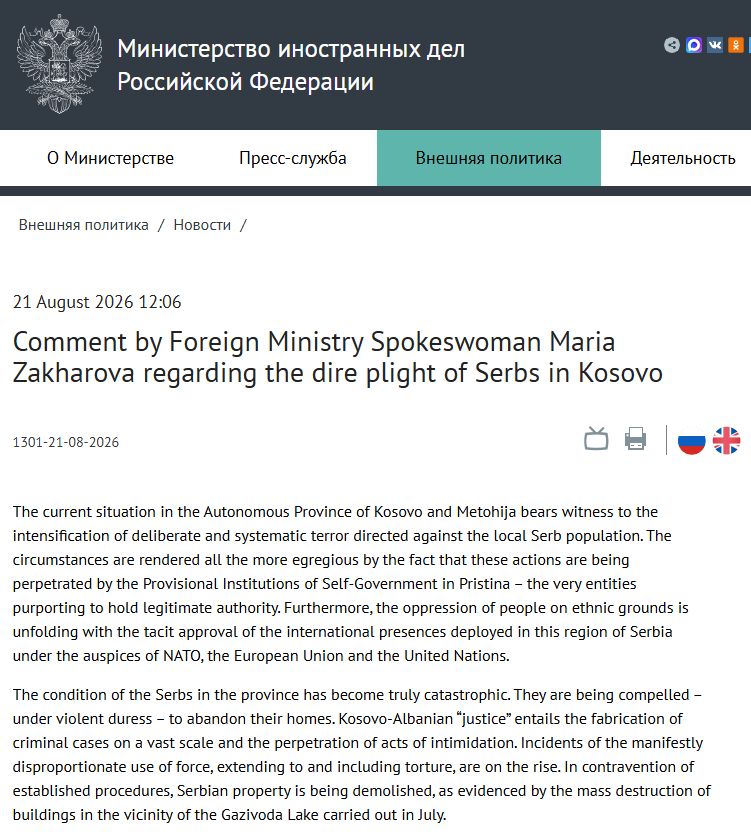
Then, on August 21, Russian Foreign Ministry spokeswoman Maria Zakharova, repeated it and expanded this framework, describing the situation of Serbs in Kosovo as "catastrophic" and claiming that "systematic and deliberate terror" is being carried out against them.
The allegation of “ethnic cleansing” and “systematic terror”
In their statements, Russian officials present a series of developments – security incidents, arrests, court proceedings, property issues, and actions by Kosovo institutions – as part of a coordinated policy against Serbs.
Zakharova alleged that Serbs are being forced from their homes, that criminal cases are being “fabricated” against them, and that disproportionate force, even torture, is being used. She also cited the demolition of buildings in the Gazivoda/Ujman area in July 2026 as an example of alleged procedural violations.
The Gazivoda/Ujman case is a real development, but the documented facts do not support its description as part of a campaign of “ethnic cleansing.” On July 21, 2026, Kosovo institutions demolished 11 buildings in the Ujman Lake area, while the action was opposed by international missions.
Likewise, the existence of arrests and investigations for war crimes does not automatically prove the existence of a coordinated state policy of "ethnic cleansing".
In her statement, Zakharova takes the narrative even further by warning of a “humanitarian catastrophe” in Kosovo and calling on UNMIK and international structures to take comprehensive measures. This wording raises the alarm level and presents the situation as a crisis heading towards a humanitarian escalation.
Delegitimization of KFOR
A central element of the new Russian narrative is also the interpretation of changes in the KFOR presence. Botsan-Kharchenko and Zakharova have linked changes to the bridge over the Ibar in North Mitrovica and in the Deçan Monastery area to increased risk to the Serb community.
Zakharova claimed that KFOR’s decision to reduce its presence in these points and partially replace its troops with Kosovo Police poses a threat of increasing interethnic tensions. In this way, an operational change in KFOR’s presence is interpreted as evidence of a broader process of “abandonment” of Serbs by the West. Meanwhile, changes in KFOR’s presence should be distinguished from a withdrawal of the mission: Resolution 1244 authorized an international security presence in Kosovo, while UN documents define KFOR as this international security presence, with significant NATO participation.
The Russian narrative goes beyond criticism of recent changes and aims to delegitimize the role of KFOR and the international presence. At the same conference where Botsan-Kharchenko spoke, former Deputy Speaker of the Russian Duma Sergey Baburin claimed that the “myth” that KFOR is in Kosovo in accordance with Resolution 1244 should be “exploded” and called for the replacement of NATO forces with another international force. This claim contradicts the UN documents themselves: Resolution 1244, adopted on 10 June 1999, authorized the establishment of an international security presence in Kosovo. United Nations documents identify this presence as KFOR, led by NATO. Thus, Russian criticism is not only aimed at the way KFOR functions, but also at creating the perception that its presence is legally dubious or illegal.
The EU and the West are presented as co-responsible
In Zakharova's statement, responsibility is also extended to the European Union, NATO and other international structures. She accused Western capitals of "apathy" and claimed that their inaction is encouraging the "ethnic cleansing" of Kosovo. As for the EU, she stated that it has failed to mediate the dialogue and that it has "sabotaged" the implementation of the agreements on the Association of Serb-majority municipalities.
In this way, the narrative constructs a clear scheme: Kosovo institutions are presented as repressive actors, the EU and NATO as actors that tolerate or enable this policy, and Russia as the actor that opposes and protects Serbia. This shifts the Kosovo issue from a political and security dispute to a broader geopolitical confrontation between Russia and the West.
The statements of Botsan-Kharchenko and Zakharova build a common narrative with four main elements: Serbs in Kosovo are presented as a community under existential threat; Kosovo institutions are accused of “ethnic cleansing” and systematic repression; KFOR, NATO and the EU are presented as actors who fail or cooperate with this process; while Russia is positioned as a defender of Serbs, Serbia and Resolution 1244.