

Wrote: Festim Rizanaj
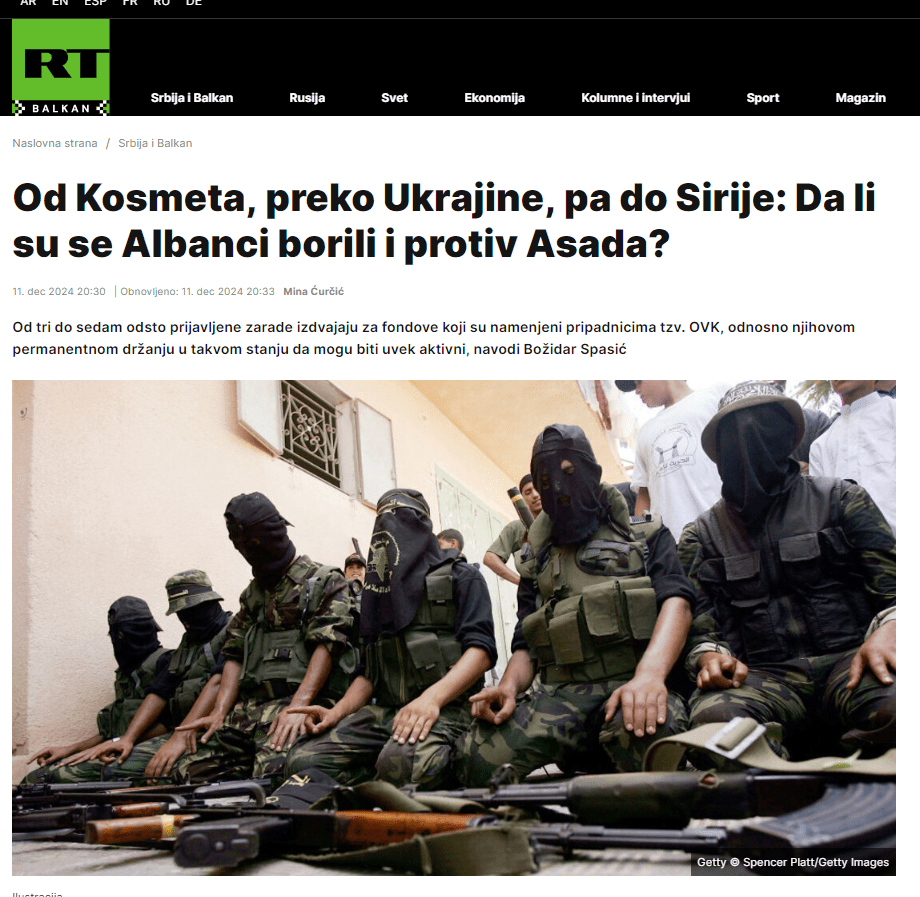
The Russian media outlet, Russia Today (RT) Balkans, Serbian language service, has published an article (December 11) with the claim that “former members of the Kosovo Liberation Army (KLA) have been involved in international terrorism.”
The article is based on a statement by retired State Security Operative Božidar Spasić, who claims that former members of the Kosovo Liberation Army (KLA) have been involved in international terrorism as mercenaries or, as he refers to them, “dogs of war” (the dogs of war – captures the idea of war as a force that, once unleashed, is very difficult to control by either side), participating in conflicts such as in Ukraine against Russia, in Syria against the Bashar al-Assad regime, and in Gaza. According to him, these individuals operate within groups such as ISIS and Al Qaeda and are financially motivated, receiving high salaries and the right to loot in war zones. A portion of their income is alleged to go to the KLA funds, to keep them ready for future mobilizations.
Spasic also claims that Albanian authorities in Kosovo cooperate with the US in equipping and training these fighters at the Bondsteel base, where logistics for their missions outside Kosovo are provided. He identifies Abdul Jashari, an Albanian jihadist leader, as a clear example of these involvements, suggesting that he was part of the KLA during the Kosovo conflict and then continued his international terrorist activities.
Context of unfounded claims
Allegations of former KLA members' involvement in international conflicts, including Ukraine and Syria, and terrorist organizations such as ISIS have not been supported by concrete evidence. There are no official reports or independent sources confirming these acts or their connections to these groups.
This year, Russian media and officials have claimed that former Kosovo Liberation Army (KLA) soldiers are INCLUDING in the war in Ukraine, including serious accusations, such as organ traffickingThese claims have been rejected by the competent bodies of the Republic of Kosovo, which have considered them unfounded and without evidence.
In addition, Kosovo has approved lawn on the prohibition of joining armed conflicts outside the territory of Kosovo, which provides for a prison sentence of five to fifteen years for those who organize, recruit, lead or train individuals to participate in paramilitary or parapolice groups outside Kosovo. This law was approved by the Kosovo Assembly on March 12, 2015, and was considered an important step in the global fight against terrorism and religious extremism.
The allegations of KLA funds and connections to the Bondsteel base remain speculation, as no verifiable evidence has been provided to support this alleged collaboration.
Otherwise, Kosovo, in cooperation with the USA, has carried out actions to return its citizens from the hotbeds of war in Syria. They have been prosecuted and many of them have been sentenced to imprisonment.
Regarding Abdul Jashar, in the publication "Foreign fighters and local jihadists from the Western Balkans: Trends and implications” from the Center for Combating Terrorism at West Point, says the unit’s commander is Abdul Jashari, an ethnic Albanian national from North Macedonia, known by the nom de guerre Abu Qatada al-Albani. Jashari is an influential figure and close military advisor to Abu Muhammad al-Julani, the leader of HTS, who appointed Abu Qatada al-Albani in the summer of 2014 to lead the organization’s military operations in Syria. The U.S. Treasury Department designated Jashari a terrorist on November 10, 2016. His name has recently appeared in HTS communications as one of the members of a senior committee tasked with leading reconciliation efforts with Hurras al-Din, a jihadist faction affiliated with al-Qaeda.
But the West Point Counterterrorism Center publication does not argue any direct connection between Abdul Jashar and the Kosovo Liberation Army (KLA). Instead, it describes Jashar as a well-known figure in the ranks of jihadist groups in Syria and a close advisor to HTS leader Abu Muhammad al-Julani, without mentioning any connection to the KLA.
Analyze:
Russian media outlets, such as Russia Today (RT) Balkans, have published claims that former members of the Kosovo Liberation Army (KLA) have been involved in international terrorism, engaging in conflicts such as in Ukraine, Syria, and Gaza, and that they operate within terrorist groups such as ISIS and Al Qaeda.
These allegations, however, have not been supported by concrete evidence and have been rejected by the Kosovo authorities, who have stressed that the accusations of KLA involvement in these activities are baseless and without factual support.
Kosovo has adopted laws to combat the involvement of its citizens in foreign conflicts and has developed actions for the return and prosecution of individuals involved in wars abroad, including convictions for many of them.
Based on the working methodology, this claim is assessed as "disinformation".
Reasoning:
"Disinformation" is defined as information content that contains a "mix" of inaccurate sources or even half-truthful attributes, and that is created and/or distributed with the deliberate intention of causing harm. The motive behind the producers/distributors of disinformation content lies in achieving a political, financial, psychological or social goal.