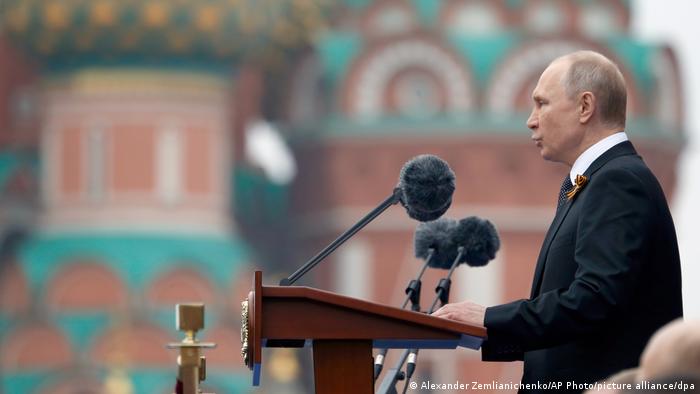

In his speech given on the occasion of the military parade in Moscow, Russian President Vladimir Putin made a series of claims about Ukraine and NATO.
The BBC has checked some of the things he said.
"Kiev has declared that it may acquire nuclear weapons"
President Putin has repeatedly said that Ukraine plans to acquire nuclear weapons as a justification for invading Russia, although there is no evidence to support this claim.
When it was part of the former Soviet Union, Ukraine had nuclear weapons, but gave them up in the 1990s in exchange for security guarantees from the US, UK and Russia.
Last year, the Ukrainian ambassador to Germany, Andriy Melnyk, said that if Ukraine could not join NATO, it might have to reconsider its nuclear-weapons-free status.
"Either we are part of an alliance like NATO... or we have the only option - to arm ourselves and perhaps rethink our nuclear status."
However, the Ukrainian government has not expressed any intention to acquire nuclear weapons, and a military strategy document published last year did not refer to them.
A report from the Bulletin of the Atomic Scientists in March noted that even if Ukraine wanted nuclear weapons, it would face major logistical and technical challenges in creating weapons-grade nuclear material and having the means to deliver it.
This would also mean that Ukraine would be violating its obligations under the Nuclear Non-Proliferation Treaty, which it joined in 1994. This prohibits countries that do not have nuclear weapons from acquiring them.
The UN nuclear watchdog, the International Atomic Energy Agency (IAEA), says it has seen no signs in Ukraine "of the diversion of nuclear material, intended for peaceful activities, to other purposes."
"There was every indication that a clash with neo-Nazis – supported by the US and its junior partners – was inevitable."
President Putin has often claimed the presence of neo-Nazis and "Banderites" in Ukraine as a justification for Russia's invasion.
In the last parliamentary elections in 2019, support for far-right candidates was just 2% – much lower than in many other European countries.
Ukrainian President Volodymyr Zelensky is Jewish and members of his family died in the Holocaust.
In the 2019 presidential election, which Zelensky won, the leading far-right candidate won only 1.6% of the vote.
But there have been far-right groups in Ukraine – the most high-profile being the Azov Regiment – elements who have expressed support for Nazi ideology.
It was formed to resist Russian-backed separatists who occupied areas of eastern Ukraine in 2014 and was later absorbed as a unit within the Ukrainian army.
The term "Banderites" refers to supporters of the World War II nationalist leader Stepan Bandera, who expressed anti-Semitic views and for a time collaborated with Nazi Germany.
He remains a highly controversial figure in Ukraine, with some hailing him as a patriotic nationalist, others condemning him for his Nazi sympathies.
(Full article published by BBC, available in English)