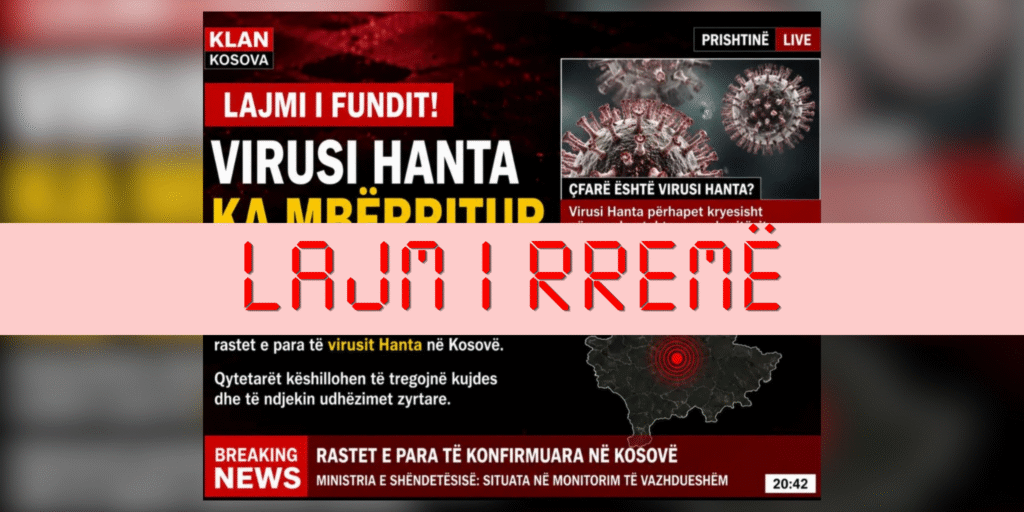

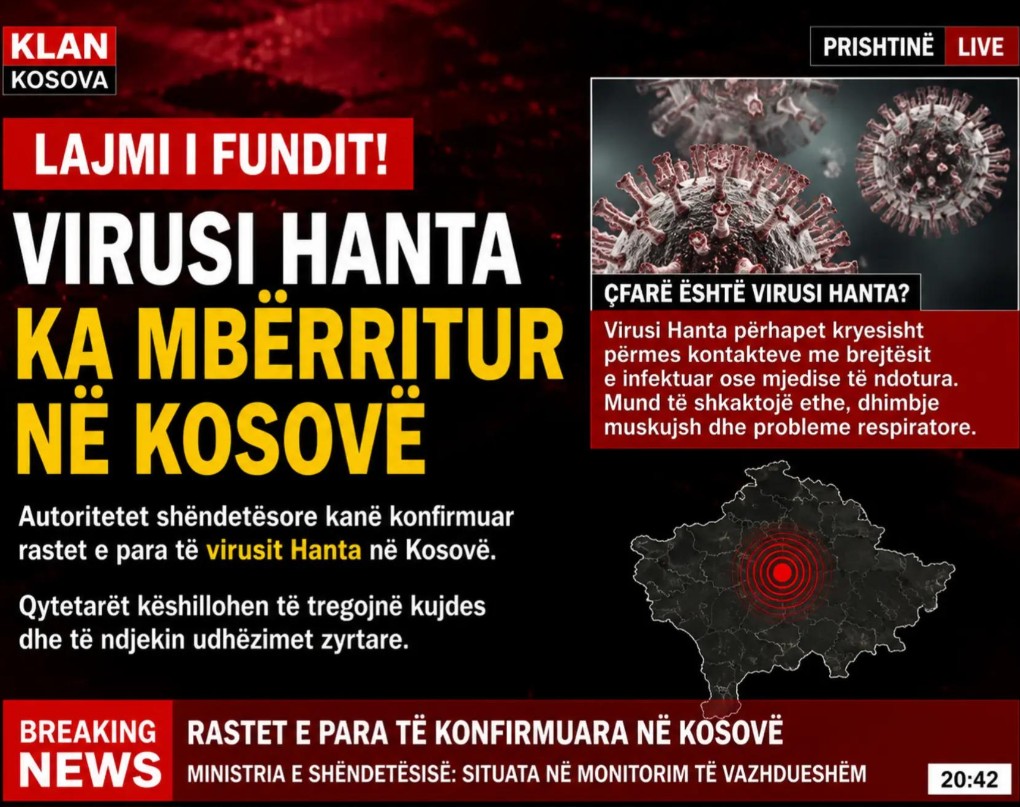
Through posts published on TikTok, it is alleged that "Hantavirus has arrived in Kosovo" and that health authorities have confirmed the first cases of this virus in the country (see here and here).
These posts also attribute a statement to the National Institute of Public Health of Kosovo (NIKPK) that "The necessary measures are being taken for control and prevention."
The truth?
After fact-checking conducted by hibrid.info, it was confirmed that this claim is false.
FACTS
Hibrid.info has checked the official Facebook page of the National Institute of Public Health regarding this claim, but has not found any official announcement or statement confirming the first cases of hantavirus in Kosovo, as claimed in the posts published on TikTok (see here).
NIKSHPK on May 8, through a Facebook announcement, has clarified that hemorrhagic fever with renal syndrome (EHSV), caused by hantaviruses, does not represent a new disease in Kosovo. According to the NIPHK, the number of cases reported over the years has remained low and stable.
"During the period 2021–2025, a total of eight cases were reported, by year: two cases in 2021, one case in 2022, with two cases each in 2023 and 2024, and one case in 2025. These data indicate a low prevalence of the disease in the country," The NIPHK announcement further states.
So, from the NIPHK there is no announcement of new cases of this infection nor a statement that "The necessary measures are being taken for control and prevention", as claimed in TikTok posts.
In the posts published on TikTok, it is noted that the name of the television Klan Kosova has been used. However, after verification on the official website of the portal “klankosova.tv”, no article was found reporting that “Hantavirus has arrived in Kosovo" (see here).
This shows that the name of this medium has been misused in content distributed on TikTok, creating the false impression that Klan Kosova has reported on confirmed cases of this virus in the country.
What is hantavirus?
NIKSHPK clarifies that hantaviruses are viruses that are transmitted from rodents to humans. Infection occurs primarily through the inhalation of particles contaminated with the urine, feces, or saliva of infected rodents. In Europe, the disease most commonly presents as hemorrhagic fever with renal syndrome (EHSV).
The incubation period is usually about two weeks, but can last from 7 days to 6 weeks. Symptoms can be mild or severe and include fever, fatigue, muscle aches, gastrointestinal problems, and in severe cases kidney damage or respiratory problems.
Transmission method
Infected rodents shed the virus through urine, feces, and saliva. Humans are primarily infected through contact with contaminated environments or materials. The hantaviruses circulating in Europe are not transmitted from person to person and are not carried by insects. Human-to-human transmission has only been documented for the Andes virus (ANDV) in some areas of South America.
Who is most at risk?
The highest risk of exposure is:
- forest workers,
- farmers,
- people who work or stay in environments where rodents are present.
Treatment and vaccine
There is currently no licensed vaccine against hantavirus in Europe and no specific antiviral treatment. Supportive care and symptomatic treatment are very important for the management of the disease.
Preventive measures
To reduce the risk of infection it is recommended:
- avoiding contact with rodents and their waste;
- regular maintenance and cleaning of living and working spaces;
- ventilation of enclosed spaces before cleaning;
- using a mask and gloves when cleaning areas where there may be rodents.
Analyze
Through posts on TikTok it is claimed that "Hantavirus has arrived in Kosovo"and that the first cases of this virus have been confirmed, also attributing a statement to the National Institute of Public Health for preventive measures.
However, after verifying the facts, it was proven that this claim is false. There is no official announcement from the National Institute of Public Health confirming new cases of hantavirus in Kosovo.
Also, content on TikTok has misused the name of Klan Kosova television, as there is no article on this medium's website reporting on the arrival of this virus in the country.
Based on its work methodology, hibrid.info assesses this content as "Fake News".
rationale
The “Fake News” rating is given to informational content that is entirely fabricated or that contains factually incorrect claims or information. Content that is rated as fake news can be defined as having been created and distributed with the intent to misinform the public, i.e., to present a claim that is completely false as fact.