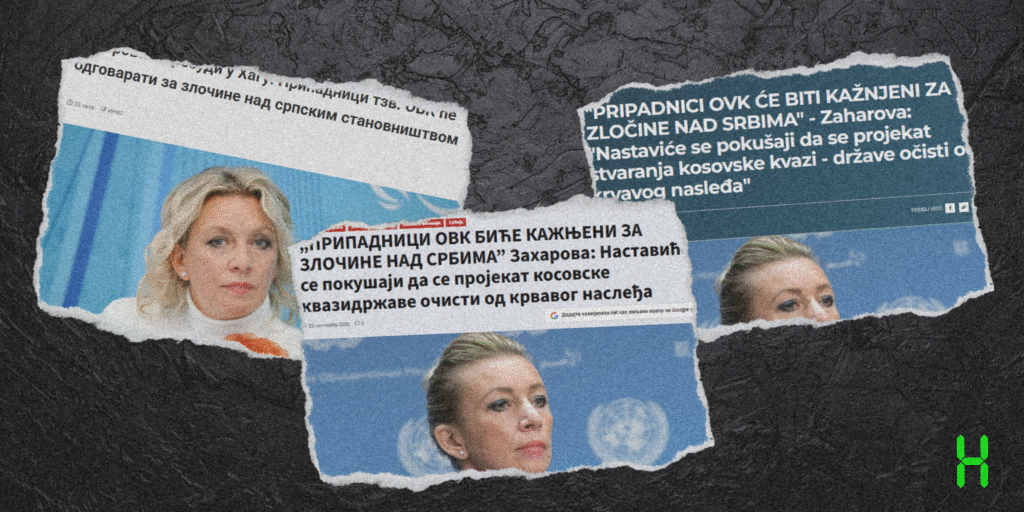

Following the verdict of the Kosovo Specialist Chambers in The Hague against former leaders of the Kosovo Liberation Army (KLA), the spokesperson for the Russian Ministry of Foreign Affairs, Maria Zakharova, has made statements that place the court decision in a broader political framework.
On September 22, 2026, Zakharova said that members of the KLA would be held accountable for crimes against the Serbian population. She described Kosovo as a “quasi-state” and said that efforts would continue to “cleanse” the project of Kosovo’s creation from its “bloody legacy.” The statement was originally published by Sputnik and was later republished by several Serbian media outlets (see here, here, here and here).
Kosovo is presented as a "quasi-state" built on a "bloody legacy"
In her statement, Zakharova described Kosovo as a “quasi-state” and claimed that efforts will continue to “cleanse” the project of its creation from the “bloody legacy.” Thus, the Hague verdict is placed in a framework where Kosovo’s statehood is directly linked to the KLA and war crimes.
The facts:
Kosovo declared independence on 17 February 2008. In its 2010 advisory opinion, the International Court of Justice (ICJ) found that Kosovo’s declaration of independence of 17 February 2008 did not violate international law. The Court also found that the adoption of the declaration did not violate UN Security Council Resolution 1244 (see here).
The KLA is presented as a "criminal organization"
Zakharova described the KLA as a “classic criminal organization” and claimed that its members should face responsibility for crimes against the Serbian population. She also cited allegations of violence against Albanians who, she said, had not shown loyalty to the Kosovo independence project.
The facts:
The Kosovo Specialist Chambers’ judgment concerns the criminal responsibility of the individuals accused in the case against Hashim Thaçi, Kadri Veseli, Rexhep Selim and Jakup Krasniqi. For this reason, the court’s findings should be distinguished from general political characterizations of the KLA as a whole (see here).
This means that a criminal verdict against specific individuals cannot automatically be presented as a judicial decision that every member of the KLA, or the KLA as a whole, is criminally responsible for the crimes in question.
NATO intervention is presented as part of a KLA-backed project
In her statement, Zakharova also links the KLA to the West and NATO's intervention in Kosovo, presenting this intervention within the framework of a broader narrative about the creation of Kosovo.
The facts:
NATO began its air campaign against the Federal Republic of Yugoslavia on 24 March 1999. The operation ended on 10 June 1999, following the reaching of a military-technical agreement and the adoption of UN Security Council Resolution 1244.
Resolution 1244, adopted on 10 June 1999, provided for the establishment of an international civilian and security presence in Kosovo (see here).
NATO's intervention and the establishment of an international presence in Kosovo are documented events of 1999. The connection that Zakharova makes between these developments and a "project" built on the KLA constitutes her political interpretation.
Justice is presented as "selective" and "politicized"
Zakharova also claimed that justice in relation to Kosovo has been characterized by “selectivity” and “politicization.” She said that the convictions of former KLA leaders are delayed and controversial, although she described the very fact that they have been convicted of war crimes as positive.
In her statement, she also mentioned crimes against Serbs and claimed that they have not been adequately addressed.
The facts:
The Kosovo Specialist Chambers were established to try individuals for alleged crimes committed in connection with the 1998–2000 conflict. The court examines the individual criminal responsibility of the accused persons and not the collective responsibility of an ethnicity, population or political organization (see here).
cONcluSiON
Maria Zakharova’s statements after the verdict in The Hague place the court decision in a broader political narrative. In this narrative, Kosovo is presented as a “quasi-state” linked to a “bloody legacy”, the KLA as a criminal organization, and the NATO intervention in 1999 as part of a Western-backed project.
On the other hand, the ICJ found in 2010 that Kosovo's declaration of independence of February 17, 2008 did not violate international law.
In this way, Zakharova's statement is not limited to commenting on the verdict against former KLA leaders, but uses it as part of a broader framework that questions the legitimacy of Kosovo's statehood, the role of the KLA, and NATO's intervention in 1999.