
Wrote: Etrit Rexhepi
The early elections of December 28 were the last event that concluded the developments and news for the year 2025. The result of these elections seemed to pave the way for the constitution of the Assembly and the formation of the government, after the almost one-year blockade following the regular elections that were held on February 9, 2025. And so it happened. The Assembly of Kosovo resulting from the December 28 elections was constituted on February 11 (here), while on the same day the Government was also elected (see here).
The year 2026, in addition to providing Kosovo with new institutions, is also the year in which the term of Vjosa Osmani, the country's current president, is expected to end. Osmani was elected president on April 4, 2021 (here), while according to the Constitution, the mandate of the head of state is five years. The election of the President of Kosovo must take place no later than thirty days before the end of the current president's mandate, which ends on April 4 of this year (here).
The results of the December 28 elections and the approaching end of President Osmani's term opened the way for various reports, publications and claims related to the process of selecting the new president. Vjosa Osmani herself, in an interview published on December 29 on Radio Free Europe, stated that after the end of this term she intends to run again for the position of president (see here).
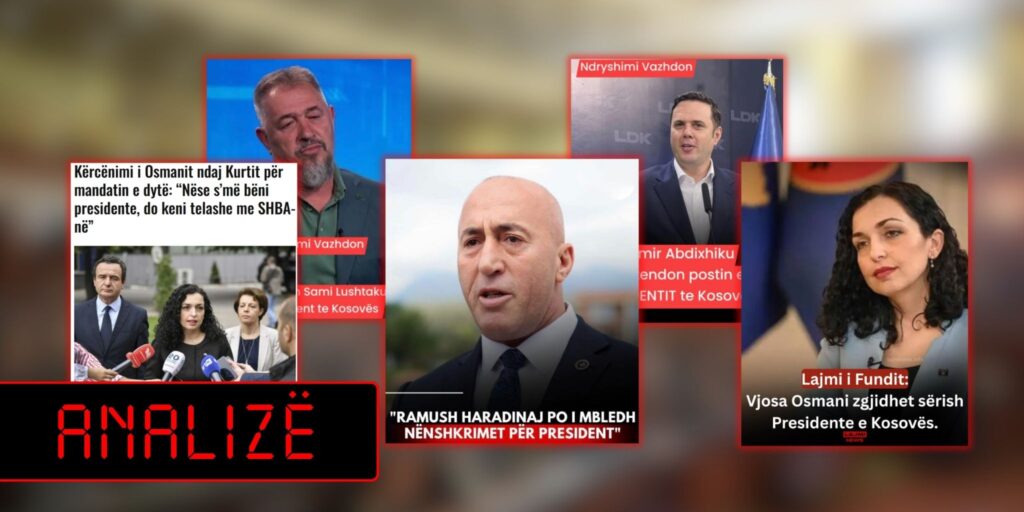
Her declaration of a possible candidacy for a second term placed the issue of electing the president at the center of political and media discussions. In this context, the topic of the Presidency began to be discussed not only at the institutional level, but also in the public space through various reports, analyses and interpretations. Alongside legitimate discussions, misinformation also began to appear in the digital space. Some of these cases were the subject of treatment by Hibrid.info.
The dominance of the presidential issue is confirmed in the January 2026 misinformation monitoring report. The position of the president was the most used topic for the creation and distribution of misinformation content in January (see here).
From the published treatments it results that, since the beginning of this year, Hibrid.info has treated at least 20 articles directly related to the presidential election process and the figure of President Vjosa Osmani. Each of these articles was categorized according to Hibrid.info's evaluation methodology. Eight of these contents were assessed as "Fake News", while the categories "Disinformation" (here, here and here) and “Manipulation of Facts” had three cases each (here, here and here).
In addition, two pieces of content were classified as “Clickbait” (see here and here), while two others received a combined rating of “Fake News/Hoax” (see here and here).
A combined rating was also given to two other pieces of content, which were rated as “Fact Manipulation/Disinformation” and “Disinformation/Clickbait” (see here and here).
In addition to President Osmani, other political figures are often mentioned in the content discussed, such as Prime Minister Albin Kurti (here and here), the leader of the Democratic League of Kosovo (LDK), Lumir Abdixhiku (here, here and here), the leader of the Alliance for the Future of Kosovo (AAK), Ramush Haradinaj (here and here), the mayor of Skenderaj Municipality Sami Lushtaku (here), LDK spokesman Besian Mustafa (here) and LDK official Lutfi Haziri (here).
In some cases, international figures such as the President of the United States (US), Donald Trump, are also included. Elon Musk has also been mentioned in the context of an artificial intelligence-generated image claiming a non-existent meeting (see here and here).
Regarding thematics, the content analysis highlights several themes, highlighting potential presidential candidacies, where claims of ambition or proposals are offered without factual basis; distorted statements, where the meaning is changed through titles or taken out of context; and non-existent international meetings and support, especially through manipulated visual content.
The right to be nominated as a candidate for president is granted to any citizen who secures the signatures of at least 30 deputies of the Assembly of Kosovo. Deputies may only sign for one candidate for president. The election of the president is made by 2/3 of the votes of all deputies. If in the first two votes no candidate receives 2/3 of the votes, a third vote is organized and between the two candidates who received the highest number of votes in the second vote, the candidate who receives the majority of the votes of all deputies (61 votes) is elected. The election of the president in the Assembly is made by secret ballot (see here).
There are only four days left until the constitutional deadline for electing a president, and no official candidacy has been announced so far. If a president is not elected within this deadline, the country faces the risk of early elections.
Intensive days
Based on the experience of the December 28 elections, where misinformation content intensified at the end of the campaign, there is a possibility that similar cases will continue to appear in the final days before the presidential election.
Therefore, in addition to warning against out-of-context headlines, unfounded claims, and manipulated visual content, readers are recommended to consult verified news sources and fact-checking platforms, such as Hibrid.info; to check information through reports from official Kosovo institutions, such as the Kosovo Assembly and the Office of the President; not to distribute news without verifying the source and content, especially on social networks, and to refrain from speculation and comments that are not based on verified documents or statements.
This warning aims to help readers follow the presidential election process in an informed manner, minimizing the impact of misinformation on public perception.