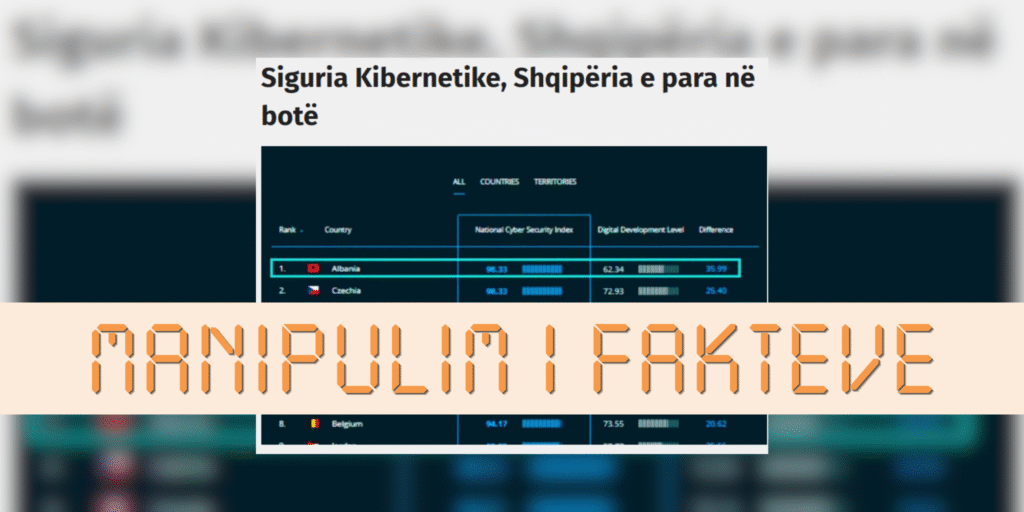

Articles have been published claiming that Albania is first in the world in cybersecurity.
Content with this claim in the title was published on Tuesday by several Albanian-language media outlets (see here, here, here, here and here).
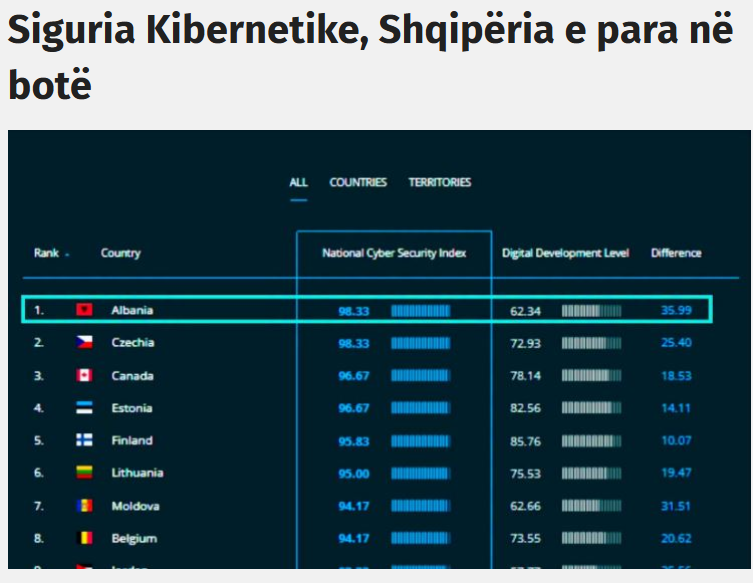
The news is based on a post by Albanian Prime Minister, Edi Rama, who published an image of the published ranking of the National Cyber Security Index (NCSI).
What's wrong with the claims published in the media?
The claim is misinterpreted, as the NCSI measures states' preparedness for cyber threats, not the overall level of cybersecurity.
What did Prime Minister Rama say?
Rama emphasized that Albania has come first in the world in the National Cyber Security Index (NCSI), with 98.33 points, presenting this as a result of strengthening cybersecurity capacities after the 2022 attack. According to him, Albania moved from 54th place in 2023 to 15th in 2025 and then to first place, thanks to investments in technology, strengthening institutional and professional capacities, cooperation with Israeli partners and the use of artificial intelligence for proactive protection.
He said that cyber attacks have continued, but have been successfully prevented, describing this achievement as evidence of Albania's strengthening in the protection of digital infrastructure and the importance of international alliances. Finally, Rama stressed that the work to strengthen cyber defense must continue, since in the world of technology, the first place today may be the last tomorrow and protection must also be extended to the private sector.
Hibrid.info researched this website index, which is compiled by the e-Governance Academy (eGA), a non-profit organization based in Estonia, and verified the data and methodology on which the ranking is based.
The data confirms Rama's claim, showing that Albania ranks first in the NCSI with 98.33 points, tied with the Czech Republic (see here). These data were published on August 10 (see here).
What does the NCSI measure?
METHODOLOGY The NCSI is based on measuring the readiness of states to prevent cyber threats and manage incidents, assessing the capacities of central governments. The index includes three categories, 12 capacities and 49 indicators, which are based on public evidence, such as laws, official documents and institutional websites.
Data is collected from government institutions, organizations or individuals, as well as the NCSI team, and then reviewed by at least two index experts. The country's score is expressed as a percentage out of a maximum of 100 points, and the ranking is continuously updated as new evidence is provided and verified.
The result shows that Albania has documented and proven a very high level of capacities measured by the NCSI methodology.
Hibrid.info also researched the Global Cybersecurity Index (GCI), published by the International Telecommunication Union (ITU). It found that the GCI distinguishes between measures taken by countries and concrete results in the field of cybersecurity. Unlike the NCSI, the measures assessed in the GCI are complemented by outcome-based indicators, such as the number of cyberattacks and the level of vulnerabilities. So, while the NCSI assesses a country's documented capabilities, the GCI also includes what happens in practice. (see here).
This means that cybersecurity is a broader concept and, therefore, the NCSI ranking cannot be interpreted as a comprehensive assessment of a country's level of cybersecurity.
What do other indices show?
Hibrid.info further researched data from other international indexes related to digital development and cybersecurity.
in GCI, published by the ITU, Albania is part of Tier 2 – “Advancing.” This level includes countries that have achieved a score of at least 85 points and demonstrate a strong commitment to cybersecurity.
Meanwhile, in Network Readiness Index (NRI) 2025, which measures the readiness of economies to utilize digital technologies, Albania ranks 79th out of 127 economies, with 45.41 points.
Analyze:
The headlines of some media articles claim that Albania is first in the world for cybersecurity, referring to its ranking in the National Cyber Security Index (NCSI).
However, this claim is misinterpreted, as the NCSI primarily measures the readiness of states to prevent cyber threats and manage incidents, through the assessment of central government capacities, but does not fully measure how effective these measures are in practice or how exposed a state is to cyber attacks and vulnerabilities.
For this reason, the NCSI ranking is not enough to determine which country has the highest level of cybersecurity in the world.
Therefore, based on its work methodology, Hibrid.info assesses this content as "Manipulation of facts".
Reasoning:
“Factual manipulation” is a rating given to informational content that uses facts known to be accurate but interprets them in a distorted manner. These reports typically use accurate information to draw incorrect conclusions or claims, thereby misleading consumers of media content about the actual meaning of the facts presented.