
The saga of the Deçan Monastery over the ownership of 24 hectares of land surrounding its church buildings has come to an end. On March 20, the Diocese of Raška and Prizren of the Serbian Orthodox Church in Kosovo confirmed that the Deçan Monastery has registered 24 hectares of land in its name in the Central Cadastre of Kosovo, in Pristina.
On March 13, Prime Minister Albin Kurti requested that the Kosovo Cadastral Agency register the property in the monastery's name. The government's request came about 8 years late, after the Constitutional Court ruled in favor of the Monastery on May 26, 2016, for the disputed 24 hectares.
But what led to this Constitutional Court ruling?
European Stability Initiative (ESI), an international organization, a few days ago published a report regarding the disputed property issue of the Deçan Monastery, urging the Kosovo government to implement the Constitutional Court's ruling.
That report also provided details regarding the 24 hectares claimed by Orthodox clergy.
“Most of this land has long been registered in the cadastre as the property of the Deçan Monastery. But 24 plots – those comprising the field (A) and the forest (B), as well as four small plots of land in the middle of the town of Deçan – were registered in the cadastre in the name of the monastery in early 1998, after being donated to it by the Serbian state in late 1997,” the report says, among other things.
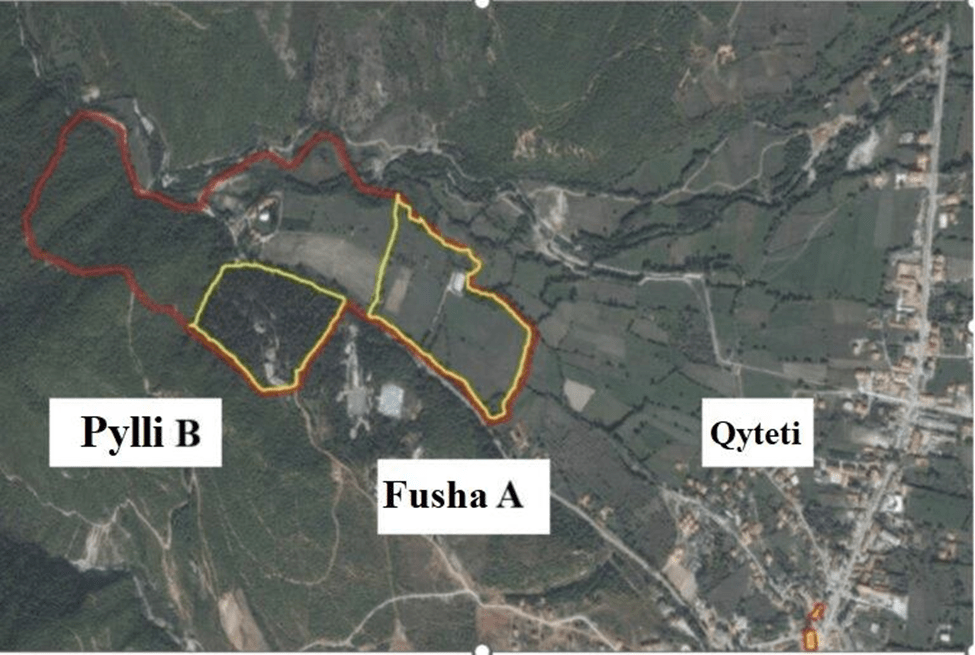
(how to read the photo above, according to ESI: The red line shows the land that the monastery considers its own property, surrounding the church and main buildings. This land is all part of a Special Protected Area (SPA), defined and established in Kosovo legislation for the protection of monuments and sites of special importance to minorities. The area extends beyond the red line. Within the red line, yellow lines mark two disputed pieces of property. One is a field (A). The other is a forest (B). These make up 24 hectares. There are also small plots of land (marked in red and yellow in the lower right corner) in the middle of the town of Deçan).
The 24 plots that were donated to the monastery in 1997, according to ESI, all of which had the corresponding plot numbers. This property, at that time, was owned by the social enterprises “APIKO” and “Iliria”, one a hotel and the other a honey factory.
Therefore, after the end of the war, in 2000, the two companies in question argued before the Municipal Court that these plots should be returned to them, as they were in the cadastre as their properties.
The Municipal Court of Deçan, in June 2002, ruled that the donation of 24 plots of land by the Serbian state to the monastery was a violation of property rights. It ordered that these plots be re-registered in the cadastre in the name of socially owned enterprises. And that is exactly what happened.
However, this decision was only the beginning of a long legal battle.
In 2005, a court in Peja overturned the 2002 decision. Despite UNMIK's executive decisions in 2008, which required that the 24 disputed plots be registered in the name of the Deçan Monastery, the situation on the ground did not change.
Then in May 2009, UNMIK, represented by the Kosovo Trust Agency (KTA), responsible for all socially owned enterprises and their properties, proposed a solution for the Deçan monastery to the Supreme Court of Kosovo.
The idea was that UNMIK/KTA would transfer, on behalf of the two socially-owned enterprises it legally represented, 20 of these 24 disputed plots of land to the monastery (field A and forest B). In exchange, the monastery would relinquish its rights to the four plots in the town of Deçan/Deçan.
Father Sava Janić, the abbot of the Deçan Monastery, had declared himself in favor of this agreement.
However, this was not the end of the legal battle. Over the following years, lawyers representing the socially-owned companies, the Privatization Agency of Kosovo, and the Municipality of Deçan contested this, arguing that UNMIK/KTA had no right to enter into such an agreement.
However, in March 2009, the Supreme Court ruled that UNMIK/KTA had “the sole right to represent the interests of [socially owned] enterprises.”
In July 2010, the appeals panel of the Supreme Court of Kosovo reaffirmed that UNMIK/KTA had the “sole legal position” in this matter.
In December 2011, the Supreme Court once again declared that the decision on the legal position of UNMIK/KTA was “final and therefore binding and no longer subject to dispute”.
On 27 December 2012, the Supreme Court ruled once again that this matter was now resolved and could no longer be challenged. Predictability and legal certainty required that final decisions should no longer be challenged, regardless of whether they were “correct or not”.
In 2015, this decision was challenged again in the Supreme Court, causing the case to be reopened and take an extraordinary turn, overturning its previous judgments. It was then that the Deçan case reached the Constitutional Court, which was asked to finally resolve the issue in 2016.
But, contrary to what is claimed in public discourse, it was not the Constitutional Court that decided that the 24 hectares belonged to the Deçan Monastery. Subsequently, both Prime Minister Kurti and other opponents of the recognition of the Deçan Monastery's ownership of 24 hectares of land attributed this decision to the Constitutional Court. Judges of this court have been the targets of online attacks and hate speech over the years.
However, the Constitutional Court was not called upon to decide whether those 24 hectares belong to the Deçan Monastery, but to review the decision of the Supreme Court.
Consequently, the Constitutional Court confirmed that the Supreme Court's decision of December 2012 was “final and binding and as such res judicata”, but did not give an opinion on whether the decision was fair or not. Consequently, from this judgment, there was no legal scope left to challenge this issue.
No government, nor the Municipality of Deçan, had the will to pursue the Constitutional Court's verdict.
Since the constitutional court's ruling on the Deçan Monastery properties, the international community has consistently called for that decision to be implemented.
In 2016, then-President Hashim Thaçi said that the Constitutional Court's decision regarding church property in Deçan was based on the State Constitution and the European Convention on Human Rights.
"Kosovo is a state of law where court decisions are respected. Property is inalienable, regardless of who owns it," Thaçi had said at the time.
Even the Prime Minister of that time, Isa Mustafa, had declared himself in favor of the implementation of the Constitutional Court's judgment on the properties of the Deçan Monastery.
"So far, we have not had a case where a decision of the Constitutional Court has been opposed, even though sometimes we have not liked these decisions. The court's decision must be respected, because it is a decision by the highest body that interprets the Constitution of the country and we should not question the implementation of the Constitutional Court," Mustafa had declared.
However, the municipality of Deçan was against it. Its mayor, Bashkim Ramosaj, in 2019 stated that he "will not implement this decision" even if it costs him the position of mayor. Ramosaj even said that he has the support of the head of his party, AAK, the then Prime Minister Ramush Haradinaj, for this insistence.
The Vetevendosje Movement also agreed with the Municipality of Deçan. This party assessed that the Constitutional Court's decision legitimizes Serbia's "fascist, colonizing and genocidal policies" towards Kosovo Albanians.
"It is surprising how high institutions like the Constitutional Court make a decision to legitimize the decisions of a regime that was considered a criminal and genocidal regime by the whole world at the time," LVV said at the time.
Even its leader, now Prime Minister Albin Kurti, said that the 24 hectares were donated to the Deçan Monastery by the regime of Slobodan Milošević. He said that the priests of this monastery have no need for so many hectares.
"The Deçan Monastery has its own courtyard and I agree that there should be as much land as the priests need for their living and work there, but this should not be at the expense of the local population. Those priests need 3 hectares, 4 and so on, but why do they need 1 thousand hectares, what will those priests do there? It is too much for the very few people who live and reside there."
"I call on the priests of Decani to give up their demands for land and property. This is not at all a religious demand and one that consists of the divine. The problem of these 24 hectares has a history. First with the decisions of the Milosevic regime in 1993 and 97 and secondly with the executive decisions of UNMIK. We believed that after the declaration of independence we would have an interruption of this injustice and its eradication, and not its forcing, as was the case in the Supreme Court, but perhaps this is the difference between independence with self-determination and without self-determination", Kurti said in 2013 in the Kosovo Assembly.
Kurti seems to have finally realized that the property, however, is needed by the priests of this monastery.
This is because on March 13, 2024, Prime Minister Albin Kurti, at the regular meeting of his government cabinet, stated that he had requested the Kosovo Cadastral Agency "to implement the decision of the Constitutional Court".
"After a massive process of meetings, visits and communications, it has become clear to us that of the many conditions we had for membership in the Council of Europe, some have been found to have been met and some have been listed as non-urgent issues, but one remains and will not be removed: the implementation of the Constitutional Court's decision on the issue related to the Deçan Monastery."
"As the Prime Minister of the Republic of Kosovo, we do not like that strange and unjust decision, and in the meantime there are other pending court processes on this issue, while we as a government no longer have legal and judicial means to annul the decision of the Constitutional Court. I will never change my stance on this harmful decision."
Although Prime Minister Kurti's action was criticized by the opposition, especially considering the opposition he had to this verdict while in opposition, the international community positively assessed it.
Analytical article by Agon Osmani