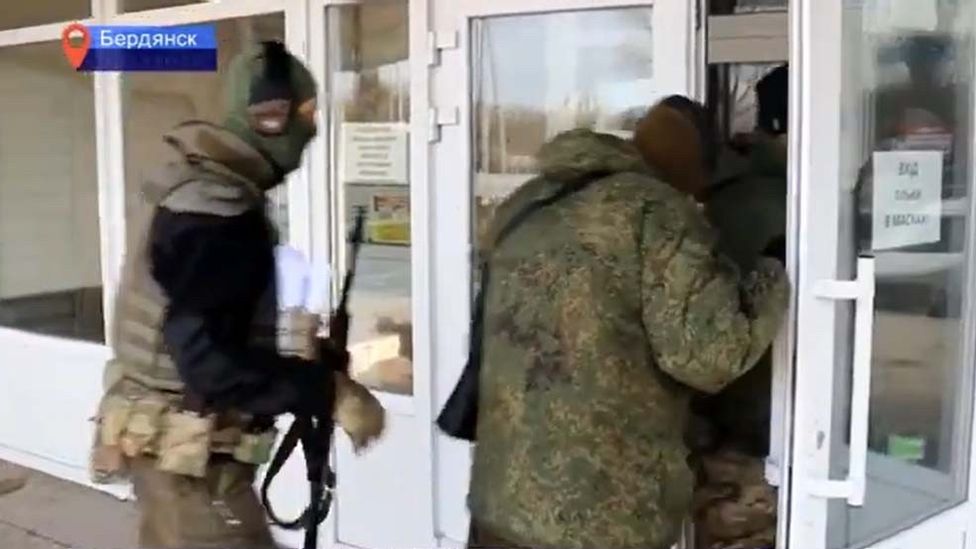

Serhiy Starushko and his fellow journalists had just finished their morning editorial meeting in early March when Russian military vehicles gathered outside.
Within minutes, soldiers entered the front doors of the three-story building, home to a local news station in the occupied Ukrainian port city of Berdyansk.
About 50 employees were held hostage for five hours.
They had become victims of the real-world war to control the flow of information.
Russian forces are occupying cities, threatening journalists and demanding that they spread pro-Kremlin views. Those who refuse are being forced to shut down their operations.
The strategy to replace Ukrainian media with pro-Kremlin press coverage includes seizing transmitter towers and shutting down access to Ukrainian national news programs in areas controlled by Russian forces.
Ukraine's State Special Communications Service told the BBC that eight stations are being used to broadcast "propaganda and disinformation" to the local population in southern Ukraine.
In Berdyansk, Serhiy – a broadcast journalist – was forced to lie down on camera and announce that he was declaring war on so-called “Ukrainian nationalists.” The Russians said they would post this forced statement online if he refused to cooperate.
“There were armed people everywhere, a few dozen of them, and I think five to six of them were from the FSB [Russian security service]. They said, ‘this is Russia now, and if you want to live, you will have to cooperate.’”, recalls Serhiy, now safely outside the region.
For him and his colleagues, “cooperation” meant demands to reveal the contacts of local pro-Ukrainian activists and soldiers, and pro-Russian propaganda. These were not empty threats.
"They took me to a separate room. They started beating me on the head, chest, legs, they beat me with their knees and palms, so there were fewer bruises", he says, recalling the event.
"Then one of them threatened me with a gun: he held it to my head and genitals. They asked me if I wanted to call my wife to say 'goodbye'."".
The next day, Russian TV channels aired a video purporting to show the capture of the station – but the building was already empty when they showed up with cameras. The Russian journalist said the military had to take control of the station because it was spreading “disinformation about the situation in the city”.
(Full article published by BBC, available in English)